Real-time reporting gets mentioned as a best practice constantly, but rarely with enough specificity to justify the infrastructure investment. This article covers what real-time reporting actually changes for marketing ROI analysis — not in theory, but in the specific operational decisions it accelerates and the waste it prevents.
Key Takeaways
- Real-time reporting gives teams live visibility into spend and conversions, so budget decisions reflect current performance rather than stale data
- The primary ROI benefit is accuracy: catching underperforming campaigns sooner, attributing conversions correctly, and protecting data quality
- Teams without real-time reporting systematically overspend on declining channels and miss the channels that are working right now
- Cleaner data produces better attribution, which drives smarter budget decisions and stronger returns over time
- Real-time reporting delivers its highest value when connected to a defined review process, not just installed as a passive dashboard
What Is Real-Time Reporting for Marketing ROI?
Real-time reporting is a setup where marketing data — spend, conversions, engagement, revenue events — is captured and made visible within minutes of the event occurring. Not batched overnight. Not compiled for a weekly review. It's available now, while there's still time to act.
In a marketing context, this applies across:
- Paid campaign metrics — spend pacing, click-through rates, and cost-per-result updating continuously across platforms
- Conversion events — form fills, demo bookings, and purchases logged as they happen and tied to the campaigns that drove them
- Multi-touch attribution — every touchpoint in a customer journey recorded in sequence, not reconstructed from incomplete logs after the fact
- Budget pacing — daily and weekly spend tracked against targets so teams catch overruns before they happen
These four areas represent the operational core of marketing ROI analysis — and they're also where delayed data causes the most damage.
The critical distinction worth making: real-time reporting is not a technology goal. A live dashboard with no defined process attached to it is just a faster way to look at data no one acts on. The value is operational. It shortens the window between a performance shift and a team response, and that's precisely where budget waste and attribution errors build up unnoticed.
Key Advantages of Real-Time Reporting for Marketing ROI Analysis
The advantages below are tied to metrics marketing teams are already accountable for: cost per acquisition, return on ad spend, pipeline contribution, and budget utilization. These aren't abstract benefits — each one describes a specific operational change with measurable consequences.
Advantage 1: Faster and More Confident Budget Reallocation
Real-time reporting allows teams to see which campaigns, channels, or audiences are over- or under-performing within hours of launch, not after a multi-day reporting cycle.
When spend and conversion data update continuously, budget can shift toward higher-performing channels the same day rather than waiting for a scheduled review. The decision window matches the performance window.
Why this matters financially: The ANA's 2024 programmatic benchmark found that only 43.9% of every $1,000 entering a DSP actually reached consumers — even after a 7.9 percentage-point efficiency improvement from the prior year. That's a structural waste problem that faster, more granular reporting is positioned to address. When a campaign begins declining on Tuesday afternoon and the next reporting review isn't until Thursday morning, that's 36+ hours of spend at a deteriorating return. Budget allocation decisions made on stale data carry compounding waste.
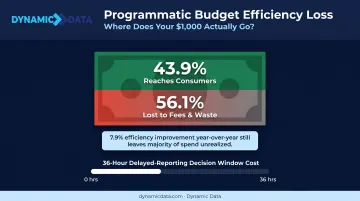
Faster reallocation means more of the total budget operates near peak efficiency for a larger share of the campaign period — which compounds positively across every metric below.
KPIs this affects:
- Return on ad spend (ROAS)
- Cost per acquisition (CPA)
- Budget utilization rate
- Spend efficiency ratio across channels
When the impact is highest: Product launches, seasonal campaigns, and competitive windows — where the hourly cost of a delayed decision is proportionally larger. Also when running across multiple platforms simultaneously, where a problem on one channel isn't visible in another platform's dashboard.
Advantage 2: More Accurate Attribution and True ROI Measurement
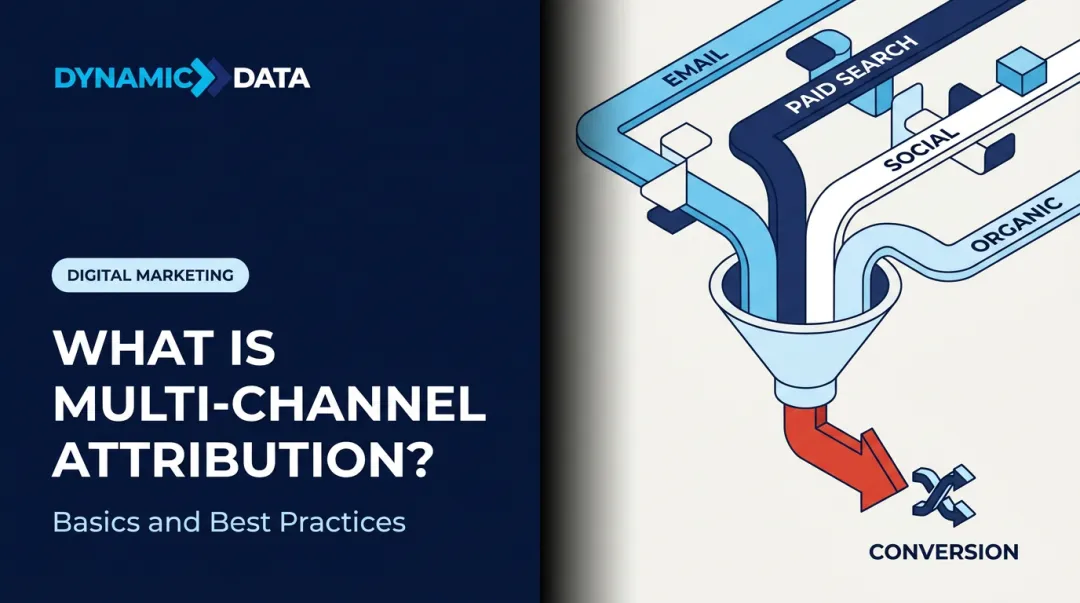
Real-time reporting enables continuous, multi-touch attribution — every touchpoint a prospect takes is logged as it happens, rather than assembled after the fact from incomplete data.
When conversion events are captured in real time and linked to the full preceding journey, attribution models work from complete data. That produces ROI figures that reflect actual channel contribution rather than last-click assumptions.
Why last-click is a real problem: eMarketer's 2024 data shows 78.4% of US senior marketers spending over $500K still use last-click attribution — and only 21.5% trust its accuracy. That gap between usage and trust is telling.
Last-click systematically undervalues upper-funnel channels (content, organic, awareness) and overvalues closing touchpoints. Upper-funnel budget gets cut, last-touch channels get over-funded, and the reported ROI stops reflecting reality.
For B2B, the distortion is even sharper. Forrester's B2B Buying Study found buying interactions rose from 17 in 2019 to 27 by 2021, with 63% of purchases involving four or more decision-makers.
A last-click model applied to a 27-interaction journey assigns credit to whichever touchpoint happened to precede the form fill — which tells you almost nothing about what actually drove the decision.
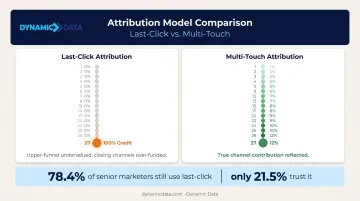
Dynamic Data's multi-touch attribution work addresses this directly, connecting upper-funnel touchpoints to closed revenue across the full customer journey.
In the Pima Solar engagement, the team integrated three previously disconnected tools — CallFire (calls), Go High Level (leads), and JobNimbus (sales) — giving the client full visibility from first contact to completed service. The result was an attribution model that reflected actual channel contribution, not just the last click before conversion.
KPIs this affects:
- Marketing-attributed revenue
- Pipeline contribution by channel
- True ROAS (versus platform-reported ROAS)
- Customer acquisition cost by source
When the impact is highest: Longer B2B sales cycles, high-consideration purchases, and any campaign running across five or more channels where siloed reporting creates false winners and false losers.
Advantage 3: Early Issue Detection and Proactive Optimization
Real-time reporting surfaces performance anomalies — a spike in CPA, a drop in conversion rate, a tracking pixel that stops firing, a slow landing page — within minutes rather than the next morning. That gap matters when a paid campaign is actively burning budget against a broken experience.
When dashboards update continuously, teams can set threshold alerts that trigger the moment a metric moves outside an acceptable range. This shifts the team's posture from reviewing what went wrong to catching what is going wrong.
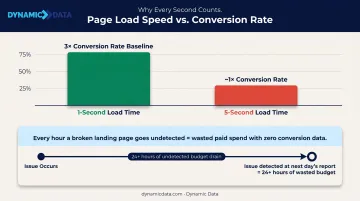
The cost of late detection: Page speed alone has measurable conversion consequences. Portent's analysis of 100 million page views found a B2B site loading in 1 second had a 3x higher conversion rate than one loading in 5 seconds. When a paid campaign is driving traffic to a slow or broken landing page and that issue isn't caught until the next day's report, every click in the interim is wasted spend with no conversion data to show for it.
Signal loss compounds this. The IAB's 2024 State of Data report found 95% of US advertising decision-makers expect continued legislation and signal loss — meaning tracking completeness is already degraded and getting harder to maintain. Real-time monitoring of data quality metrics, not just campaign KPIs, is part of what makes this operational.
KPIs this affects:
- Conversion rate by campaign
- CPA trend
- Tracking completeness rate
- Landing page performance (bounce rate, load time)
- Campaign quality score
Where detection speed matters most: High-spend campaigns where the hourly cost of an undetected problem is significant; multi-platform setups where a tracking issue on one platform is invisible to others; retargeting campaigns where audience data integrity depends on clean, continuous event logging.
What Happens When Real-Time Reporting Is Missing
Operating on delayed or fragmented reporting creates three costs that compound quietly:
- Budget waste accumulates invisibly — underperforming campaigns run until the next reporting cycle, and by the time the issue is visible, a meaningful portion of the period's budget has been spent at poor returns
- Attribution is systematically distorted — without real-time multi-touch data, upper-funnel channels are undervalued and eventually defunded, while last-touch channels receive disproportionate credit and over-investment
- Teams become permanently reactive — issues get corrected after they've cost money, and opportunities are recognized after they've passed
Adverity's 2025 survey of 200 CMOs found respondents estimated 45% of their decision data is incomplete, inaccurate, or outdated — yet 85% of those same CMOs trust their marketing data. Confidence can persist long after data quality has degraded. The result: teams making decisive budget calls on numbers that no longer reflect campaign reality.
That dynamic plays out the same way across industries. Pima Solar came to Dynamic Data running business analytics almost entirely out of custom Google Sheets, with no way to connect their calls, leads, and sales data into a coherent view. The result was exactly what delayed and fragmented reporting produces: hours wasted reconciling data, no clear visibility into which marketing sources were driving revenue, and budget decisions made on incomplete information.
How to Get the Most Value from Real-Time Reporting
Real-time reporting delivers its full value only when three conditions are met:
- The data infrastructure is automated and connected — all marketing platforms feed into a centralized data layer without manual exports or spreadsheet compilation
- The team has a defined process for acting on what the dashboard surfaces — not just viewing it, but knowing in advance what each metric threshold means and who responds
- Reporting cadence matches decision cadence — active paid campaigns need updates every few minutes to hours; strategic reviews can use daily or weekly summaries built from the same live data
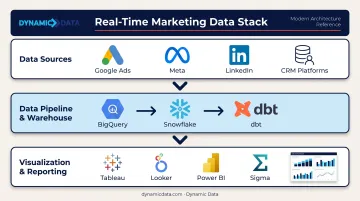
The implementation step most teams underestimate is data pipeline automation. If someone is still manually pulling exports from Google Ads, Meta, and LinkedIn and combining them in a spreadsheet, the reporting is not real-time — regardless of how frequently those exports happen. A modern, automated data stack is the prerequisite for true real-time visibility, not the bonus feature.
This infrastructure typically includes automated reporting pipelines, custom dashboards, and a connected data stack — tools like BigQuery, Snowflake, and dbt on the backend, with Tableau, Looker, Power BI, or Sigma surfacing results to marketing teams. Dynamic Data builds this kind of stack for mid-market and enterprise clients, so that campaign performance is always one dashboard view away — not one spreadsheet assembly away.
Beyond the infrastructure, insights need clear ownership. For each metric monitored in real time, the team should know:
- What change in that metric triggers a response
- Who is responsible for that response
- What the response looks like
Without that structure, a live dashboard generates noise rather than signal. The data moves faster, but without assigned ownership, marketing ROI analysis stalls at observation — never reaching the adjustments that actually improve returns.
Conclusion
Real-time reporting earns its place in marketing operations through the control it creates: fewer wasted budget hours, more accurate attribution, and problems caught before they compound into meaningful losses.
The advantages build on each other in a consistent pattern. Cleaner data improves attribution accuracy. Better attribution informs budget decisions. Those decisions compound into stronger returns across every campaign cycle — not as a single improvement, but as an ongoing operational edge.
Treat real-time reporting as an ongoing operational practice, not a one-time dashboard implementation. That requires:
- Connected data infrastructure feeding accurate, current signals
- Defined review cadences so insights reach the right people
- A team equipped to act on findings, not just view them
The tool matters less than the system around it.
Frequently Asked Questions
What is real-time reporting in marketing analytics?
Real-time reporting is a system where marketing performance data — spend, conversions, revenue events — is captured and made visible within minutes, rather than batched overnight or compiled manually for weekly reviews. Data is available while campaigns are still running, so decisions can still be made.
How does real-time reporting improve marketing ROI?
ROI improves through three mechanisms:
- Faster reallocation of budget to performing channels
- More accurate multi-touch attribution that reflects true channel contribution
- Early detection of technical issues before they drain spend without producing conversion data
What is the difference between real-time and traditional marketing reporting?
Traditional reporting relies on delayed, batched data reviewed on a fixed schedule. Real-time reporting surfaces data continuously. The operational difference is that teams using real-time reporting can correct course while a campaign is still live — not after it ends and the budget is already spent.
What marketing KPIs benefit most from real-time analytics?
Cost per acquisition, return on ad spend, conversion rate by channel, and pipeline-attributed revenue benefit most. These are decision-driving metrics where timing and accuracy matter — a 24-hour delay in seeing a CPA spike is a 24-hour delay in stopping the spend that's causing it.
How often should marketing ROI reports be updated?
The update frequency should match the speed of budget decisions. For active paid campaigns, updates every few minutes to hours are appropriate. For strategic channel reviews, daily or weekly summaries work alongside the live operational view.
What is needed to implement real-time marketing reporting?
Three core requirements: an automated data pipeline connecting all marketing platforms, a centralized dashboard that visualizes the unified data, and clear internal processes defining who acts on which alerts. Infrastructure and process must be built together — one without the other leaves teams with either data they don't act on or decisions they can't trust.