The gap between ambition and impact isn't a technology problem. It's a strategy problem.
Most organizations are running experiments. Fewer are running enterprises. This guide cuts through the noise to give you a practical blueprint for building an enterprise AI strategy that moves from scattered pilots to measurable, production-scale outcomes — covering the five core pillars, a step-by-step roadmap, the most common failure patterns, and what's coming next.
Key Takeaways
- Enterprise AI strategy is a formal, organization-wide blueprint — not a vision deck or a series of one-off pilots
- Most AI programs fail due to poor data foundations, leadership misalignment, and missing governance, not flawed models
- A winning strategy covers five areas: business alignment, data readiness, governance, architecture, and change management
- The 2026 shift toward autonomous AI agents means strategy must now account for speed, accountability, and ongoing course-correction
- McKinsey finds only 1% of companies describe themselves as mature in AI deployment, despite 92% planning increased investment — a documented strategy is what separates the two groups
What Is an Enterprise AI Strategy — And Why It Matters in 2026
An enterprise AI strategy is a formal, organization-wide plan that connects AI initiatives to measurable business outcomes. That distinction matters. Vision decks, vendor evaluations, and isolated proofs of concept are not strategies — they're activities. A real strategy answers four questions:
- Where does AI create business value for this specific organization?
- What data and infrastructure is required to support it?
- How will risk, ethics, and compliance be managed?
- How will the organization change to adopt AI at scale?
The Adoption-Impact Gap
Those four questions are harder to answer than most organizations expect — and the gap between intent and results shows it. According to McKinsey's 2025 State of AI survey, 88% of organizations report using AI in some form, yet only 39% report enterprise-level EBIT impact. Nearly two-thirds say they haven't begun scaling AI across functions. Only 23% are scaling an agentic AI system.
AI is no longer experimental, but for most organizations it isn't yet delivering on its promise either. The companies seeing real returns share one thing: strategic infrastructure. Not better models — a clearer plan for deploying them.
The 5 Core Pillars of a Winning Enterprise AI Strategy
Enterprises with the highest AI maturity treat AI as a system of interconnected pillars. Weakness in any single pillar undermines the others. Here's what each one requires.
Pillar 1: Business-First Use Case Identification
Effective enterprise AI strategy starts with business priorities, not models. Every use case must tie to a measurable outcome: revenue growth, cost reduction, operational efficiency, or risk mitigation.
A simple Impact × Feasibility scoring matrix helps prioritize where to start:
| Dimension | What to Evaluate |
|---|---|
| Impact | Revenue potential, cost reduction, risk mitigation, CX improvement |
| Feasibility | Data availability, integration complexity, regulatory implications, time-to-value |
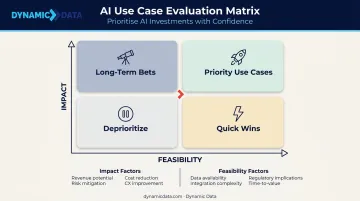
The most common mistake is pursuing hype-driven use cases — generative AI features that look impressive but connect to no P&L line. The fix is straightforward: map each AI initiative to a specific KPI before any technical work begins. If you can't name the metric it moves, the use case isn't ready.
Pillar 2: Modern Data Foundation & Readiness
Data readiness is the single biggest predictor of AI success — and the single biggest cause of failure. Gartner warns that organizations without AI-ready data will see over 60% of their AI projects fail by end of 2026. McKinsey adds that over 70% of enterprises cite data management as their biggest barrier to scaling AI.
A strong data foundation requires:
- Unified data pipelines that eliminate silos across systems
- Clean, accessible data models with consistent definitions
- Real-time or near-real-time data flows for operational AI use cases
- Metadata governance for lineage, discovery, and compliance
This is where partners like Dynamic Data do their most consequential work. Before any model gets introduced, the team works with clients to assess existing data systems, build ETL/ELT pipelines using platforms like Snowflake, BigQuery, and Databricks, and establish transformation frameworks using dbt. That sequencing — data infrastructure first, AI second — is what gives models accurate, consistent inputs to act on.
Pillar 3: AI Governance, Ethics & Risk Controls
Regulatory pressure has made governance a hard requirement, not a best practice. The EU AI Act reached full applicability in August 2026. The US issued a unified national AI policy framework in December 2025. And internally, 47% of organizations have already encountered measurable governance or ethical lapses linked to GenAI projects, per McKinsey.
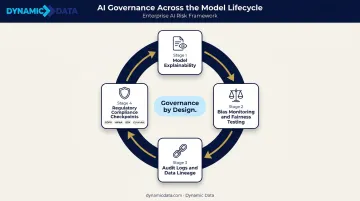
Governance-by-design means embedding compliance into the AI lifecycle from the start — not auditing after deployment. Key components include:
- Model explainability and interpretability documentation
- Bias monitoring and fairness testing at regular intervals
- Audit logs and data lineage tracking
- Regulatory compliance checkpoints (GDPR, HIPAA, SOX, EU AI Act)
The practical implication: every deployed model should have traceable, accountable, and auditable outputs built into its MLOps pipeline, not appended as an afterthought.
Pillar 4: Technology Architecture & MLOps
Enterprise AI needs a purpose-built technical backbone. The core architectural layers include:
- Cloud infrastructure (AWS, Azure, or GCP)
- ETL/ELT pipelines for data ingestion and transformation
- Model deployment and CI/CD workflows for ML
- API orchestration across systems
- Vector databases or knowledge bases for grounding GenAI responses
- Observability and monitoring tools for drift detection and performance tracking
Over-engineering kills momentum. The right tech stack matches your current maturity — not an idealized future-state blueprint that takes 18 months to build before a single model reaches production.
Pillar 5: Change Management & Workforce Enablement
AI transformation is a people challenge first. Research from McKinsey and BCG consistently shows that approximately 70% of digital transformation initiatives fail to meet their objectives — and cultural resistance, not technology, is the primary cause.
Workforce enablement in 2026 requires:
- Role redesign to integrate AI into existing workflows
- AI literacy training across business and technical teams
- Structured onboarding to AI-enabled tools with clear escalation paths
- Prompt engineering standards for teams using generative AI daily
McKinsey's January 2025 research makes a sharp point: the biggest barrier to scaling AI isn't employee readiness — it's leadership. Executives who aren't steering AI strategy fast enough are the bottleneck, not the workforce.
How to Build Your Enterprise AI Strategy: A Step-by-Step Blueprint
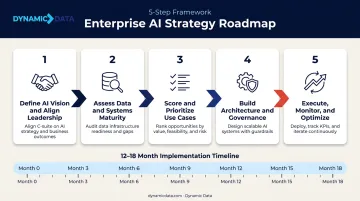
A 12–18 month horizon is the industry-standard planning window for enterprise AI strategy. The steps below move from discovery to production in a sequenced, value-driven order.
Step 1: Define the AI Vision and Align Leadership
AI strategy must be co-owned at the C-suite level. This step produces three outputs:
- A clear AI vision — where AI creates competitive advantage and what the risk appetite is
- Realistic investment and adoption targets
- A governance structure — typically an AI steering committee or Center of Excellence
Without executive alignment here, AI initiatives stall in budget reviews, compete with conflicting departmental priorities, and lose momentum before the first model ships.
Step 2: Assess Data and Systems Maturity
Conduct a current-state assessment covering:
- Data quality and completeness across key systems
- Integration architecture and pipeline reliability
- Infrastructure readiness (cloud vs. legacy)
- Governance and access controls
The goal is reaching medium-to-high data maturity before scaling AI. Low maturity means manual fixes, disconnected systems, and no reliable foundation for model training. High maturity means standardized, monitored data with unified access.
Step 3: Score and Prioritize AI Use Cases
Apply the Impact × Feasibility model to rank use cases. Start with initiatives that offer a clear path to value within 90–180 days. Early wins build organizational confidence and fund continued investment — and they surface the process gaps you'll need to resolve before scaling to more complex deployments.
Step 4: Build Architecture and Governance
This step defines the technical and compliance foundation that will support AI at scale. Key components to address:
- Cloud environment design and data pipeline architecture
- MLOps workflows for model deployment and version control
- Ethics and bias prevention controls
- Explainability standards and regulatory alignment
Governance frameworks belong in architecture from day one. Retrofitting them after deployment is expensive and often incomplete.
Step 5: Execute, Monitor, and Continuously Optimize
Deploying models is not the finish line. The production phase requires:
- Clear KPIs tied to business outcomes for each deployed model
- Monitoring for model drift and performance degradation
- Feedback loops with business teams to catch real-world edge cases
- Scheduled retraining cycles to keep models current
Adoption tracking matters as much as technical monitoring. Track usage rates alongside accuracy metrics — if utilization is low, the issue is usually workflow friction or insufficient training, not the model itself.
Why Enterprise AI Strategies Fail — And How to Avoid the Pitfalls
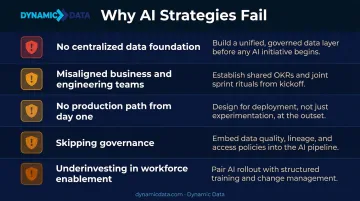
The most common failure point isn't the model. It's everything before the model.
The Three Root Causes
No centralized data foundation. AI amplifies siloed or incomplete data — it doesn't fix it. Models trained on fragmented inputs produce unreliable outputs, and unreliable outputs destroy stakeholder trust fast.
Misaligned business and engineering teams. When use cases lack a named KPI or P&L owner, they drift. Engineering builds something technically impressive; the business has no way to measure whether it worked.
No production path from day one. This is the "pilot purgatory" trap: endless proofs of concept that prove feasibility but never reach scale. According to Writer's 2026 research, **46% of AI pilots are scrapped between POC and broad adoption**. Architecture, observability, governance, and model lifecycle planning need to be scoped before the first pilot runs — not retrofitted after.
The Governance and Change Management Blind Spots
Two failure patterns surface reliably in the later stages of the AI lifecycle:
- Skipping governance creates regulatory and reputational exposure that becomes expensive to unwind — especially as AI-specific legislation matures globally
- Underinvesting in workforce enablement means tools go unused; AI literacy gaps turn capable models into shelf-ware
Strategy must treat people and process change as first-class deliverables, not afterthoughts appended to a technical roadmap.
What's Driving Enterprise AI Strategy Adoption in 2026
The pressure to formalize enterprise AI strategy has never been sharper — and five distinct forces are behind it.
Investment scale: IDC reports that AI infrastructure spending reached $318 billion in 2025 — more than double 2024's $153 billion — with projections of $487 billion in 2026. Without a clear deployment strategy, most of that spend produces little return.
Competitive pressure: Top-performing companies generate over 5x more revenue from data than their peers, per McKinsey, and generative AI is widening that gap. 80% of CEOs say AI will force complete operational capability overhauls, according to Gartner's April 2026 survey.
Agentic AI emergence: Gartner predicts 40% of enterprise applications will feature task-specific AI agents by 2026, up from less than 5% in 2025. Autonomous agents operating across systems require governance frameworks that most current AI programs weren't built to handle.
Regulatory pressure: The EU AI Act reached full applicability in mid-2026. Organizations without formal governance frameworks face rising legal exposure as AI-specific legislation spreads globally.
Data infrastructure maturity: Cloud adoption and modern data stack deployment have matured enough that more enterprises now have the foundational infrastructure to support reliable AI at scale — making enterprise-scale AI deployment genuinely feasible for organizations that have done the foundational work.
Future Signals: What Enterprise AI Strategy Looks Like Next
Enterprise AI strategy is not a one-time deliverable. Gartner's guidance on continuous realignment is direct: "AI strategy can't be set and frozen." Competitive, technological, and regulatory disruptions should each trigger a strategic review.
What the Next 1–3 Years Require
The shift from single AI use cases to coordinated multi-agent systems is already underway. By 2028, Gartner projects that 33% of enterprise software will include agentic AI. These systems handle complex, multi-step workflows autonomously — and require new oversight structures, distinct agent identities, and governance frameworks that go well beyond what earlier AI programs needed.
Three developments deserve close attention:
- Model Context Protocol (MCP): Developed by Anthropic and launched in November 2024, MCP is now an open standard supported by OpenAI, Google, Microsoft, and AWS. It enables seamless AI interoperability across enterprise tools — a foundational layer for multi-agent architectures.
- Advanced RAG techniques: The retrieval-augmented generation market is projected to grow from $1.94 billion in 2025 to $9.86 billion by 2030. RAG grounds AI responses in real company data, making enterprise GenAI significantly more accurate and auditable.
- AI agent governance: As agents gain autonomy, they need defined identities, access controls, and audit trails. Organizations building governance frameworks now will have far less retrofitting to do as agentic AI proliferates.
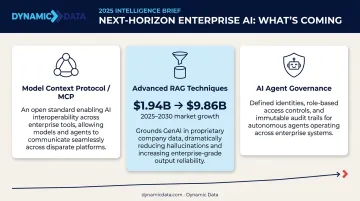
Each of these developments shifts what "production-ready AI" means at the enterprise level — and together, they raise the stakes for strategy that can adapt.
The Compounding Advantage
Organizations that treat AI strategy as bidirectional — where business goals shape AI priorities and emerging capabilities influence business direction — move beyond incremental efficiency gains. Companies investing in scalable foundations now build an advantage that accelerates as AI capabilities do. Those still running disconnected pilots face not just a gap in output, but a growing gap in organizational readiness for what comes next.
Frequently Asked Questions
What is an AI strategy for the enterprise?
An enterprise AI strategy is a structured, organization-wide blueprint that connects AI initiatives to measurable business outcomes — covering use case prioritization, data readiness, governance, technology architecture, and workforce enablement. Without one, AI efforts tend to stay fragmented: a handful of promising pilots that never reach production.
What is the AI roadmap for enterprise?
An AI roadmap is the execution plan derived from the enterprise AI strategy — typically a 12–18 month phased plan that sequences use case delivery, infrastructure build-out, governance rollout, and model deployment. Each phase ties to measurable business KPIs, not just technical delivery milestones.
What are the 4 pillars of AI strategy per Gartner?
Gartner's data-centric AI framework identifies four pillars: data management, data quality, data governance, and data literacy. For broader AI strategy, Gartner's guidance prioritizes defining an AI vision, understanding business and technology drivers, and proactively managing risk.
Which AI is best for enterprise?
The right AI depends on use case, data readiness, and integration requirements. Generative AI fits content, language, and decision support; analytical ML fits prediction, optimization, and automation; AI agents fit autonomous multi-step workflows. Most enterprise programs combine all three.
How long does it take to build an enterprise AI strategy?
Most organizations need 8–12 weeks to develop a comprehensive strategy document covering use case prioritization, data assessment, governance, and architecture. Full execution of the first roadmap phase typically runs 12–18 months, depending on data maturity and integration complexity.
Why do most enterprise AI strategies fail?
The top causes: skipping data readiness before model development, pursuing use cases without measurable KPIs, building pilots with no plan for production deployment, and underinvesting in governance and workforce change management. In most cases, the gap is organizational, not technical.