That's where metadata management comes in. Without it, governance lives in spreadsheets and strategy decks. With it, policies become searchable, lineage becomes traceable, and compliance becomes auditable.
This article covers the best metadata management tools for data governance in 2025 — what each one does well, where each falls short, and how to evaluate fit for your organization's specific needs.
Key Takeaways
- Metadata management is the operational layer that makes data governance actually enforceable — not just a policy document
- The strongest 2025 tools combine automated discovery, end-to-end lineage, business glossary, and policy enforcement in one platform
- Top options: Collibra, Alation, Informatica IDMC, Microsoft Purview, and Atlan — each built for different stack types and maturity levels
- Tool selection should match your governance maturity, tech stack, and compliance obligations — not just your feature wishlist
- The right starting point is a specific governance problem, not a vendor shortlist
What Is Metadata Management (and Why It's Central to Data Governance)?
Metadata management is the practice of capturing, organizing, and maintaining information about your data assets — where data originates, what it means, who owns it, how it transforms across systems, and where it lands. It's not the data itself; it's the context that makes data usable and trustworthy.
The distinction between the two matters. Governance defines the policies, roles, and accountability frameworks for how data should be handled. Metadata management is what makes those policies visible, searchable, and enforceable at scale.
Gartner defines data governance as specifying decision rights and an accountability framework for appropriate behavior in valuing, creating, consuming, and controlling data. That framework needs operational infrastructure to function. Without metadata management, governance stays theoretical.
The adoption gap is real. A 2025 State of Data Governance report found that 83% of organizations use data catalogs to centralize metadata, but only 42% use data quality monitoring and 17% have adopted data contracts — showing most governance programs are still in early stages.
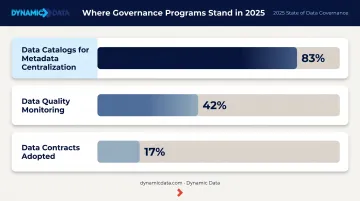
In 2025, active metadata management separates functional governance programs from stalled ones. The tools reviewed below were selected specifically for their ability to crawl sources automatically, classify assets, detect lineage changes, and surface quality issues in real time — rather than relying on manual documentation updates.
Best Metadata Management Tools for Data Governance in 2025
These five tools were selected based on metadata depth, lineage capability, integration breadth, compliance readiness, and real-world adoption across enterprise and mid-market organizations.
Collibra
Collibra is one of the most established data governance platforms in the market, widely adopted by large enterprises in regulated industries. It powers over 100 Fortune 500 companies, with customers including BNY Mellon, Equifax, Freddie Mac, and Siemens. Its strength lies in a centralized metadata catalog, business glossary, ownership assignment, and structured stewardship workflows that create a formal system of record for governance decisions.
Named a Leader in both the 2025 Gartner Magic Quadrant for Data and Analytics Governance Platforms and the Forrester Wave for Enterprise Data Catalogs Q3 2024, Collibra excels at policy definition and workflow automation. Both technical and business stakeholders can see governance decisions in one place, rather than siloed across tools.
The honest caveat: G2 reviewers note an average implementation time of 6 months and an ROI timeline of 25 months. Collibra requires a mature governance operating model and dedicated implementation effort to realize value. Organizations without defined data owners and stewardship processes tend to underuse it.
| Attribute | Details |
|---|---|
| Best For | Large enterprises with formal governance programs; regulated industries (finance, healthcare) |
| Key Metadata Features | Business glossary, automated lineage, stewardship workflows, policy management, data quality integration, 100+ native integrations |
| Pricing Model | Custom enterprise quote; typically significant licensing and implementation investment |
Alation
Alation is built around data discovery and active metadata management. It uses its ALLIE AI engine to auto-curate metadata, surface data usage patterns across 120+ connectors, and make governed data easier for analysts and business users to find and trust.
Named a Leader in The Forrester Wave: Data Governance Solutions, Q3 2025, Alation's core strength is usability and collaboration. It bridges the gap between technical data teams and business users, making governance approachable rather than bureaucratic. Usage analytics help teams identify popular data products and flag assets ready for retirement.
For organizations prioritizing compliance automation over discovery, Alation is sometimes paired with a complementary tool. Deep policy enforcement and lifecycle automation aren't its primary focus.
| Attribute | Details |
|---|---|
| Best For | Organizations prioritizing data literacy, self-service analytics, and cross-team data discovery |
| Key Metadata Features | AI-powered metadata cataloging, usage analytics, stewardship workflows, automated lineage, data quality alerts |
| Pricing Model | Tailored pricing based on users, data volume, and modules selected |
Informatica (IDMC / Cloud Data Governance and Catalog)
Informatica's governance suite — part of its Intelligent Data Management Cloud (IDMC) — uses the CLAIRE AI engine to automate metadata discovery, classification, lineage mapping, and data quality monitoring across complex multi-cloud and hybrid environments. Informatica is recognized as a Leader in six Gartner Magic Quadrant reports simultaneously, spanning data quality, data governance, and data integration.
Key differentiator: Informatica is one of the few vendors that connects governance directly to data quality and master data management (MDM) under one platform. That tight integration matters when governance needs to be embedded across the full data pipeline, not just the catalog layer.
The trade-off is complexity. The breadth of the platform introduces a steep learning curve, and smaller teams often find themselves using a fraction of available capabilities. Teams typically see better outcomes by phasing rollout — starting with catalog and lineage before expanding into MDM and policy automation.
| Attribute | Details |
|---|---|
| Best For | Large enterprises needing unified metadata management, data quality, and MDM under one vendor |
| Key Metadata Features | CLAIRE AI-driven metadata discovery, end-to-end lineage, automated classification, policy automation, compliance reporting |
| Pricing Model | Custom enterprise quote; consumption-based options available for IDMC |
Microsoft Purview
Microsoft Purview is a cloud-native governance and metadata management platform tightly integrated with Azure, Microsoft 365, and Microsoft's security ecosystem. It supports automated data discovery, classification, lineage tracking, and compliance reporting across Microsoft and multi-cloud environments.
For organizations already running on Azure, Purview delivers strong out-of-the-box metadata coverage with minimal additional tooling. Its sensitivity labeling and compliance capabilities are particularly mature. Purview Information Protection lets organizations classify and protect data at scale, and the unified catalog and data map support governed asset management with pay-as-you-go billing.
The limitation is straightforward: Purview's value concentrates heavily in Microsoft-native environments. Organizations with significant non-Microsoft infrastructure — Databricks on AWS, dbt-managed pipelines, Airflow orchestration outside Azure — will find coverage gaps that require complementary tools.
| Attribute | Details |
|---|---|
| Best For | Microsoft-centric organizations on Azure seeking native metadata and compliance management |
| Key Metadata Features | Automated data classification, sensitivity labeling, lineage tracking, policy enforcement, compliance dashboards |
| Pricing Model | Pay-as-you-go via Data Governance Processing Units (DGPUs); additional capacity units for the Data Map |
Atlan
Atlan is a modern, collaborative metadata platform designed for data-driven teams building on cloud-native stacks. It emphasizes clean UX, active metadata management, and embedding governance into the daily workflows of data engineers, analysts, and business users.
Atlan is named a Leader in both the Forrester Wave for Enterprise Data Catalogs Q3 2024 and the 2025 Gartner Metadata Management Magic Quadrant, receiving the highest possible scores in 15 Forrester criteria including governance, data lineage, and adoption. Its native integrations with Snowflake, dbt, Airflow via OpenLineage, and Looker make it a natural fit for the modern data stack.
G2 reviewers rate it 4.5/5 across 135 reviews, with consistent praise for onboarding speed and collaboration features. Worth noting: some advanced reporting features are still maturing, and users managing complex enterprise governance programs have flagged gaps between pre-sales expectations and delivered functionality.
| Attribute | Details |
|---|---|
| Best For | Data-first organizations with modern cloud stacks needing fast deployment and strong team collaboration |
| Key Metadata Features | Collaborative data catalog, automated lineage, role-based access control, AI-assisted metadata enrichment, impact analysis |
| Pricing Model | Variable pricing by scale, modules, and connectors; better value at higher data and user volumes |
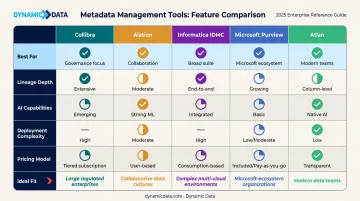
Key Features to Look for in a Metadata Management Tool
Not all metadata platforms are equal. These four capabilities separate tools that deliver governance outcomes from those that just add another catalog to manage.
Automated Metadata Discovery
The tool should crawl databases, data lakes, BI tools, and pipelines automatically — building and maintaining a living catalog without relying on manual documentation. If your team has to manually register every asset, the catalog will be outdated before it's finished.
Look for tools that support:
- Scheduled crawls across all connected data sources
- Push-based connectors for real-time asset registration
- Change detection that flags schema updates automatically
End-to-End Data Lineage
Tracing a data element from its source through every transformation to its final destination is essential — for compliance audits and for understanding the blast radius of any schema change. Table-level lineage tells you a table was used; field-level lineage tells you which column changed and what broke downstream. That distinction matters when diagnosing a broken dashboard at 9 AM.
Policy Enforcement and Compliance Automation
Effective metadata tools don't just catalog data — they enforce it. Look for:
- Automated PII classification (for GDPR, CCPA, HIPAA)
- Access control enforcement tied to data sensitivity labels
- Audit-ready compliance reports generated from the catalog
- Policy assignment recommendations based on data type
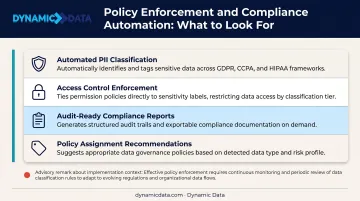
Any tool that treats compliance as a separate manual step defeats the purpose of automation.
AI Readiness and Modern Stack Integration
In 2025, governance programs that can't extend into AI environments will fall behind. Gartner warns that 60% of organizations will fail to realize anticipated value from AI use cases by 2027 due to incohesive data governance. Look for tools that support:
- Native connectors to Snowflake, Databricks, BigQuery, and dbt
- AI model lineage or LLM-safe data handling
- Vector store metadata support for AI pipeline visibility
- Active metadata updates that keep pace with fast-moving pipelines
How to Choose the Right Metadata Management Tool
Evaluation Criteria That Actually Matter
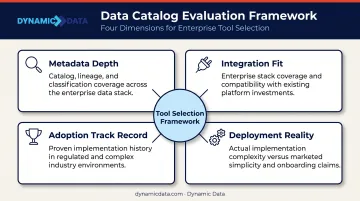
Tools were assessed across four dimensions for this guide:
- Metadata depth — catalog + lineage + classification capabilities
- Integration fit — coverage of widely used US enterprise data stacks
- Adoption track record — proven use in regulated and scaling organizations
- Deployment reality — actual implementation complexity versus marketed simplicity
Common Mistakes to Avoid
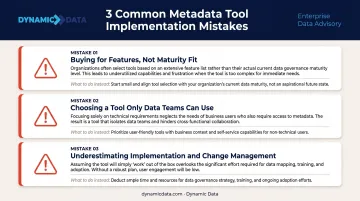
Most organizations that struggle with metadata tool implementations make one of three errors:
- Buying for features, not maturity fit. Collibra is an excellent platform for organizations with defined data owners and governance processes. Without those, it becomes an expensive, underused catalog. The tool can't substitute for governance operating model readiness.
- Choosing a tool only data teams can use. If business users can't access or contribute to the catalog, governance stays siloed. Usability for non-technical stakeholders is as important as technical depth.
- Underestimating implementation and change management. Metadata platforms require data owners to be identified, stewardship workflows to be defined, and teams to actually use the tool. Technical deployment is the easier part.
Dynamic Data's team evaluates metadata management tool fit as part of its data governance engagements, helping clients assess governance maturity, match tools to their existing stack, and avoid committing to platforms that outpace their operational readiness. A structured fit assessment — before any contract is signed — is what separates a tool that gets adopted from one that never leaves the pilot phase.
Conclusion
Metadata management isn't a feature to bolt onto a governance program. It's the operational layer that makes governance work in practice — connecting policy to the actual data assets teams use every day.
The right tool depends on where you are, not where you aspire to be. Each platform targets a different starting point:
- Collibra and Informatica serve mature governance programs in regulated industries
- Alation prioritizes data discovery and cross-functional literacy
- Microsoft Purview is strongest inside existing Microsoft ecosystems
- Atlan fits organizations building on modern cloud stacks who need fast time-to-value
Start with a concrete governance problem — lineage gaps, compliance exposure, data discovery failures — before evaluating vendors. Then run a proof-of-concept with real data before committing to a platform.
Tool selection is only half the challenge — implementation decisions made early tend to determine whether governance programs stick or stall. If your organization is building or modernizing its data governance program, Dynamic Data's consultants work directly with data and engineering teams to select, configure, and implement the right metadata management tooling for your stack. Contact Dynamic Data to discuss your governance priorities.
Frequently Asked Questions
What is the difference between metadata management and data governance?
Data governance defines the policies, roles, and accountability frameworks for how data should be managed. Metadata management is the technical practice of capturing and maintaining information about data assets — it's the execution layer that makes governance policies visible, searchable, and enforceable across an organization.
What features should a metadata management tool have for data governance?
Core capabilities include automated metadata discovery and cataloging, end-to-end data lineage tracking, a business glossary, policy and access control enforcement, and data quality monitoring. In 2025, AI-driven classification and active metadata capabilities are increasingly important differentiators — separating tools that stay current automatically from those that depend on manual documentation cycles.
Do small and mid-sized businesses need a dedicated metadata management tool?
Not necessarily at the start. SMBs with growing data complexity can benefit from lighter-weight tools like Atlan, or from starting with built-in catalog and lineage features in platforms like dbt or Snowflake Horizon before committing to a standalone governance tool. Enterprise platforms like Collibra or Informatica are designed for organizations with dedicated governance teams and processes.
What is active metadata management and why does it matter in 2025?
Active metadata management means the tool continuously collects, updates, and acts on metadata in real time — rather than relying on manually maintained documentation. This enables automated lineage updates, real-time quality alerts, and AI-assisted governance recommendations that keep pace with fast-moving data environments.
How much do enterprise metadata management tools typically cost?
Most enterprise-grade tools — Collibra, Informatica, Alation, and Atlan — use custom pricing based on data volume, users, connectors, and modules. Costs typically range from tens of thousands to hundreds of thousands of dollars annually. Factor in implementation, training, and support: the license is rarely the largest line item.
Can open-source metadata management tools meet enterprise governance needs?
Open-source options like Apache Atlas and DataHub work well for organizations with strong technical teams, particularly in Apache or cloud-native ecosystems. They require significant engineering effort to configure and maintain, though. For enterprises with compliance obligations and limited data engineering capacity, commercial tools typically deliver faster time-to-value and more mature compliance reporting.