Traditional analytics wasn't built for this pace. Static reports and manual segmentation can't keep up with real-time campaign dynamics, shifting customer behavior, or the sheer volume of signals modern marketing generates. The result: teams react instead of anticipate, and money gets left on the table.
AI-driven analytics changes the equation. Rather than describing past performance, it predicts future outcomes and recommends actions — continuously, at scale. This article covers what that actually means in practice: the core capabilities, the highest-impact use cases, the data foundation you need first, and a practical roadmap for getting started.
Key Takeaways
- AI analytics shifts marketing from reactive reporting to proactive decision-making
- Predictive lead scoring, multi-touch attribution, and anomaly detection deliver the highest ROI
- Clean, unified data is the prerequisite — fragmented data is the most common reason AI implementations fail
- Poor data quality costs organizations an average of $12.9M per year, per Gartner
- Run one focused pilot first, measure it against a baseline, then scale what works
What Is AI-Driven Analytics for Marketing?
AI-driven marketing analytics applies machine learning, predictive models, and automation to continuously analyze marketing data, surface patterns, and generate specific, timely recommendations — before performance issues surface in your weekly report.
Three technologies power it:
- Machine learning — identifies patterns across large datasets and improves predictions over time as more data flows through
- Natural language processing (NLP) — interprets unstructured data like customer reviews, social posts, and support tickets to surface sentiment and intent
- Predictive modeling — uses historical campaign data to forecast future outcomes like revenue, conversion rate, or churn probability
From Reactive to Proactive: The Analytics Spectrum
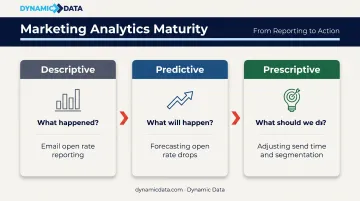
Most marketing teams operate at the descriptive level — they know what happened. AI analytics pushes further:
| Analytics Type | Question Answered | Example |
|---|---|---|
| Descriptive | What happened? | Last month's email open rate was 18% |
| Predictive | What will happen? | Open rate will drop 4% next week based on send-time patterns |
| Prescriptive | What should we do? | Shift send time to Tuesday 10am and segment by engagement tier |
Prescriptive analytics is where the real value concentrates. It doesn't just flag a problem — it recommends the fix. For marketing teams managing multiple channels, that distinction determines whether you're optimizing campaigns in real time or explaining missed targets after the fact.
Why AI Analytics Delivers Real Marketing Performance Gains
Speed of Decision-Making
The most immediate payoff from AI analytics is speed. A Forrester TEI study for Adverity found that analytics automation reduced local marketing teams' time on manual analytics activities by 75% — freeing roughly six hours per week per team member. Teams also moved from monthly reporting cycles to acting on campaign signals within days.
That speed translates directly to budget. The same study modeled $2.9M in wasted ad spend saved and reallocated over three years — not by spending more, but by catching underperformers earlier.
Personalization That Actually Scales
Manually segmenting audiences into four or five buckets misses most of the signal. AI processes behavioral data at the individual level — across thousands or millions of customers simultaneously — to identify who's ready to buy, who's at risk of churning, and who's primed for an upsell.
McKinsey's 2025 personalization research found that targeted, analytics-driven promotions can generate 1–2% sales lift and 1–3% margin improvement. A North American retailer saw a 3% annualized margin boost in initial testing. Those numbers reflect better targeting, not bigger budgets.
Compounding Competitive Advantage
AI models improve with more data. A Forrester TEI study for Analytic Partners modeled marketing spend efficiency improving from 4% in Year 1 to 8% by Year 3 — not because the team worked harder, but because the models learned more.
Organizations that start building attribution models and predictive segmentation today will be operating with materially stronger models in 18 months — while competitors who wait are still working with last year's assumptions.
Key Use Cases: Where AI Analytics Drives the Most Impact
AI analytics isn't one monolithic tool. The value comes from specific applications tied to real marketing decisions. These four use cases deliver the clearest, most measurable returns.
Customer Segmentation and Predictive Lead Scoring
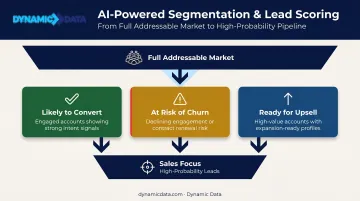
ML-powered segmentation goes well beyond age, location, or job title. Models group audiences by predicted behavior: likely to convert, at risk of churn, ready for an upsell offer. This shifts campaigns from broad-spray messaging to precision targeting.
Predictive lead scoring extends this to the sales funnel. AI models analyze historical conversion data, engagement signals, and firmographic attributes to score every inbound lead by likelihood to close. Sales teams stop working the full list and focus time on the opportunities most likely to move.
The practical result: marketing budget concentrates on high-probability segments rather than getting diluted across the full addressable market.
Multi-Touch Attribution and Campaign Optimization
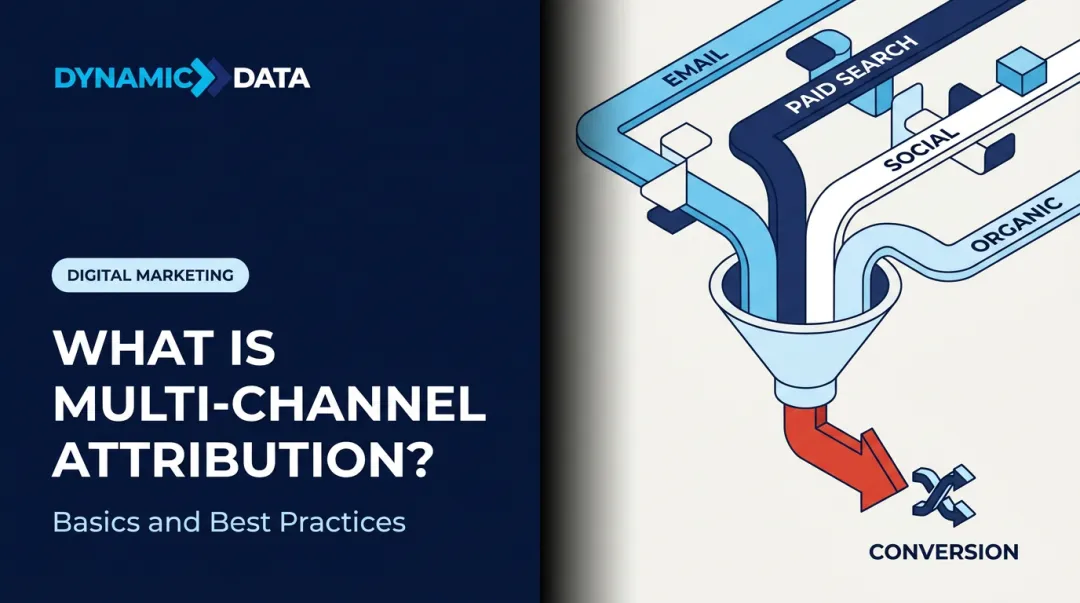
Last-click attribution gives 100% of conversion credit to the final touchpoint before a customer converts — ignoring every earlier interaction that may have created awareness, built trust, or moved the deal forward. According to the IAB's Digital Attribution Primer, this distortion is mechanical: it's baked into how last-touch models are structured.
AI-powered multi-touch attribution distributes credit across the full customer journey using statistical methods — giving marketers an accurate picture of which channels actually drive conversions, not just which ones get the final click.
Beyond attribution, AI enables continuous campaign optimization:
- Monitors performance in real time against historical baselines
- Flags when creative, bidding strategy, or audience targeting is underperforming
- Recommends adjustments before end-of-campaign reviews would catch the problem
Anomaly Detection and Forecasting
AI constantly monitors KPIs — conversion rate, CPC, traffic, email open rates — against statistical norms. When something unusual happens (a sudden CPC spike, a drop in form completions, a revenue dip), the system alerts the team immediately rather than waiting for a human to notice in the next report.
For planning, AI-powered forecasting uses historical campaign data to predict future performance across key metrics. Marketing leaders get a data-backed basis for budget planning and goal-setting — forward-looking models that account for seasonal patterns and trend signals, not last year's numbers recycled as targets.
Building this infrastructure in-house takes significant time and specialized expertise. Dynamic Data's custom AI and ML services let teams skip the build phase entirely — deploying anomaly detection and forecasting models tailored to their specific data environment and marketing stack.
Building the Data Foundation: The Prerequisite for AI Success
Why Data Quality Is the Real Risk
AI is only as good as the data it's trained on. Most AI implementations don't fail because of the algorithm — they fail because the underlying data is fragmented, inconsistently defined, or siloed across platforms that have never talked to each other.
The numbers make this concrete:
- 81% of respondents in Salesforce's 2025 Connectivity Benchmark Report identified data integration as a significant challenge when implementing AI
- Gartner estimates poor data quality costs organizations at least $12.9M per year on average
- Only one in four marketers are satisfied with how they currently use data to power personalization
These aren't implementation hiccups. They're structural blockers that need to be resolved before AI models can produce reliable outputs.
What a Clean Data Foundation Requires
A unified marketing data foundation typically means:
- Single source of truth — CRM, paid channels, email platforms, web analytics, and offline data connected into one normalized dataset
- Consistent definitions — the same metric means the same thing across every source (a "conversion" in Google Ads matches a "conversion" in your CRM)
- Automated validation — deduplication, schema monitoring, and data quality checks that run continuously, not quarterly
- Governance framework — documented data ownership, standardized naming conventions, and audit trails
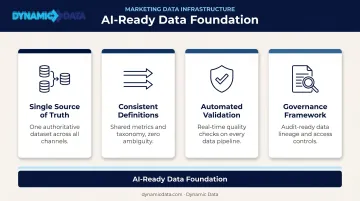
Getting these four elements in place is where most teams stall — and where the right infrastructure partner makes the difference. Dynamic Data's data engineering work covers the full pipeline: Fivetran and dbt for ingestion and transformation, Snowflake for warehousing, and automated testing that catches data problems before they reach dashboards. For marketing clients, that means campaign data, CRM records, web analytics, and offline sources unified into a clean, modeled layer — before any AI work begins.
How to Implement AI-Driven Analytics in Your Marketing Strategy
The most common implementation mistake is skipping straight to platform selection. Starting with the right foundation changes everything.
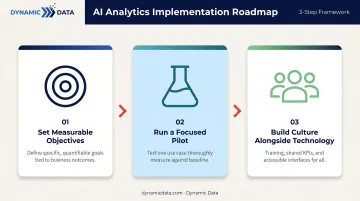
Step 1: Set Measurable Objectives
Before evaluating any technology, identify the exact problem to solve. "Improve marketing performance" isn't a goal. "Reduce customer acquisition cost by 20% for the enterprise segment" is. The objective determines which use case to pursue and how to measure success.
Step 2: Run a Focused Pilot
Choose one high-impact use case — predictive lead scoring for a single product line, or attribution modeling for your paid channels. Implement it, measure results against a pre-pilot baseline, and document what worked. This builds internal credibility and surfaces integration issues before they affect the full deployment.
Step 3: Build Culture Alongside Technology
AI tools only deliver value if the team acts on the insights. That requires:
- Shared KPI definitions that all stakeholders agree on
- Training that helps non-technical marketers interpret model outputs
- A clear process for translating AI recommendations into campaign decisions
- Accessible interfaces — natural language query tools, interactive dashboards — that reduce the technical barrier to engaging with data
This last point matters more than most teams expect. Conversational AI analytics tools — like those Dynamic Data builds for marketing teams — let analysts query data in plain language, removing the SQL dependency that slows adoption and keeps insights siloed in the data team.
Common Challenges and How to Overcome Them
The "Black Box" Problem
When stakeholders can't see why an AI model made a recommendation, trust breaks down. Look for AI tools that include explainability features: outputs that show which factors drove a prediction, ranked by influence. When a recommendation is traceable to specific signals, it's far easier to defend to leadership and act on with confidence.
The Skills Gap
Most marketing teams don't have in-house data scientists — and that's expected, not a shortcoming. Two practical paths forward:
- Partner with a specialized data analytics provider who handles model development, pipeline management, and interpretation
- Implement no-code or natural language interfaces that allow non-technical marketers to engage directly with AI-generated insights without going through a technical team
Data Privacy and Compliance
Solving the skills gap is only part of the picture. Any AI analytics program also has to account for how customer data is collected and used — particularly as GDPR, CCPA, and similar regulations continue to expand in scope. Build compliance in from the start:
- Collect first-party data with clear consent
- Map all customer data processing to notice, access, deletion, and opt-out requirements
- Avoid building models that depend on third-party cookie data as that infrastructure continues to erode
- Conduct data protection impact assessments for any automated decision-making that affects customers
Frequently Asked Questions
What is AI-driven analytics in marketing?
AI-driven analytics applies machine learning, predictive models, and automation to analyze marketing data at scale, identify patterns, and generate specific optimization recommendations. Unlike static dashboards, it shifts teams from describing past performance to predicting future outcomes and recommending specific optimizations.
How does AI improve marketing performance optimization?
AI improves performance through real-time monitoring, predictive forecasting, automated segmentation, and continuous campaign optimization. Teams move from reviewing monthly reports to acting on signals within hours or days — catching underperformers and reallocating budget before damage accumulates.
What data do you need before implementing AI marketing analytics?
You need unified, clean, and consistently structured data from all marketing sources — CRM, paid platforms, email, and web analytics. Data silos, inconsistent metric definitions, and poor data quality are the most common blockers, and most implementations require a dedicated data foundation project before AI models can produce reliable results.
What are the most impactful AI analytics use cases for marketing teams?
Predictive lead scoring, ML-powered customer segmentation, multi-touch attribution, real-time anomaly detection, and campaign performance forecasting deliver the clearest ROI for most marketing teams. Attribution and segmentation tend to have the fastest measurable payback.
How do you measure ROI from AI-driven marketing analytics?
Track ROAS, CPA, conversion rates, time recovered from manual reporting, and lead-to-close improvements before and after implementation. The Forrester TEI model for Analytic Partners benchmarked 495% ROI with payback under six months for enterprise implementations.
What are the biggest challenges in implementing AI marketing analytics?
The main obstacles are data quality and fragmentation, internal skills gaps, and low stakeholder trust in AI recommendations. Each is solvable — through a proper data foundation investment, external partnerships with accessible tooling, and explainable AI interfaces that document how recommendations are generated.