Introduction
Enterprises are spending aggressively on AI. According to McKinsey's 2025 research, 92% of companies plan to increase AI investments over the next three years — yet only 1% of leaders describe their organizations as genuinely mature in AI deployment. That gap is where most AI initiatives quietly stall.
The technology isn't the problem. As Harvard Business Review put it, most firms struggle to capture value from AI "not because the technology fails — but because their people, processes, and politics do." Employees aren't using the tools, executives are misaligned on priorities, and data foundations are too shaky to support production-grade models. Nobody defined what success actually looks like.
These aren't technology problems — they're strategy and change management problems. This guide is for business and technology leaders planning an AI initiative or already mid-rollout and hitting friction. It covers what AI strategy and change management consulting actually involves, where organizations most commonly go wrong, and how to build a repeatable approach that drives genuine adoption across your organization.
Key Takeaways
- 92% of companies plan to increase AI investment, but only 1% have mature deployments
- Most AI failures stem from people and process issues, not technology
- Effective AI strategy runs on three tracks simultaneously: vision alignment, data foundation, and culture readiness
- Change management is what separates deployment from actual adoption
- Measuring only license activations misses the point: behavioral change and business outcomes are the real benchmarks
What Is AI Strategy Development and Change Management Consulting?
These two disciplines are often treated separately. They shouldn't be.
AI strategy development is the structured process of identifying where AI will create the most business value, selecting the right technologies, and building the organizational capabilities — data infrastructure, governance, talent — needed to deploy them effectively.
Change management consulting, in the AI context, is the practice of preparing and supporting people through the transition AI requires. This covers leadership alignment, communication planning, role-specific training, and resistance mitigation.
Why Both Disciplines Must Work Together
Most organizations treat AI as a purely technical deployment. Buy the tools, configure the integrations, call it done. But that approach consistently produces the same outcome: expensive tools that employees don't trust, don't understand, or simply don't use.
An AI strategy consultant bridges the gap between technical implementation and human adoption. The technical work answers what gets built; the change management work determines whether people actually use it — and whether the investment delivers measurable results.
Dynamic Data structures every AI engagement around both dimensions. Technical work — data stack architecture, machine learning implementation, governance — runs in parallel with workforce readiness planning, so adoption isn't an afterthought bolted on after deployment.
Why AI Initiatives Fail Without a Change Management Strategy
Gartner predicted that at least 30% of generative AI projects would be abandoned after proof of concept by end of 2025 — citing poor data quality, inadequate risk controls, and unclear business value as the primary causes. That's not a technology indictment. It's an organizational one.
The Most Common Failure Modes
These patterns appear repeatedly across failed AI initiatives:
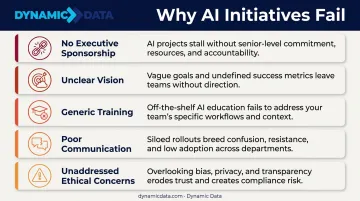
- No executive sponsorship — AI is owned by IT, disconnected from business strategy
- Unclear vision — teams can't articulate what AI is supposed to achieve or how success is measured
- Generic training — employees receive broad AI awareness sessions instead of role-specific guidance
- Poor communication — workers hear nothing about how their day-to-day jobs will change until the tool goes live
- Unaddressed ethical concerns — data reliability, privacy, and bias questions fester without structured responses
Deployment Is Not Adoption
AI implementation means the tools are installed and configured. AI adoption means employees are actually using AI effectively in their workflows, trusting its outputs, and changing how they work.
McKinsey's research found that employees are using gen AI three times more than their leaders realize — yet measurable business impact remains elusive. Employees experimenting with tools independently doesn't translate to workflow change or business results. Organizations that measure success by licenses activated rather than behavioral change end up with adoption dashboards that look healthy while the underlying work hasn't shifted at all.
The Cost of Skipping Change Management
Low adoption compounds. Wasted investment leads to leadership skepticism. Skepticism makes the next AI initiative harder to fund and launch. Middle managers — whom McKinsey identifies as the critical link between AI strategy and frontline execution — disengage. And the organization falls further behind.
A Gartner survey found that only 20% of low-maturity organizations keep AI projects operational for at least three years, compared to 45% of high-maturity organizations. Better technology doesn't explain the gap — organizational readiness does.
The Three Pillars of an Effective Enterprise AI Strategy
No single workstream is sufficient on its own. Organizations that succeed treat these three pillars as parallel, interdependent work — not a sequential checklist.
Pillar 1: Strategic Vision and Use Case Prioritization
AI strategy starts with a clear answer to one question: What specific business outcome are we trying to achieve?
Not "efficiency gains" in the abstract. Specific outcomes — faster credit decisions, reduced customer churn, lower supply chain costs. A concrete vision gives employees a reason to engage and gives leadership a clear measure of success.
From there, use case prioritization matters enormously. McKinsey's analysis of AI high performers — roughly 6% of organizations — found they are three times more likely to fundamentally redesign individual workflows rather than bolt AI onto existing processes. Broad experimentation produces scattered, incremental results. Focused workflow redesign produces measurable change.
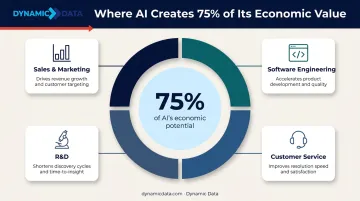
Four functional areas — sales and marketing, software engineering, customer service, and R&D — capture approximately 75% of AI's total economic potential, according to McKinsey. That's a practical starting point for use case prioritization in most enterprises.
Pillar 2: Data and Technology Foundation
AI models are only as good as the data they're trained on. Before scaling any AI initiative, organizations need:
- A modern data stack with clean, well-structured pipelines
- Strong data governance policies covering ownership, access, and quality standards
- Platform choices that integrate with existing workflows rather than forcing parallel systems
Dynamic Data specializes in building exactly this foundation — from data warehouse architecture on platforms like Snowflake, BigQuery, and Databricks, to fully automated transformation and testing pipelines using dbt. The Zenus engagement is a direct example: before scaling their AI-driven facial analysis platform, Dynamic Data stood up a data warehouse on Google Cloud, built automated transformation pipelines, and implemented governance through automated testing — all to confirm data integrity before any AI model reached production.
Sequence matters here. Organizations that skip the foundation and jump straight to model deployment tend to end up with AI outputs their employees don't trust — and adoption stalls as a result.
Pillar 3: People and Culture Readiness
For most employees, the right target is AI literacy: knowing when to trust, question, or override an AI recommendation. Technical expertise and prompt engineering certification are beside the point. What matters is the ability to work intelligently alongside AI tools.
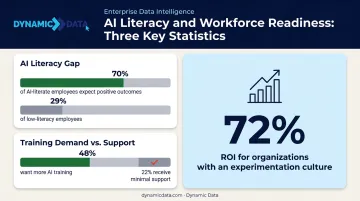
SAP's research makes the stakes clear: 70% of AI-literate employees expect positive outcomes from AI, compared to just 29% of those with low literacy. Yet 48% of employees want more formal AI training, and 22% currently receive minimal to no support from their employers. That gap is where adoption breaks down.
That training gap doesn't exist in isolation — it's compounded when culture discourages experimentation. Deloitte's research found that organizations with a culture of experimentation and tolerance for failure report 72% ROI on AI initiatives, higher than organizations focused solely on automation and cost reduction. Psychological safety around learning new tools isn't a soft consideration. That 72% figure is the proof.
The three pillars work together: vision focuses the effort, data infrastructure makes it reliable, and people readiness determines whether it sticks.
Building a Change-Ready Organization for AI Adoption
Change readiness is an ongoing organizational capability, not a project with a finish line. The four steps below form the operational backbone of any serious AI change management effort.
1. Establish leadership alignment and governance Form a cross-functional AI steering group that includes IT, HR, operations, and business unit leaders. This group defines ethical guidelines, data access policies, and use case approval processes — and ensures AI decisions reflect the needs of the people most affected, not just the preferences of technical teams.
2. Assess skill gaps and design targeted training Generic AI awareness sessions don't change behavior. Role-specific training — designed around how AI tools affect specific job functions — does. Map proficiency levels by role, identify the gaps that matter most, and build learning paths that tie training directly to job performance expectations.
3. Communicate transparently at every level Prosci's research identifies two distinct preferred sender roles: senior leaders should communicate the business reasons for the change, and direct managers should communicate the personal impact on individual employees. Organizations that collapse these into a single message — or deliver everything through project team announcements — undermine their own change efforts.
4. Reinforce adoption over time McKinsey found that involving at least 7% of employees in transformation initiatives doubles the likelihood of positive shareholder returns. High-performing organizations push that participation to 21–30% of the workforce.
Sustaining adoption means building in:
- Ongoing feedback loops between users and implementation teams
- Recognition of early wins to build momentum
- Continued training investment as tools evolve
Addressing Resistance by Role
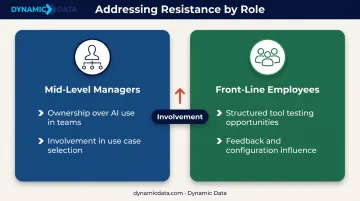
Mid-level managers and front-line employees are typically the most resistant groups — because they have the most to lose if AI goes badly.
- Managers: Give them ownership over how AI is used in their teams. Involve them in use case selection and tool evaluation. When managers shape the rollout, they advocate for it.
- Front-line employees: Create structured opportunities to test tools, provide feedback, and influence final configurations. Involvement reduces fear. Exclusion amplifies it.
The Role of Data Governance in a Sustainable AI Strategy
AI outputs are only trusted when the data behind them is trusted. If employees encounter AI recommendations built on inconsistent, incomplete, or biased data, they stop using the tool. At that point, even a technically sound model becomes a liability — unused and undefended in budget reviews.
The three elements of AI-ready data governance:
- Clear data ownership and access controls — every dataset has a defined owner responsible for quality, and access permissions are enforced systematically
- Model training data standards — documented requirements for data quality, completeness, and representativeness before any model enters production
- Output monitoring mechanisms — ongoing audits of AI recommendations for accuracy, consistency, and bias over time
Dynamic Data builds governance programs across all three layers — defining data ownership structures, setting model training standards, and instrumenting ongoing output monitoring. For clients in regulated industries like healthcare and financial services, this work typically precedes any model deployment, since regulators and internal risk teams require documented data lineage and audit trails before AI recommendations can influence decisions.
That investment in early governance pays off beyond compliance. PwC's guidance on responsible AI notes that proactive governance "reduces the risk of incurring significant operational costs associated with retrofitting or redesigning systems later." For organizations scaling AI across multiple teams or use cases, fixing governance gaps after deployment costs far more — in engineering time, model retraining, and lost stakeholder confidence — than building it correctly from the start.
Key Metrics to Track AI Strategy and Change Management Success
Only 39% of organizations report measurable EBIT impact from AI despite 88% using AI regularly, according to McKinsey. The reason: most organizations track deployment activity, not business outcomes.
Effective measurement requires two distinct categories:
Adoption Metrics
- Employee AI usage rates by role and department
- Proficiency levels (self-reported and observed)
- Training completion rates
- Employee sentiment scores and resistance indicators
Outcome Metrics
- Process-level improvements: time saved, error rate reduction, cycle time changes
- Business outcomes: revenue impact, cost reduction, customer satisfaction scores
- Change management health: manager engagement scores, escalation frequency, feedback loop participation
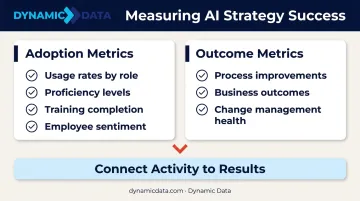
Neither category works in isolation. The goal is to connect adoption activity directly to performance results — tracking both gives you the proof needed to justify continued AI investment and show where the strategy needs adjustment.
Frequently Asked Questions
What is an AI strategy consultant?
An AI strategy consultant helps organizations identify where AI creates business value, design a roadmap for implementation, and align technology decisions with business objectives and workforce readiness. In practice, this means connecting technical deployment with organizational adoption — so tools actually get used, not just installed.
What are the benefits of AI consulting strategy for enterprises?
Key benefits include:
- Faster time-to-value through focused use case prioritization
- Reduced adoption risk via structured change management
- Stronger ROI from aligning AI tools with actual business goals
- Better employee engagement through targeted communication and training
How is AI changing management consulting?
AI is shifting consulting from advisory-only engagements to hands-on implementation partnerships. Consultants increasingly help organizations build internal AI capabilities, govern data, and create AI-augmented decision-making processes — rather than handing over a report and ending the engagement there.
What are the three key areas where enterprises are adopting AI?
The three most common enterprise AI adoption areas are operations and process automation, customer experience and personalization, and data-driven decision-making and forecasting. Successful adoption in each area depends on a clear strategy, strong data foundations, and structured change management support.
What types of AI are best for AI consulting engagements?
The most impactful AI types for enterprise consulting engagements are:
- Machine learning for predictive analytics and decision support
- Generative AI for content and workflow automation
- Natural language processing for customer interaction and knowledge management
Selection depends on the organization's specific use cases and data maturity.
What project management metrics can AI improve?
AI-powered forecasting, monitoring, and automated reporting tools can improve:
- Project delivery timelines
- Resource allocation efficiency
- Risk identification and escalation speed
- Budget variance tracking
- Stakeholder communication effectiveness