

Introduction
Most people assume validation means agreeing with someone — telling them their feelings are correct, their reactions are justified, or their conclusions are right. In DBT, that's not what validation means at all.
Dialectical Behavior Therapy (DBT), developed by Dr. Marsha Linehan, treats validation as a precise clinical skill with a specific purpose: communicating that another person's emotional response, thought, or behavior is understandable given their circumstances — without requiring agreement. This distinction matters more than it sounds.
Linehan's biosocial theory identifies growing up in an invalidating environment — where emotions are routinely dismissed, punished, or ignored — as a core contributor to emotional dysregulation. Validation in therapy directly counters that pattern.
This article breaks down the 6 levels of validation in DBT, explains why the differences between levels matter, and covers how to apply validation in your own relationships — and toward yourself.
Key Takeaways
- dbt validation tests catch data quality issues — null values, duplicates, referential breaks — before they reach downstream reports
- There are four built-in generic tests:
not_null,unique,accepted_values, andrelationships - Custom and singular tests extend coverage for business-specific logic that generic tests can't handle
- Running tests at multiple model layers (staging, intermediate, marts) stops bad data from compounding
- A tiered validation strategy is the difference between a trustworthy pipeline and one that silently fails
What Is Validation in DBT — and Why Does It Matter?
Validation, as defined in Linehan's 1997 clinical framework, means finding the "kernel of truth" in another person's experience and communicating it back to them. You're not endorsing every thought or action — you're acknowledging that, given their history, biology, or current circumstances, their response makes sense.
Why Clinicians Prioritize It
DBT's biosocial theory links emotional dysregulation to the transaction between biological sensitivity and an invalidating environment. A 2018 Clinical Psychology Review systematic review identifies key features of invalidating environments: dismissing valid emotional experiences, misattributing emotions to negative character traits, discouraging emotional expression, and offering oversimplified solutions to real pain.
Validation directly interrupts that cycle. Clinicians use it because it:
- Builds trust and therapeutic alliance faster than technique alone
- Reduces shame, which otherwise blocks openness to change
- De-escalates emotional intensity in the moment
- Models self-validation for the client over time
- Makes people more receptive to behavioral change strategies
Without validation, even technically correct therapeutic interventions tend to backfire. People who feel dismissed rarely stay open to change — and the therapeutic relationship suffers for it.
The 6 Levels of Validation in DBT
Think of the six levels as a range of responses — not a staircase you must climb in order. The right level depends on what the moment requires. Level 1 delivered genuinely is far more useful than Level 6 delivered mechanically.
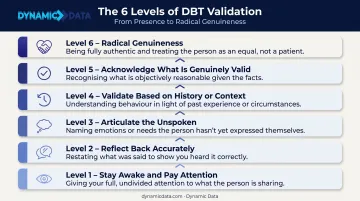
Level 1: Stay Awake and Pay Attention
This is the foundation everything else rests on. Full presence — eye contact, body language oriented toward the speaker, no phone, no split attention. It sounds basic, yet this is where most everyday invalidation actually occurs.
Validating: Setting your phone face-down, making eye contact, nodding while someone speaks.
Invalidating: Half-watching TV, giving distracted one-word answers, checking notifications mid-sentence.
People register immediately whether attention is genuine or performed. Skipping this level doesn't just weaken what follows — it undermines every other response you offer.
Level 2: Reflect Back Accurately
Level 2 means summarizing or paraphrasing what the person said without distorting, adding judgments, or editorializing. The goal is to confirm you understood — not to offer your verdict on whether they should feel that way.
Staying open to correction matters here. If your summary is off, say so and try again.
Validating: "It sounds like you felt dismissed when your manager didn't respond to your proposal."
Invalidating: "You're probably just overreacting — they're busy."
The invalidating version adds an interpretation the person didn't offer and implies their emotional read is wrong. Accurate reflection withholds that judgment entirely.
Level 3: Articulate the Unspoken
Level 3 goes beyond what was said. Using tone of voice, body language, and context, you gently name what the person seems to feel but hasn't put into words yet.
Tentative language is non-negotiable here: "I'm guessing…" or "I wonder if you're feeling…" You're checking a hypothesis, not declaring a diagnosis. Being wrong is fine — what matters is the attempt.
Validating: "I'm guessing there's some fear mixed in with the frustration — like you're not sure how this will affect your job going forward?"
Invalidating: "That reaction doesn't make sense. You don't even know what they meant by it."
Naming an emotion tentatively invites the person to explore it further. Labeling it illogical shuts that down entirely.
Level 4: Validate Based on History or Context
Here the frame shifts from what was said to why the response makes sense given the person's past experiences, biological state, or prior learning. You're not endorsing the reaction as universally appropriate — you're recognizing that for this person, in this context, it's understandable.
Validating: "Given how your last manager treated you, it makes complete sense that this situation would put you on edge."
Invalidating: "That was years ago. You need to stop letting it affect you."
Level 4 is particularly important for people whose emotional responses get labeled as "too much" by others. The response isn't too much — it just needs context to make sense.
Level 5: Acknowledge What Is Genuinely Valid
Level 5 moves from context to current facts. It communicates that most people, facing these same circumstances right now, would feel the same way. This level validates against the present reality — not just the person's history.
Core DBT principle: Only validate the valid. Level 5 is not used to confirm distorted beliefs or harmful conclusions — only what actually fits the facts.
Validating: "Of course you're devastated. Losing your job suddenly, with no warning — that's a genuine loss."
Invalidating: Pivoting immediately to silver linings or what they can do next, before they feel heard at all.
Jumping to solutions before Level 5 validation is one of the most common mistakes well-meaning people make.
Level 6: Radical Genuineness
The highest level: treating the person as a full, capable equal and responding with authentic empathy that says "I would feel the same way in your position." This level communicates deep respect — no condescension, no treating the person as fragile, no therapeutic distance.
Linehan's skills handouts describe this as showing equality — responding to the other person not as a patient to be managed, but as a human being whose experience you genuinely share. That quality can't be faked.
One important caveat: if the emotion doesn't honestly resonate for you, Level 6 isn't available. Forcing it when it isn't genuine is itself a form of invalidation. A sincere Level 3 or Level 4 response will always outperform a hollow Level 6.
Self-Validation: Turning the Skill Inward
Many people who struggle with emotional dysregulation have an equally harsh internal critic — one that labels their own feelings as stupid, excessive, or embarrassing. This pattern of self-invalidation mirrors the external environments that shaped their emotional development.
What Self-Validation Looks Like in Practice
Linehan's 2015 skills curriculum teaches clients to validate themselves using the same framework they'd apply to someone else. That means:
- Acknowledging that your emotion is real, not exaggerated
- Recognizing why the feeling makes sense given your circumstances
- Separating the emotion from any action taken in response (you can validate the feeling without validating every behavior)
- Responding to yourself with the same compassion you'd offer a close friend
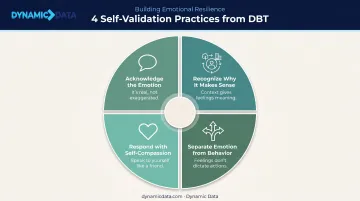
Practicing self-validation reduces shame. And reduced shame makes every other DBT skill easier to access — because shame tends to block the capacity to think clearly and act deliberately.
Therapists model validation throughout treatment so clients can internalize it as a self-directed skill. The goal is building a reliable internal source of validation, not ongoing dependence on others to provide it.
What Validation Is NOT in DBT
Validation is frequently misunderstood, and the confusion causes people to either overdo it or avoid it entirely. A few clear lines:
- Not agreement. You can validate that someone feels betrayed without agreeing that they were actually betrayed.
- Not approval. Validating a behavior's emotional underpinning is not the same as endorsing the behavior itself.
- Not reassurance. Telling someone "everything will be fine" without acknowledging their pain is not validation — it's deflection.
- Not reframing. Finding the silver lining before someone feels heard bypasses the validation step entirely.
- Not universal. DBT's rule is "only validate the valid." Confirming a factually inaccurate belief or reinforcing a harmful conclusion is not validation — it undermines the entire purpose.
Timing Matters
DBT also cautions against validating immediately after a problem behavior. The 24-hour rule — which discourages therapist contact for crisis coaching within 24 hours of self-harm or parasuicidal behavior — exists precisely because certain supportive responses can inadvertently reinforce the behavior. Validation requires awareness of what it is maintaining, not just how it feels in the moment.
Frequently Asked Questions
What are the 6 levels of validation in DBT?
The six levels are: attentive listening (Level 1), accurate reflection (Level 2), articulating the unspoken (Level 3), validating based on history or context (Level 4), acknowledging what is genuinely valid against current facts (Level 5), and radical genuineness (Level 6). Levels progress from basic presence toward full recognition of a person as inherently valid and capable.
What are the 6 core mindfulness skills of DBT?
DBT mindfulness skills divide into "what" skills — observe, describe, and participate — and "how" skills — nonjudgmentally, one-mindfully, and effectively. Together, they anchor every other DBT module by building awareness of the present moment without judgment.
What is the 24-hour rule in DBT?
The 24-hour rule discourages clients from contacting their therapist for crisis coaching within 24 hours of engaging in self-harm or parasuicidal behavior. The goal is to avoid reinforcing harmful behavior — not to withhold support, but to encourage reaching out before a crisis escalates.
Is validation in DBT only for therapists to use?
No. DBT explicitly teaches validation as an interpersonal skill for clients to use in their own relationships, through the Walking the Middle Path module. Self-validation is also a core component of emotion regulation — the goal is for clients to internalize the skill, not remain dependent on receiving it from others.
What is the difference between validation and agreement in DBT?
Validation acknowledges that a person's emotional response is understandable given their history or circumstances. Agreement means sharing their view or endorsing their conclusions. You can fully validate someone's experience without agreeing with their interpretation or approving of their actions.