Introduction
Global AI spending is forecast to reach nearly $1.5 trillion in 2025, according to Gartner. Yet despite that capital surge, at least 50% of generative AI projects are abandoned after the proof-of-concept stage — and only 1% of companies consider themselves mature in AI deployment.
That gap is rarely a technology problem. What fails is everything around the tools: unclear use cases, incomplete data foundations, missing executive ownership, and workforces that were never prepared for the shift.
The organizations that struggle most share a recognizable profile: no structured deployment framework, no visible C-suite champion, and data infrastructure that wasn't ready before the first pilot launched.
The result is predictable — wasted licenses, stalled pilots, and employees who've grown skeptical of the next initiative.
This guide covers the full lifecycle of enterprise AI adoption — from readiness checks and phased deployment through governance and the mistakes that derail even well-funded programs.
Key Takeaways
- Enterprise AI adoption succeeds or fails on organizational readiness, not model selection
- Data infrastructure, compliance posture, and executive sponsorship must be in place before deployment begins
- Successful deployment follows four phases: strategic assessment → pilot → phased rollout → optimization
- Governance and responsible AI must be built into Phase 1, not added after the fact
- Most deployments take 6–18 months to reach production — set realistic timelines to avoid premature cancellation
What Makes Enterprise AI Deployment Complex
Enterprise AI deployment stalls most often on organizational dependencies — data quality, change management, governance alignment, cross-functional coordination — not on the technology itself.
Stanford's Enterprise AI Playbook, which studied 51 deployments, found that 77% of the hardest challenges were "invisible costs": change management, data quality, and process redesign. The technology itself was described as "the easiest part."
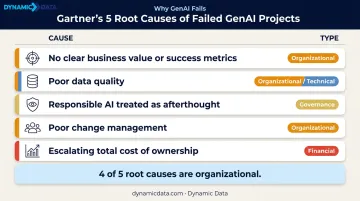
Gartner's analysis of failed GenAI projects identifies five root causes. Four of the five are organizational:
| Failure Cause | Type |
|---|---|
| No clear business value or success metrics | Organizational |
| Poor data quality | Organizational/Technical |
| Responsible AI treated as afterthought | Governance |
| Poor change management | Organizational |
| Escalating total cost of ownership | Financial |
These failure patterns point to the same gap: a structural ownership problem. Fixing it starts with getting the right people in the room.
Who Actually Owns a Successful AI Initiative
IT alone cannot own enterprise AI deployment — and when it does, technically functional systems still fail to improve business outcomes. Successful initiatives are led by a cross-functional team with:
- A named C-suite sponsor (or dedicated AI lead) with operational authority
- IT and data engineering managing infrastructure and pipeline reliability
- Business unit leaders who define and co-own success metrics
- A change management lead embedded from day one, not brought in at rollout
McKinsey's January 2025 research found the same pattern: "the biggest barrier to scaling is not employees — who are ready — but leaders, who are not steering fast enough."
Before You Deploy: Prerequisites and Readiness Checks
Skipping pre-deployment assessment is a leading reason AI pilots fail. Before any tool is selected or licensed, four areas must be evaluated: data readiness, infrastructure, compliance posture, and organizational culture.
Data and Infrastructure Readiness
AI systems are only as reliable as the data feeding them. The numbers here are stark: according to research by Precisely and Drexel University, 77% of organizations rate their data quality as average or worse, and only 12% report data sufficient for AI implementation.
Before a pilot launches, organizations must audit:
- Whether data is complete, accurate, and consistent across sources
- Whether the right data can reach the right systems without manual intervention
- ETL/ELT pipeline reliability, data warehouse architecture, and integration gaps
- Governance coverage — 62% of organizations cite lack of data governance as their primary data challenge
Building or modernizing a data stack is a prerequisite, not a parallel workstream. Most organizations discover their infrastructure isn't AI-ready until a project stalls — at which point timelines slip by months. Dynamic Data's data engineering practice builds and deploys modern data stack infrastructure — Snowflake, BigQuery, dbt, and Databricks — alongside data governance frameworks, automated pipelines, and data preparation work that AI projects require before they can begin.
Compliance and Security Assessment
Regulatory requirements determine which vendors, deployment architectures, and data residency options are even permissible. Before platform selection, map your applicable frameworks:
- GDPR — any organization handling EU resident data
- HIPAA — healthcare and health-adjacent data
- SOC 2 — SaaS and technology companies with enterprise customers
- Sector-specific rules — financial services (FINRA, SEC), government, etc.
Three conditions should pause deployment entirely until resolved:
- Data classification is incomplete
- Access controls are undefined
- AI vendor agreements haven't received legal review
Executive Sponsorship and Team Readiness
Without a visible C-level champion, AI adoption stalls at the department level. McKinsey data shows that organizations with strong executive endorsement see performance improvements 3.8 times higher than peers without it. Nearly 73% of CEOs now identify themselves as their company's primary AI decision-maker — twice the share from the prior year, per BCG's 2026 AI Radar.
The core team required before any deployment begins:
- AI lead or steering committee — sets priorities, clears obstacles, owns cross-functional coordination
- Data engineering support — builds and maintains the infrastructure layer
- Department champions — business-side owners who translate AI capabilities into workflow value
- Change management owner — addresses resistance before it takes hold
The Enterprise AI Deployment Framework: Phase by Phase
Enterprise AI deployment follows a defined sequence. Compressing or skipping phases consistently produces failed outcomes. Time-to-production typically spans 6–18 months, and data preparation consumes the largest share of that time.
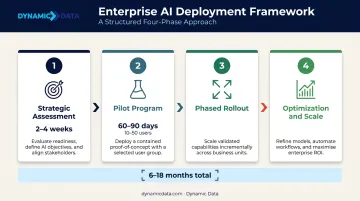
Phase 1: Strategic Assessment (2–4 Weeks)
The goal is identifying 2–3 high-impact, measurable use cases — not selecting technology. Starting with the tool before defining the problem is the leading cause of wasted AI licenses.
Survey departments for repetitive, time-intensive knowledge work where automation or augmentation would produce measurable output. Before exiting this phase, define:
- Success metrics for each use case (specific, measurable, agreed upon)
- Platform shortlist aligned to existing infrastructure
- Compliance checklist
- Budget scope including training and governance costs
Phase 2: Pilot Program (60–90 Days, 10–50 Users)
Select an enthusiastic, metrics-driven department and recruit power users who will champion adoption and support peers, not passive bystanders waiting to be convinced.
Set these ground rules before the pilot launches:
- Agree on success metrics before results come in, not after
- Cap the timeline at 90 days — longer pilots lose stakeholder confidence
- Keep scope tight: one department, defined workflows, measurable output
Phase 3: Phased Rollout
With a successful pilot behind you, expand department by department, adding one team every 2–4 weeks. Prioritize enthusiastic adopters first — they become the proof points that ease adoption in more resistant functions.
A champions program is what separates sustained rollouts from stalled ones:
- Pilot users formally onboard new departments rather than relying on generic training
- Onboarding connects AI capabilities directly to each team's daily workflows
- Resistant functions follow after early adopters demonstrate tangible results
Phase 4: Optimization and Scale
Once rollout is complete, optimization becomes an ongoing operational rhythm, not a project milestone. Build in:
- Quarterly ROI reviews against the success metrics defined in Phase 1
- Regular policy updates as AI regulations evolve (the EU AI Act's high-risk compliance deadline hits August 2026)
- Advanced use case pipeline — including agentic AI applications as organizational capability matures
Governance, Data Quality, and Responsible AI
Governance built in from Phase 1 costs a fraction of governance retrofitted after an incident. Cumulative GDPR fines have surpassed EUR 4.4 billion across 2,000+ enforcement actions. The EU AI Act's penalty regime goes further — up to EUR 35 million or 7% of global annual turnover for non-compliance with high-risk AI requirements.
Governance Frameworks to Know
| Framework | Type | Best For |
|---|---|---|
| NIST AI RMF | Voluntary | US organizations; flexible risk management starting point |
| ISO 42001 | Voluntary (certifiable) | Organizations seeking formal, auditable AI governance certification |
| EU AI Act | Mandatory | Any enterprise with EU customers or operations — extraterritorial scope applies |
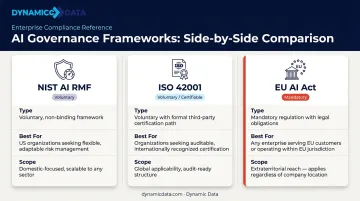
Select based on your geography, industry, and risk profile. US-only enterprises can start with NIST AI RMF. Any organization with EU market exposure must treat the EU AI Act as mandatory: the Act mirrors GDPR's extraterritorial reach, so even without an EU office or servers, compliance obligations still apply.
Responsible AI in Practice
Responsible AI requires operational controls, not policy documents:
- Ownership: assign a governance lead or AI steering committee with clear authority
- Use policy: define acceptable and prohibited uses explicitly, in writing
- Bias monitoring: implement ongoing model performance reviews across demographic variables
- Audit logging: maintain records of model decisions for regulatory and internal review
The business case extends beyond compliance. Enterprises with transparent AI practices build internal trust faster, reduce employee resistance, and create a defensible position with customers and regulators. Legal, HR, Risk, and Compliance teams are consistently among the loudest sources of internal AI pushback — often more so than frontline users. Governance structures that address their concerns early clear one of the most consistent adoption barriers.
Common Enterprise AI Adoption Mistakes and How to Fix Them
The same mistakes appear repeatedly across failed enterprise AI deployments — and most are organizational, not technical.
Mistake 1: Licensing AI Tools Before Defining Use Cases
Problem: Organizations buy enterprise AI licenses before identifying specific use cases. Tools go unused, budgets are wasted, and leadership loses confidence in the program.
Fix: Define 2–3 specific business problems with measurable outcomes first. Then evaluate which tools address them. The tool evaluation follows the use case definition — not the other way around.
Mistake 2: Treating AI Adoption as an IT Project
Problem: When AI deployment is delegated entirely to IT, technically functional systems fail to improve business processes. IT and business units measure success differently, and that gap doesn't close on its own.
Fix: Establish a cross-functional steering committee with business leaders as co-owners. Require jointly defined success metrics before any deployment begins. IT owns the infrastructure layer; business units own the outcomes.
Mistake 3: Underinvesting in Change Management
Problem: Resistance from middle management and distrust of AI outputs derail even technically sound deployments. McKinsey research found that 92% of companies plan to increase AI investment, yet only 1% reach deployment maturity — and poor change management is a primary driver of that gap.
Fix:
- Address job security concerns directly and early — don't let silence create anxiety
- Frame AI as augmentation, not replacement
- Invest in role-specific training, not generic onboarding
- Recognize early adopters visibly to create positive social proof within the organization

Avoiding these three patterns won't guarantee success, but they're the clearest places where well-funded programs quietly stall — and where early course corrections have the biggest payoff.
Conclusion
The Stanford Enterprise AI Playbook studied 51 deployments across the same technologies and use cases and found vastly different outcomes. Their conclusion: "The difference was never the AI model — it was always the organization."
That finding is echoed by Gartner, McKinsey, BCG, and Forrester. Organizations that succeed with enterprise AI are not the ones with the most sophisticated models. They're the ones with clean data, structured deployment phases, executive ownership, and change management that began before the first pilot launched.
That clarity points to a single starting point: the data foundation. Without reliable, accessible, governed data, every AI initiative that follows will underperform.
Dynamic Data works with mid-market and enterprise organizations to build that foundation — data pipelines, warehousing, governance frameworks, and AI-readiness preparation — so that when production deployments launch, they produce results worth measuring.
Frequently Asked Questions
What is enterprise AI strategy?
An enterprise AI strategy is a structured plan that aligns AI initiatives with specific business objectives. It covers use case prioritization, technology selection, governance, data infrastructure, and organizational change management, with each element tied to measurable business outcomes.
What is an enterprise AI model?
An enterprise AI model is an AI system — often a large language model, machine learning model, or predictive model — deployed within an organization's environment to automate tasks, generate insights, or support decision-making. It differs from consumer AI in that it must meet stricter compliance, security, and integration standards.
What is an example of enterprise AI?
Common examples include an AI system that automatically classifies and routes customer support tickets, or a machine learning model that forecasts inventory demand. In both cases, success is tied to a specific, measurable business problem — not general AI capability.
How long does enterprise AI deployment typically take?
Most organizations take 6–18 months to move from intake to production. The timeline depends heavily on data readiness, organizational complexity, and use case scope — with data preparation typically consuming the largest share of elapsed time.
What is the biggest reason enterprise AI pilots fail?
Most pilots fail due to poor use case definition, lack of executive sponsorship, inadequate data infrastructure, or unrealistic timelines. The technology itself is rarely the issue. Organizational readiness almost always is.
How important is data quality for successful AI deployment?
Data quality determines the reliability of every AI output. AI systems are only as accurate as the data they are trained or grounded on, so data auditing and pipeline preparation should be completed before deployment begins — not treated as a parallel workstream.