Introduction
Enterprise organizations don't just have more data than small businesses — they have more exposure. More systems feeding conflicting numbers into executive dashboards. More business units operating on different definitions of "customer" or "revenue." More regulatory jurisdictions watching how data gets stored, accessed, and shared.
Without a deliberate governance program, that complexity compounds quickly. Data becomes a liability: compliance gaps accumulate, AI initiatives stall on bad inputs, and decision-makers lose confidence in the numbers in front of them.
According to IBM research, over a quarter of organizations estimate poor data quality causes annual losses above $5 million — and 7% report losses of $25 million or more each year. For enterprises operating at scale, ungoverned data is a measurable financial risk — not an IT inconvenience.
What follows is a practical breakdown of enterprise data governance: what it is, how mature frameworks are structured, how to implement one, and what obstacles to expect at scale.
Key Takeaways
- Enterprise data governance is the organization-wide system of people, policies, processes, and technology that manages data across its entire lifecycle
- Poor data quality carries a steep price tag — IBM estimates bad data costs US businesses $3.1 trillion per year — and it's often what prevents AI initiatives from delivering value
- A governance framework rests on four pillars: People, Rules, Processes, and Technology
- Start with a minimum viable project in one high-value domain, not an organization-wide rollout
- The biggest governance failures are organizational, not technical. Accountability structures and executive sponsorship matter more than any tool you deploy
What Is Enterprise Data Governance?
Enterprise data governance is the organization-wide system of people, rules, processes, and technology that manages data across its entire lifecycle — from collection and storage through access, use, and eventual retirement — keeping it accurate, secure, and strategically useful.
Gartner defines it as decision rights and accountability. IBM calls it the policies, standards, and procedures governing data collection, ownership, storage, and use. The framing differs, but the point is the same: governance is how organizations take control and accountability at scale over their most critical asset.
How Enterprise Governance Differs From General Governance
Enterprises face a fundamentally different governance challenge than smaller organizations — one defined by structural complexity, not just data volume. Enterprises typically contend with:
- Multiple data domains (customer, financial, product, operational, HR) each requiring different rules
- Dozens of business units with competing priorities and inconsistent data definitions
- Legacy systems that predate modern data infrastructure and can't easily be standardized
- Overlapping regulatory requirements across federal, state, and international jurisdictions
- Acquisition-driven fragmentation where merged companies bring incompatible data environments
This complexity demands a governance program that is formally structured, clearly documented, and actively enforced — not a set of guidelines that lives in a spreadsheet.
The Four Foundational Pillars
Every enterprise governance program is built on four pillars:
| Pillar | What It Covers |
|---|---|
| People | CDOs, data owners, stewards, and custodians with documented responsibilities |
| Rules | Data standards, quality definitions, classification policies, and a business glossary |
| Processes | Workflows for data collection, validation, access control, and cleansing |
| Technology | Governance platforms, data catalogs, MDM tools, and modern data stack components |
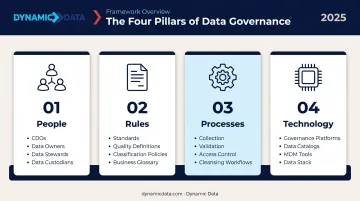
None of these pillars functions in isolation. Governance platforms without accountable owners fail. Policies without enforcement processes stay theoretical. When any pillar is missing, the gaps tend to show up where it hurts most — in audits, in analytics accuracy, or in a compliance incident.
Why Enterprise Data Governance Is a Strategic Priority
Data Quality, Decision-Making, and AI Readiness
Governed data directly improves forecasting accuracy, cross-team communication, and the quality of strategic decisions. But the urgency has intensified with the rise of AI.
Gartner predicts that 60% of organizations will fail to realize anticipated AI value by 2027 because of incohesive data governance frameworks. The same research found at least half of generative AI projects were abandoned after proof of concept — frequently because the underlying data couldn't support the model.
AI models are only as reliable as the data feeding them. Ungoverned data introduces:
- Inconsistent training inputs that produce biased outputs
- Duplicate or conflicting records that corrupt model predictions
- Undocumented data transformations that make audit trails impossible
- Missing values that reduce model accuracy without warning
Governance is what separates an AI investment that scales from one that stalls at the proof-of-concept stage.
Regulatory Compliance and Legal Exposure
Enterprises operating across jurisdictions face a patchwork of overlapping requirements. NCSL reported that 49 states and DC introduced or considered over 800 consumer privacy bills in 2025 — and that's before accounting for federal regulations and international frameworks.
The enforcement record demonstrates the cost of non-compliance:
- Meta Ireland: €1.2 billion GDPR fine in 2023 for unauthorized data transfers
- Anthem: $16 million HIPAA settlement in 2018 following the largest U.S. health data breach at the time
- Sephora: $1.2 million CCPA settlement in 2022
A governance program creates the documented policies, access controls, and audit trails needed to demonstrate compliance — and to respond quickly when regulators ask questions.
The Cost of Staying Ungoverned
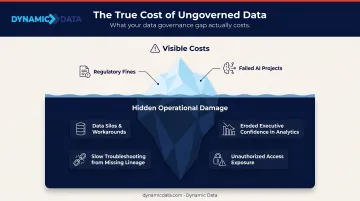
Regulatory fines and failed AI projects are the visible costs. The operational damage runs deeper:
- Data silos force teams into workarounds that compound inconsistency over time
- Conflicting reports erode executive confidence in analytics outputs
- Missing data lineage makes troubleshooting slow and expensive
- Unauthorized access exposes sensitive data before anyone notices it's happening
Core Components of an Enterprise Data Governance Framework
Data Ownership and Stewardship
Named ownership is what separates a governance program that functions from one that exists only on paper. The accountability hierarchy works like this:
- Chief Data Officer (CDO) — owns the governance program and sets strategic direction
- Data Owners — accountable for specific domains (customer data, financial data, product data)
- Data Stewards — handle day-to-day quality assurance, issue resolution, and policy adherence
- Data Custodians — manage the technical infrastructure: storage, access controls, and security
Each role needs documented responsibilities, not just titles. RACI matrices and written charters are what turn a governance org chart into daily practice.
Data Policies, Standards, and a Business Glossary
Three distinct artifacts do different jobs here:
- Data policies define how data should be collected, classified, stored, shared, and eventually retired
- Data quality standards specify what "good data" means per domain — acceptable completeness thresholds, formatting rules, update frequency requirements
- A business glossary establishes shared definitions across the enterprise, so "active customer" means the same thing in Finance as it does in Marketing
That last artifact matters more than most teams expect. Reporting discrepancies are often definitional, not technical. Two dashboards showing different revenue figures because two teams count differently points to a governance gap, not a data engineering flaw.
Metadata Management and Data Lineage
Metadata management creates a centralized inventory of every data asset: its origin, format, update frequency, owner, and classification. Data lineage tracks how that data flows and transforms as it moves across systems.
Together, these capabilities make data:
- Discoverable — teams can find assets without hunting through multiple systems
- Auditable — every transformation is traceable back to its source
- Easier to troubleshoot — when a model produces a suspicious output or a report shows an unexpected number, lineage documentation tells you exactly where to look
Data Quality Management
Quality management isn't a one-time cleanup. It's an ongoing cycle:
- Profile data to understand its current state
- Validate against defined standards
- Monitor for drift, errors, and anomalies
- Cleanse when issues are detected
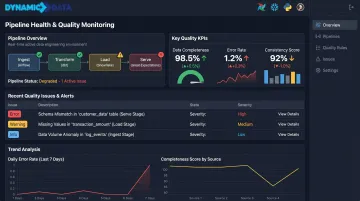
Organizations should establish measurable quality KPIs — error rates, completeness scores, consistency metrics — and review them on a regular cadence. Dynamic Data's data quality engineering practice builds automated testing directly into data pipelines using dbt, catching problems before they reach end users.
Technology Infrastructure
The right technology stack depends on the organization's existing architecture and maturity level. Core categories include:
- Governance platforms and data catalogs — Microsoft Purview, Google Knowledge Catalog — for policy enforcement, asset discovery, and lineage visualization
- Master Data Management (MDM) tools — SAP MDG and similar — for maintaining a single source of truth on core entities like customers, suppliers, and products
- Modern data stack tools — cloud warehouses (Snowflake, BigQuery, Databricks), transformation layers (dbt), and BI tools (Tableau, Power BI, Looker) — for building governed, analytics-ready data pipelines
Dynamic Data's team holds multiple dbt Certified Developer credentials and works across Snowflake, BigQuery, Azure, and Databricks — platforms where governance architecture decisions have direct consequences for downstream analytics and AI reliability.
How to Build and Implement an Enterprise Data Governance Program
Step 1 — Define the Mission and Tie It to Business Objectives
Before any tooling or policy work begins, define what success looks like. Faster decision-making or fewer compliance incidents? AI-ready data pipelines? The answer shapes every subsequent decision.
Secure executive sponsorship at this stage. McKinsey's research on governance excellence identifies top management attention as a non-negotiable success factor — governance without leadership commitment stalls as soon as it asks business units to change behavior.
Step 2 — Audit the Current Data Landscape
Map what exists before designing what should exist:
- Inventory all systems, data sources, and domains
- Document where data lives, who accesses it, and how it flows between systems
- Identify gaps: redundant databases, missing metadata, inconsistently defined fields, undocumented transformations
This audit becomes the baseline for measuring governance progress. Without it, you can't demonstrate improvement — and you can't prioritize where to start.
Step 3 — Establish the Governance Structure and Assign Accountability
Stand up a data governance council, chaired by the CDO or equivalent, to make policy and resourcing decisions. Below that:
- Advisory groups gather practitioner input from business units
- Domain working groups own governance within specific areas (customer data, finance, product)
Document charters and role assignments in writing. Define escalation paths for when data quality issues or policy conflicts surface. Governance frameworks that exist only in people's heads don't survive staff turnover.
Step 4 — Start With a Minimum Viable Project in One High-Value Domain
Launching governance organization-wide simultaneously almost always fails. The scope overwhelms teams, and early stumbles undermine credibility before the program gains any traction.
Instead, choose one domain where data quality problems are creating real business pain — customer data, financial reporting, or operational data are common starting points. Implement governance there first, measure the results, and use early wins to build internal momentum before scaling.
Dynamic Data works with organizations at exactly this stage — helping teams identify the right starting domain and structure the initial project so early results translate into a model the rest of the organization can adopt.
Step 5 — Monitor, Measure, and Iterate Continuously
Establish governance KPIs:
- Data quality: accuracy rates, completeness scores, error frequency
- Compliance: audit findings, breach incidents, policy adherence rates
- Adoption: steward participation, governance tool usage
- Business impact: decision-making speed, reduction in data-related rework
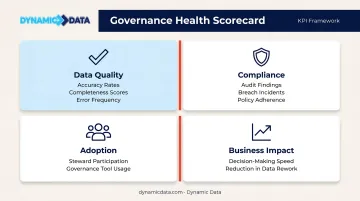
Set a regular cadence for governance health reviews — quarterly at minimum. Build feedback loops so policies evolve alongside new regulations, expanding data systems, and changing business priorities. Programs that treat governance as a one-time implementation tend to decay within 18 months as data systems evolve and the policies governing them don't.
Common Enterprise Data Governance Challenges
Data Silos and Fragmented Sources
Harvard Business Review identifies access to data — not skill or technology — as the biggest obstacle to advanced data analysis. Enterprises that have grown through acquisitions often have dozens of disconnected systems, each with its own data definitions and formats.
Governing across these environments requires cataloging every source, establishing integration standards, and resolving conflicting definitions before quality can be enforced at scale.
Dynamic Data's data engineering practice tackles this by connecting disparate sources into a single, governed data layer — removing the fragmentation that makes consistent governance enforcement nearly impossible.
Regulatory Complexity Across Jurisdictions
UNCTAD tracks data protection and privacy legislation across 195 countries. ISACA's 2026 State of Privacy report found 62% of privacy teams cite compliance challenges as a primary concern, while 61% report resource shortages.
The challenge isn't just keeping up with regulations — it's keeping governance policies aligned with requirements that change at different speeds across federal, state, and international frameworks. Three principles help teams stay ahead:
- Embed compliance requirements into the governance architecture from day one, not after enforcement risk surfaces
- Map regulatory obligations by jurisdiction so policy owners know exactly which rules apply where
- Build audit trails into data pipelines rather than reconstructing them during reviews
Change Management and Stakeholder Buy-In
Governance requires behavioral change across every business unit. Resistance from teams that hoard data, units that push back on new standards, or executives who don't see immediate ROI is one of the most common reasons programs stall.
What works:
- Early listening sessions with business unit leads to surface concerns before implementation
- Clear communication that frames governance in terms of business outcomes, not policy compliance
- Small, visible wins that demonstrate value before asking for organization-wide commitment
McKinsey's research reinforces this: governance programs that lack executive sponsorship and measurable business outcomes rarely move beyond policy documents on a shared drive.
Best Practices for Sustainable Enterprise Data Governance
Sustainable governance programs share a few consistent traits — and they're not complicated. They're just consistently overlooked.
Document everything in searchable, maintained systems. Standards, lineage, glossaries, and processes need to live in documented repositories — not in individual contributors' heads. Governance frameworks that depend on institutional memory break down through staff turnover, reorganizations, and system migrations.
Assign named owners for every domain, policy, and quality metric. Without clear accountability, governance becomes everyone's responsibility in theory and no one's in practice. Tie ownership directly to KPIs and business outcomes so governance can demonstrate measurable ROI.
Treat AI and analytics readiness as a design requirement, not an afterthought. Governed data needs to be structured, well-documented, and ready to flow into analytics dashboards, reporting pipelines, and machine learning workloads. Cloud warehouses, transformation layers like dbt, and BI platforms should be integrated into governance architecture decisions from day one. Retrofitting them later creates technical debt and compliance gaps.
Frequently Asked Questions
What is enterprise data governance?
Enterprise data governance is the organization-wide framework of people, policies, processes, and technology used to ensure data is accurate, secure, compliant, and consistently managed across all departments and systems throughout its lifecycle. It defines who owns data, how it should be handled, and how quality and compliance are enforced and measured.
Is MDG part of SAP?
Yes. SAP Master Data Governance (MDG) is a native module within SAP S/4HANA used to consolidate and govern master data across the organization. It's one platform-specific tool within a broader category — enterprise data governance can also be implemented using non-SAP or multi-platform approaches depending on your architecture.
What is the difference between data governance and data management?
Data governance sets the policies, standards, and accountability structures that define how data should be handled. Data management is the operational execution of those policies — storing, integrating, transforming, and maintaining data according to governance rules. Governance defines the rules; data management carries them out.
How do you measure the success of a data governance program?
Success is measured across four categories:
- Data quality: accuracy, completeness, and consistency scores
- Compliance: audit findings and breach incidents
- Adoption: steward participation and policy adherence rates
- Business impact: decision-making speed and reduction in data-related rework
Tracking all four together gives a complete picture of program health.
What are the biggest challenges in enterprise data governance?
The most common obstacles are organizational, not technical:
- Data silos across business units and legacy systems
- Unclear ownership and accountability
- Lack of executive sponsorship
- Resistance to behavioral change
Programs that focus only on tooling consistently underperform because these root causes go unaddressed.
When should a company work with a data governance services partner?
A partner adds the most value when launching a governance program for the first time, modernizing a data stack, or when data quality issues are blocking analytics or AI initiatives. Organizations without deep internal expertise in governance frameworks or compliance requirements tend to move faster and avoid costly missteps with external specialists involved early.