Introduction
Most organizations are sitting on more data than they know what to do with. According to Seagate's Rethink Data report, 68% of enterprise data goes unleveraged — largely because organizations lack the structures to trust and use it effectively.
The root cause is a gap between strategy and execution. Companies invest in data infrastructure without clearly defining who owns the rules, who enforces them, or how the two connect.
That gap usually comes down to a misunderstanding of two core concepts: data governance and data stewardship. They're often used interchangeably, but they operate at completely different levels. Treating them as the same thing is one of the most common reasons data programs underdeliver.
Understanding the distinction — and how the two work together — is the first step toward building a data program that actually delivers.
Key Takeaways
- Data governance is the strategic framework: the policies, standards, and decision rights that define how data is managed organization-wide.
- Data stewardship is the operational execution: the day-to-day practices that implement those governance policies and maintain data quality.
- Stewardship is a component within governance, not a separate or competing discipline.
- Organizations need both to ensure data is trustworthy, compliant, and fit for decision-making.
What Is Data Governance?
Data governance is an organization-wide framework that establishes the policies, processes, standards, and roles needed to manage data quality, accessibility, security, and compliance across the full data lifecycle. As IBM describes it, governance defines and implements the rules for how data is collected, owned, stored, processed, and used.
The Three Core Pillars
| Pillar | What It Addresses |
|---|---|
| Data Quality | Accuracy, completeness, and reliability of data across systems |
| Data Security & Compliance | Protecting data and meeting regulations like GDPR, CCPA, and HIPAA |
| Data Access & Accountability | Who can see, use, and be held responsible for which data |
These pillars don't operate in isolation. A gap in any one of them affects the others — poor access controls create compliance exposure, and inconsistent quality undermines analytics.
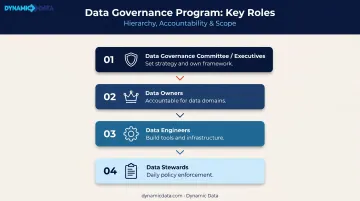
Key Roles in a Governance Program
- Data governance committee / executives — set organizational data strategy and own the framework
- Data owners — hold accountability for specific data domains and their strategic value
- Data engineers — integrate the tools and infrastructure that support governance policies
- Data stewards — handle daily enforcement of those policies at the ground level
Why Governance Matters Beyond Compliance
Governance isn't just a compliance checkbox. A 2024 survey of 565 data and analytics professionals found that organizations investing in data governance programs reported improved data quality (58%). The same research found that 62% of organizations cited lack of data governance as the primary challenge inhibiting AI initiatives.
Without governance, analytics programs produce unreliable outputs, AI models train on bad data, and every downstream decision inherits that risk.
What Data Governance Actually Governs
In practice, governance reaches further than policy documents. It directly controls four operational areas:
- Decision rights — who has authority to make choices about data
- Controls — mechanisms to detect and mitigate data risk
- Policies and standards — how data is classified, transformed, and retained
- Data products and datasets — the actual assets flowing through the organization
What Is Data Stewardship?
Data stewardship is the operational practice of implementing and maintaining the policies set by the governance framework. A data steward is the "operational arm" of governance — someone who works directly with data assets day to day, rather than setting strategy from above.
Core Day-to-Day Responsibilities
A data steward's work covers:
- Managing metadata and data definitions
- Enforcing data quality rules and monitoring for violations
- Monitoring access permissions and flagging anomalies
- Resolving data inconsistencies across systems
- Maintaining documentation — data dictionaries, business glossaries, data lineage records
This is hands-on, continuous work. It doesn't happen in quarterly governance reviews; it happens every time a dataset changes, a new source gets ingested, or a business user raises a discrepancy.
Data Steward vs. Data Owner — Not the Same Role
This distinction matters. A data owner is a senior stakeholder who is ultimately accountable for a data domain and its strategic value. A data steward is operationally responsible for enforcing governance policies within that domain. Both roles serve distinct functions and neither replaces the other.
Mixing up the two creates accountability gaps — either no one is actually managing the data day-to-day, or the wrong person is making strategic decisions about it.
Consequences of Poor Stewardship
When stewardship is absent or underfunded, the effects compound quickly:
- Data quality deteriorates without consistent monitoring
- Compliance violations become likely as policy enforcement lapses
- Data silos grow as teams develop their own informal standards
- Trust in data erodes, and teams stop relying on it for decisions
Unmanaged data actively works against you. McKinsey's research found that poor data quality and availability caused organizations to spend an average of 30% of enterprise time on non-value-added tasks.
Types of Data Stewards
Stewardship roles vary significantly by scope:
- Business data stewards — embedded in specific departments, focused on business context, definitions, and domain-specific quality
- Technical data stewards — focused on data infrastructure, pipelines, and metadata management
- Enterprise data stewards — cross-functional, responsible for governance consistency organization-wide
Most organizations need all three working in concert. The business steward defines what the data means in context; the technical steward ensures it flows correctly through systems. The enterprise steward's job is to keep both aligned with the broader governance framework.
Data Governance vs. Data Stewardship: Key Differences
The clearest way to frame this: governance defines the what and why at an organizational level; stewardship defines the how at an operational level.
Governance is the laws of the road — speed limits, right-of-way, acceptable behavior. Stewardship is the traffic enforcement that makes those laws real in daily practice. One without the other breaks down fast: unenforced policies drift into irrelevance, and enforcement without policy becomes inconsistent.
Side-by-Side Comparison
| Dimension | Data Governance | Data Stewardship |
|---|---|---|
| Definition | Framework of policies, standards, and decision rights | Day-to-day management and enforcement of those policies |
| Scope | Organization-wide | Domain or department-specific |
| Focus | Setting standards and accountability structures | Maintaining data quality and policy compliance |
| Accountability | Owns the framework itself | Owns specific data assets within the framework |
| Roles | Governance committee, executives, data owners | Data stewards, working alongside data owners |
The Risk of Having One Without the Other
Both gaps carry real consequences:
- Governance without stewardship — well-documented policies that nobody enforces. The framework exists in a SharePoint folder while the actual data drifts out of compliance.
- Stewardship without governance — individuals managing data without consistent direction. Every team develops different standards, and there's no single source of truth.
Neither scenario produces trustworthy data. Gartner predicts that by 2027, 80% of data and analytics governance initiatives will fail — and much of that failure traces back to exactly this misalignment between strategy and execution.
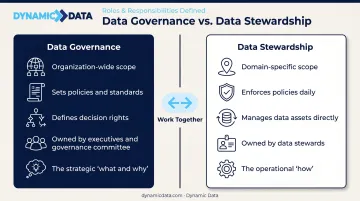
Data stewardship isn't a competing discipline — it's a set of roles and practices nested within the governance framework. The confusion stems from stewardship being the most visible, hands-on part of any governance program, and visibility often gets mistaken for independence.
How Data Governance and Data Stewardship Work Together
Consider a practical scenario: a marketing team wants to use customer data for a new campaign.
Here's how governance and stewardship interact in that moment:
- The governance framework defines what customer data can be used for, what approvals are required, and what regulatory constraints apply (CCPA opt-outs, GDPR consent records, etc.)
- The data steward receives the request, validates whether the specific dataset complies with those policies, checks data quality and completeness, and either approves access or flags a gap back to the governance committee
- The governance committee uses that flag to update policy if needed — closing a gap the steward surfaced from real-world use
This feedback loop is what keeps governance from becoming stale. As data environments, regulations, and business needs change, stewards surface real-world issues upward. Governance responds by updating policies, keeping the program relevant as conditions shift. This is an ongoing cycle, not a one-time setup.
Why This Matters for AI and Machine Learning
That governance-stewardship feedback loop becomes especially high-stakes in AI and ML contexts. Governance frameworks must vet and approve the data used to train models. Stewards ensure that data lineage (the record of where data originated and how it's been transformed), quality, and compliance are maintained as AI systems ingest and transform data at scale.
The numbers reflect the stakes: at least 50% of generative AI projects were abandoned after proof of concept by the end of 2025, largely due to poor data quality and inadequate risk controls. Gartner also predicts that 60% of organizations will fail to realize the anticipated value of their AI initiatives by 2027 because of weak data governance frameworks.
For teams building ML solutions on platforms like Snowflake, Databricks, and dbt, this pattern shows up consistently: models trained on poorly governed data produce unreliable outputs — regardless of how sophisticated the modeling itself is. Strong stewardship practices are what close that gap before it becomes a production problem.
Why Both Matter for Your Business
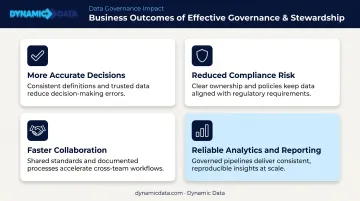
The combined value of governance and stewardship isn't abstract. It shows up directly in business outcomes:
- More accurate decisions — teams use data they trust, rather than defaulting to gut instinct or spreadsheets
- Reduced compliance risk — clear policies and active enforcement prevent violations before they become regulatory events
- Faster collaboration — shared definitions and standards eliminate the "which version of this metric are we using?" friction
- More reliable analytics and reporting — dashboards reflect reality, not data noise
The cost of getting this wrong is measurable. According to Gartner research, poor data quality costs organizations at least $12.9 million per year on average.
For companies scaling data infrastructure, adopting AI tools, or integrating new data sources, having governance (the roadmap) and stewardship (the implementation) in place from the start prevents costly rework and data debt. This is the core of how Dynamic Data approaches governance engagements: establishing frameworks that enforce data integrity, standardize ownership, and ensure compliance, so organizations have an auditable foundation before they build further on top of it.
Governance and stewardship aren't exclusively enterprise concerns either. A mid-market company with three data sources and a small analytics team still needs clear data policies and accountable ownership — particularly as privacy regulations grow broader and stricter.
Frequently Asked Questions
What is the difference between data stewardship and data governance?
Governance is the strategic framework — it defines the policies, standards, and accountability structures for managing data organization-wide. Stewardship is the operational execution of those policies, carried out by data stewards working directly with data assets. Stewardship exists within governance, not alongside it as a separate discipline — and data stewards are the "who" that makes governance work in practice, not just on paper.
What are the main pillars of data governance?
The three core pillars are: data quality (accuracy and reliability), data security and compliance (protecting data and meeting regulations like GDPR, CCPA, and HIPAA), and data access and accountability (defining who controls and uses data and under what conditions).
What tools or platforms support data governance?
Common tools include data cataloging platforms (like Alation or Collibra), metadata management systems, and data quality monitoring solutions. The right stack depends on your existing infrastructure — organizations on Snowflake, Databricks, or BigQuery each have native and third-party options that integrate directly into their pipelines.
What is the role of a data steward?
A data steward manages the day-to-day quality, metadata, access permissions, and compliance of data assets within a specific domain. They bridge business users and technical teams — enforcing governance policies and escalating anything that requires a policy-level decision.
What are the risks of having poor data governance?
Without governance, organizations face deteriorating data quality, regulatory non-compliance, security vulnerabilities, fragmented data silos, and analytics that can't be trusted. In practice, this means executives making strategic calls on dashboards that contradict each other — and no clear owner responsible for fixing it.
How does data governance support AI and machine learning initiatives?
Governance frameworks ensure AI models are trained on vetted, high-quality, and compliant data. Stewardship maintains data lineage and quality as AI systems transform and consume data in volume — without it, model outputs are only as trustworthy as the pipelines feeding them, which is why weak governance is one of the leading causes of AI project failure.