Introduction
Real estate professionals aren't short on data. MLS feeds, ownership records, mortgage filings, foreclosure data, demographic layers — the sources exist. The struggle is that none of it connects by default, leaving teams to bridge the gaps manually.
Most teams end up with property records sitting in one system, CRM data in another, and valuation outputs in a spreadsheet someone updates manually every Friday. Decisions get made on information that's three weeks old, reconciled by hand, and stored in formats that no analytics tool can readily consume.
The global real estate software market is projected to reach $31.96 billion by 2033, growing at 12.2% annually. That spending is going toward consolidation tools, integration platforms, and data pipelines — because more software alone hasn't fixed the fragmentation problem.
This guide covers the services and platforms that go beyond selling data access — focusing on those that actively integrate real estate data into operational workflows, analytics pipelines, and business systems. It also covers what to ask when evaluating them.
Key Takeaways
- Real estate data integration connects MLS feeds, property records, mortgage data, and more into a unified format your systems can use
- Three primary service models exist: raw API/bulk data providers, automated workflow platforms, and custom integration partners
- Evaluate providers on data freshness, delivery format compatibility, entity resolution quality, and licensing terms
- Custom partners like Dynamic Data suit teams reconciling three or more disconnected sources or running proprietary analytics on integrated data
What Is Real Estate Data Integration?
Real estate data integration is the process of connecting, normalizing, and standardizing data from multiple sources into a unified format that business systems can actually use. Those sources typically include MLS feeds, public property records, ownership records, mortgage data, foreclosure filings, and demographic data.
It's worth separating two things that often get conflated:
| Term | What It Means |
|---|---|
| Data Provider | Sells access to a dataset — you get the raw feed |
| Data Integration Service | Handles extraction, transformation, normalization, and delivery into your operational systems |
The distinction matters. A data provider gives you the ingredients. An integration service turns those ingredients into something your CRM, data warehouse, or analytics dashboard can consume without manual intervention.
Why Fragmented Data Is a Real Operational Cost
Decisions built on stale or manually reconciled data carry compounding risk. A valuation model running on ownership records that are 60 days behind can miss recent transfers, LLC restructurings, or new encumbrances. An outreach workflow pulling from a CRM that isn't synced with foreclosure filings will generate lists that don't reflect current distress signals.
The costs show up in deal velocity, model accuracy, and the hours analysts spend reconciling records instead of building insights. Real estate firms that replace retrospective, manually patched data with properly integrated feeds gain a measurably clearer view of risk and opportunity — before decisions are locked in.
Types of Real Estate Data Integration Services
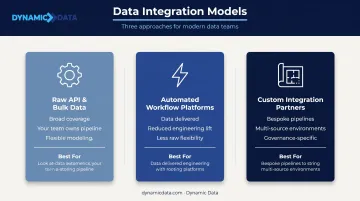
Before evaluating vendors, identify which integration model fits your team. Three primary models dominate the market.
Raw Data Access and API Platforms
These providers — ATTOM, HouseCanary, Zillow via API — deliver structured data feeds covering property records, ownership, AVMs, foreclosures, and mortgage history. You get the data; your team builds the pipeline.
Strengths:
- Broad geographic coverage and consistent schema
- Predictable update cadence
- Flexibility to model data however your team needs
Limitations:
- Your engineering team owns the ETL/ELT pipeline
- Schema normalization across county sources requires internal effort
- System integration into downstream tools (CRM, warehouse, dashboards) is your responsibility
This model works well for PropTech companies, lenders, and data science teams with dedicated engineering capacity.
If your team lacks that capacity — or would rather focus on decisions than pipeline maintenance — the next model takes a different approach.
Automated Workflow Intelligence Platforms
These platforms handle sourcing, validation, enrichment, and delivery — the data arrives in your CRM or data warehouse without internal pipeline work. Forage AI operates in this space, continuously processing and structuring property-related datasets for operational use.
Considerations:
- Less flexibility for teams that need raw data for custom modeling
- Reduced operational burden for teams focused on outreach and decision workflows
- Best for organizations that need data delivered, not data they want to transform themselves
When neither off-the-shelf APIs nor managed platforms can accommodate your environment, a custom-built solution becomes the practical path.
Custom Data Integration and Engineering Partners
Specialized data engineering firms design and build bespoke pipelines tailored to a specific organization's sources, systems, and reporting requirements. This model fits organizations with complex, multi-source data environments — multiple MLS feeds, third-party property APIs, internal portfolio tools, and CRM systems that all need to talk to each other.
When this model wins:
- Off-the-shelf platforms can't accommodate proprietary scoring logic
- Data governance requirements are organization-specific
- Reporting structures are complex enough that no SaaS tool can generate them out of the box
The trade-off is timeline and upfront investment — these engagements take longer to scope and build than activating an API subscription.
Top Services That Offer Real Estate Data Integration
The right fit depends on your team's technical resources, use case, and existing infrastructure.
API and Bulk Data Providers
ATTOM covers more than 160 million U.S. properties, offering a RESTful API, bulk licensing, and cloud delivery options including Snowflake and Databricks. It's well-suited for enterprise PropTech teams, lenders, and data science teams that want to build integration pipelines on a nationwide standardized dataset. Coverage is broad, but teams must own the normalization and pipeline work themselves.
HouseCanary is built API-first, with documented REST endpoints, 75+ data points per property, and 36-month property value forecasting models. Its AVMs are updated monthly with real-time market data. Particularly strong for SFR investors, lenders, and fintech teams that need property-level valuation data embedded directly in their own systems.
Automated Workflow Intelligence Platforms
Forage AI automates the scraping, cleaning, and structuring of property-related datasets — permits, ownership records, and other property-market data — for real estate investors and teams that need data delivered rather than raw feeds to process. It offers both real-time and historical property datasets with customizable fields, cutting the internal engineering lift for teams without dedicated data infrastructure.
Bright Data offers Real Estate Scraper APIs covering 21 real estate sites including Zillow, Zoopla, and Realtor, with pre-collected datasets from 12 sources containing over 300 million records. Structured output is delivered via JSON, CSV, or Parquet to S3, GCS, Snowflake, Azure, or other destinations.
That said, meaningful internal effort is still required to transform raw outputs into operational intelligence.
Custom Real Estate Data Integration Partners
Custom integration partners design pipelines that connect MLS feeds, third-party property APIs, internal CRMs, and portfolio management tools into a governed, automated architecture — typically using modern data stack tools like dbt, BigQuery, Snowflake, and cloud-native orchestration layers.
Dynamic Data is one such partner, having built real estate data infrastructure for clients including Rob Ramsdell of Gibson Sotheby's International Realty in Boston. For that engagement, Dynamic Data built a BigQuery-based architecture that kept market reports continuously updated, with real-time visualizations embedded directly in the client's website.
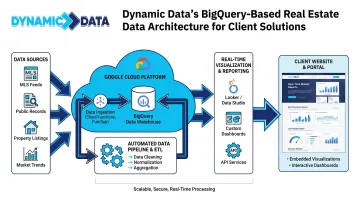
Ramsdell was subsequently recognized among the top 1.5% of real estate professionals nationwide — with data becoming a core part of client presentations and marketing.
Dynamic Data's team includes dbt Certified developers and covers the full stack across:
- Pipeline engineering and ETL/ELT architecture
- Data warehousing on BigQuery, Snowflake, and Databricks
- Visualization and reporting in Tableau and Looker Studio
How to Evaluate a Real Estate Data Integration Service
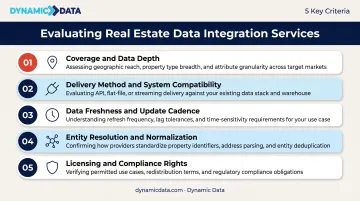
Five criteria separate adequate services from genuinely useful ones.
1. Coverage and Data Depth
Ask specifically about geographic coverage by county, property type, and data category. A service claiming 99% U.S. population coverage may still have meaningful gaps in rural markets, commercial assets, or secondary property classes. Request sample data for your specific target markets before signing.
2. Delivery Method and System Compatibility
Whether data arrives via API, bulk export, cloud warehouse share, or managed feed changes your integration architecture significantly. Verify that the delivery model matches your existing infrastructure — a team running on Snowflake needs different delivery than one running on BigQuery or a local PostgreSQL instance.
3. Data Freshness and Update Cadence
Data freshness is the most underestimated criterion in procurement. Ask vendors specifically:
- How frequently is each dataset updated (not the platform — each dataset)?
- What's the lag between a public record event and its appearance in the feed?
- Are update schedules guaranteed by SLA?
Stale data creates downstream model risk. A foreclosure filing that takes 45 days to surface in your feed is effectively invisible during that window.
4. Entity Resolution and Normalization Methodology
According to FinCEN's residential real estate rules, a large share of residential property ownership runs through LLCs, trusts, and shell companies — structures that obscure beneficial ownership by design. How a service handles these entities, deduplicates records across county sources, and maintains consistent property identifiers across updates is critical for any workflow that depends on ownership intelligence.
Most vendors don't publish this methodology. Ask directly.
5. Licensing, Compliance, and Redistribution Rights
Teams building mortgage products, insurance workflows, or regulated applications must confirm permitted downstream use in writing before signing. Key compliance considerations include:
- GDPR: Requires careful handling of owner data from property registers; penalties reach €20 million or 4% of group turnover
- CCPA: Generally excludes publicly available government records, but derived or enriched data occupies a gray area
- Redistribution rights: Confirm in writing what downstream use is permitted before signing
The line between raw public records and enriched data isn't always clean. Have legal review the contract before assuming compliance.
Building a Unified Real Estate Data Stack
Managing multiple data providers, CRM records, portfolio tools, and reporting feeds through point-to-point integrations breaks down fast. The practical long-term architecture is a central cloud data warehouse as the hub, with automated pipelines delivering normalized feeds from every source.
When a Custom Partner Adds the Most Value
Off-the-shelf platforms handle straightforward use cases well. Custom integration partners earn their place when:
- Data reconciliation spans three or more disconnected tools
- Proprietary scoring or underwriting models need to run on integrated, cleaned data
- Reporting logic is specific enough that no SaaS platform generates it out of the box
- Governance requirements mandate specific data lineage or access controls
Dynamic Data builds these unified stacks for real estate clients. That means connecting MLS data, property records, CRM exports, and third-party APIs into a single automated architecture, with dbt-certified data modeling handling the transformation layer.
A Practical Audit Framework to Start
Before engaging any service or partner, do this:
- Identify your two or three most critical data sources — the feeds your valuations, outreach, or reporting actually depend on
- Confirm the delivery method and refresh cadence for each, and document where the current gaps are
- Map how those feeds connect (or fail to connect) to the systems where decisions get made — valuation models, CRMs, dashboards
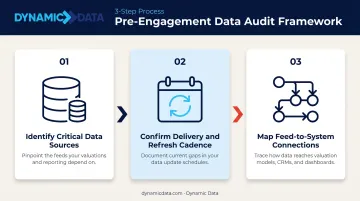
This audit surfaces the integration gaps that matter most and gives any partner or vendor a clear scope to work from.
Frequently Asked Questions
What is real estate data integration?
Real estate data integration connects and standardizes data from multiple sources — MLS feeds, property records, mortgage data, foreclosure filings — into a unified format that business systems can use directly. The goal is eliminating manual reconciliation and making data available where decisions happen.
What's the difference between a real estate data provider and a data integration service?
A data provider sells access to a dataset. A data integration service handles the full pipeline — extracting, transforming, normalizing, and delivering data into your operational systems, removing the need for your team to build and maintain that infrastructure yourself.
What types of real estate data can be integrated?
The main categories include MLS and listing feeds, public property records (ownership, deeds, tax assessments), mortgage and lien data, foreclosure filings, demographic and neighborhood data, and AVM or valuation outputs.
How do real estate APIs support data integration workflows?
APIs are the technical mechanism by which data is requested and delivered programmatically into applications, analytics platforms, or data warehouses. API quality, documentation depth, and rate limits all directly affect how easy integration is to build and maintain over time.
What should I look for in a real estate data integration partner?
The five most important criteria:
- Data coverage and freshness by dataset
- Delivery method compatibility with your infrastructure
- Entity resolution quality
- Licensing and redistribution rights
- Direct experience with your use case (residential, commercial, rental, or institutional)
How much does real estate data integration typically cost?
Costs vary by delivery model. API providers like HouseCanary start around $19/month for consumer tiers, with enterprise pricing negotiated per contract. Automated workflow platforms and custom integration partners are typically project-based with ongoing maintenance fees. Request documented SLAs and refresh cadence alongside any pricing proposal.