According to Dun & Bradstreet, B2B contact data accuracy erodes by 2.5% per month — roughly 30% per year. That decay rate alone means a CRM that was reasonably clean 12 months ago may now be a third unreliable. Layer automated enrichment tools and AI-powered workflows on top, and errors don't just persist — they compound.
GTM data architecture consulting is the discipline of fixing this at the structural level. This article covers what it actually is, which failure modes signal you need it, and what a consulting engagement looks like in practice.
Key Takeaways
- GTM data architecture defines how revenue-critical data flows between your CRM, enrichment tools, sequencers, and analytics platforms
- Without it, automations misfire, routing fails, and no two teams agree on what the data says
- A consultant audits your stack, designs the data model and orchestration logic, and builds governance rules that stick
- Warning signs: enrichment tools overwriting each other, leads routed to the wrong rep, reps spending time fixing data manually
- Choose a consultant based on governance orientation and stack depth — not just the tools they know
What GTM Data Architecture Is (and Isn't)
GTM data architecture is the deliberate design of how revenue-critical data is structured, stored, moved, validated, and acted upon across every tool in your sales, marketing, and customer success stack.
That's different from simply "having a CRM and some integrations." Architecture implies intentional rules: which enrichment source wins when two conflict, in what order automations fire, what validation gates record creation, and who owns data quality decisions over time.
GTM Architecture vs. GTM Engineering
A GTM engineer builds and runs automated revenue plays — sequences, routing workflows, enrichment triggers. GTM data architecture is the infrastructure those plays run on. Strong engineering on a weak architecture produces inconsistent results — the plays can't perform better than the data underneath them.
This distinction matters more now than it did two years ago. AI-powered enrichment APIs, automated routing engines, and field normalization tools write to your CRM more autonomously than ever. Without architecture that governs which source wins, in what order workflows fire, and what gets validated before a record moves downstream, these tools don't improve accuracy. They spread errors faster.
The core questions GTM data architecture answers:
- Which data source takes precedence when two enrichment tools return conflicting values?
- In what order do automations fire to prevent downstream overwrites?
- What validation logic must pass before a record is created or promoted?
- Who owns data quality decisions — and how are they enforced over time?
The emerging "Revenue Architect" or "GTM Architect" role exists precisely because someone needs to own this layer. In most companies, nobody does.
The Three Layers of GTM Data Architecture
Most companies intentionally design one layer and leave the other two to chance. Understanding all three is what separates a GTM system that scales from one that breaks under pressure.
The Data Layer
This is where data lives and how fresh it is. It includes:
- CRM data model design — object structures, field definitions, validation rules
- Data warehouse architecture — how Snowflake, BigQuery, or similar platforms store and surface revenue data
- Enrichment pipeline structure — which tools enrich which fields, and when
- Identity resolution logic — how the same account appears across tools without creating duplicates
Data completeness and freshness here determine the accuracy of every downstream play. Salesforce has noted that the average customer contact database is 90% incomplete, with more than 25% of records being duplicates.
If that's what your enrichment and routing logic is operating on, no workflow fix solves it.
The Orchestration Layer
Orchestration governs how data moves between systems and in what sequence. This is where most architectures fail.
The sequencing must follow a specific order:
- Enrichment runs first — so matching and routing have accurate firmographic data to work with
- Lead-to-account matching runs second — so a lead is correctly associated before territory logic fires
- Territory and hierarchy resolution runs third — so parent-child account structures are resolved before routing
- Routing fires last — on clean, matched, resolved data
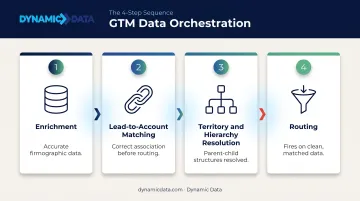
Wrong sequencing produces errors that propagate downstream and become invisible until a deal breaks. A lead routed before matching runs lands on the wrong rep. When enrichment fires after routing, the record is already assigned — and the error it caused goes uncorrected.
Source-of-truth precedence rules also live here. When two enrichment providers disagree on an account's employee count or industry, which one wins? Without a documented rule, the answer is whichever one ran most recently — which is no governance at all.
The Execution Layer
This is where most teams focus: email platforms, sequencers, ad platforms, sales engagement tools.
The execution layer only performs reliably when the two layers beneath it are sound. When they aren't, reps override systems, sequences fire on bad data, and attribution becomes unreliable. The execution layer gets blamed for failures that originate two layers up.
Warning Signs Your GTM Data Architecture Is Failing
These four failure modes appear consistently in GTM organizations that have outgrown their original stack configuration.
Enrichment Conflicts and Field-Overwrite Chaos
When multiple enrichment tools write to the same CRM fields with no governance rule determining which source wins, the result is inconsistent data across records — different employee counts, wrong industry classifications, stale titles.
This is one of the most common and least visible failure modes. Clearbit's Salesforce documentation explicitly offers an "Always Overwrite" option that replaces existing field values with the latest data regardless of what was previously there. That's a legitimate configuration choice — but only if you've intentionally decided that Clearbit wins for that field.
If ZoomInfo also writes to the same field and neither has explicit precedence, both tools are fighting over the same real estate with no referee.
AI models trained or operating on those fields then make decisions based on conflicting inputs, compounding the error at every subsequent step.
Lead Routing Errors and Territory Misfires
Routing logic breaks in predictable ways. It fails when geography is read before account ownership is resolved, or when subsidiary accounts haven't been matched to their parent before the rule fires. The result: a prospect contacted by two reps with no shared context, or an enterprise signal landing on a mid-market SDR.
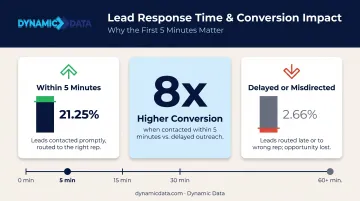
InsideSales/XANT research puts the conversion impact in stark terms — conversion rates are 8x higher when a lead is contacted within 5 minutes. Routing errors that delay or misdirect that first touch don't just create friction; they measurably reduce pipeline conversion.
No Single Source of Truth
Sales, marketing, and customer success teams each trust different systems — CRM, warehouse, BI tool — and reach different conclusions about the same accounts. Symptoms include:
- Conflicting pipeline reports going into the same leadership meeting
- Reps preparing for calls using data that differs from what marketing sees
- AI workflows trained on inconsistent inputs producing unreliable outputs
At that point, the real problem isn't disagreement between teams — it's that no single layer of the stack has earned enough trust to settle it.
Manual Intervention as the Default
Salesforce reported in 2022 that reps spend just 28% of their week actually selling, with the remainder consumed by tasks like deal management and data entry. When a meaningful share of that remaining time goes toward correcting automation errors, fixing bad records, or routing around system failures, that's the clearest diagnostic available: the architecture is broken, and the team has quietly built workarounds to survive it.
What GTM Data Architecture Consulting Actually Involves
A consulting engagement covers five distinct phases, each building on the last.
Stack Audit and Diagnostic
The engagement begins with mapping current state: what data exists in which tools, what integrations are active, what percentage of critical fields are populated, where workflows conflict, and where handoffs break down.
The goal is a functional gap analysis: what the current architecture can actually support versus what the GTM motion requires. Dynamic Data's assessment starts by understanding data sources and processing needs before designing any solution — and internal teams stay involved throughout discovery rather than receiving a predetermined answer at the end.
Data Model Design and CRM Architecture
This phase defines how objects relate in the CRM:
- Account hierarchies — parent-child structures that prevent subsidiary routing failures
- Lead-to-account matching rules — the logic that associates inbound leads with existing accounts before routing fires
- Contact vs. lead object logic — which records live where and why
- Field definitions and validation rules — what gates record creation and what keeps data clean at entry
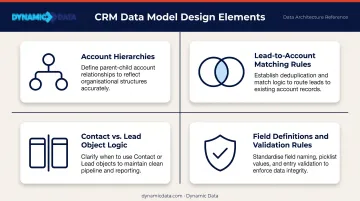
For B2B companies with complex account structures, parent-child hierarchy design is often the single change that resolves the most routing errors.
Integration Design and Orchestration Logic
This is where GTM strategy becomes executable rules. A consultant designs:
- Which enrichment source has field-level precedence for each data attribute
- The order in which automations fire (enrichment → matching → hierarchy → routing)
- How job changes, M&A events, or account merges cascade through the system
- What triggers enrichment versus what triggers routing
Translating strategic intent into executable logic is where the orchestration layer proves its value — or exposes its weaknesses.
Data Governance Framework
Governance establishes the policies that maintain data quality over time:
- Field-level validation standards and enrichment quality thresholds
- Ownership rules for data stewardship across teams
- Guidelines for what AI is permitted to write back to the CRM without human review
- Refresh schedules and decay monitoring
Dynamic Data's dbt Certified Developers, with expertise across 35+ platforms, build governance frameworks designed to hold as the GTM stack evolves. dbt is central to this: it enables automated data quality tests and transformation logic that enforce governance rules at the warehouse layer, not just at the CRM surface.
Implementation, Testing, and Handoff
A consulting engagement doesn't end at design. Implementation support includes:
- Building workflows in a sandbox environment before touching production
- Testing orchestration logic against real records to validate sequencing
- Confirming that routing fires only after matching and hierarchy resolution complete
- Documenting every governance rule, field ownership decision, and orchestration sequence
A well-structured handoff includes runbooks for the most common operational scenarios, ownership assignments for each data domain, and training for internal teams on governance rules. That documentation is what prevents the architecture from reverting once the consultant exits.
How to Choose the Right GTM Data Architecture Consultant
Three criteria separate consultants who build durable architecture from those who build technical debt.
Stack depth and platform breadth. A consultant who only knows one CRM designs architecture optimized for that tool. Look for demonstrated experience across the platforms you use — and platforms you may adopt. That breadth matters because informed build-vs.-buy decisions require familiarity with the full landscape, not just the tools a consultant already has on their resume.
Governance orientation. Stack knowledge only matters if it's applied with discipline. The right consultant asks about your data governance policies before recommending tools.
- 🚩 Red flag: leads with tool recommendations before completing a diagnostic
- ✅ Green flag: starts with data completeness, field validation standards, and source-of-truth rules before touching workflow design
Business-outcome accountability. GTM data architecture should be measured by revenue outcomes, not just whether integrations are technically functional. That means shorter time-to-first-touch, fewer routing errors, higher automation success rates, and better attribution accuracy.
Ask prospective consultants how they define success. Answers that stay at the technical layer ("the integration is live") without referencing downstream outcomes are a warning sign.
Frequently Asked Questions
What are the 5 pillars of GTM?
The traditional five pillars — target audience, value proposition, channels, sales motion, and metrics — all depend on a functioning data architecture. Without clean, governed data connecting them, even a well-designed GTM strategy breaks down at execution.
What's the best tool for automating GTM data?
There is no single best tool. The right stack depends on your CRM, data warehouse, and GTM motion. Common layers include enrichment tools (Clay, ZoomInfo), workflow automation (n8n, Zapier), and transformation layers (dbt). Architecture design should always come before tool selection.
What is the difference between GTM and a GTM engineer?
GTM refers to the overall strategy for bringing a product to market. A GTM engineer is a technical role that builds the automated systems executing that strategy — using enrichment, AI, and workflow automation to operationalize the GTM motion at scale.
What does a GTM data architecture consultant actually do?
They audit your current stack, design your data model and integration logic, define governance rules, and implement the orchestration layer that connects CRM, enrichment, sequencing, and analytics tools into a coherent system that requires minimal manual intervention.
How do I know if my business needs GTM data architecture consulting?
These are the signs your architecture — not your workflows — is broken:
- Leads routing to the wrong rep
- Enrichment tools overwriting each other's data
- Reps manually correcting automation errors
- Sales and marketing disagreeing on basic pipeline metrics
GTM data architecture consulting addresses the root cause, not the symptoms.