Introduction
Most companies are experimenting with AI. Far fewer are actually running it in production.
According to McKinsey's 2025 State of AI report, only 23% of organizations have scaled an agentic AI system, while nearly two-thirds remain in the experimentation or piloting phase. The gap between those two groups isn't a technology gap — it's a strategy and infrastructure gap.
AI advisory services exist to close that gap. What follows covers the specific operational advantages structured advisory creates — and what it costs organizations that try to scale AI without it.
Key Takeaways
- AI advisory services pinpoint where AI creates real value, build the infrastructure to support it, and drive adoption across teams.
- The three core advantages are faster decisions, reduced operational waste, and controlled AI rollout that limits exposure as you expand.
- Most AI failures trace back to poor data readiness or misaligned strategy — the exact areas advisory services target.
- AI leaders generate 2.1x greater ROI than peers by focusing on fewer, better-defined use cases.
- Businesses that treat AI advisory as an ongoing practice sustain competitive advantage; those that treat it as a one-time project rarely do.
What Are AI Advisory Services?
AI advisory services are structured engagements where experts assess your current capabilities, identify high-value AI opportunities, and guide implementation from data infrastructure through team adoption — all tied to specific business goals.
They're not a technology exercise. The value lands in operational results: lower costs, faster decisions, fewer errors, and growth that doesn't require proportional headcount increases.
Where Advisory Services Apply
A well-scoped engagement typically covers:
- Strategy development — identifying which business problems AI can solve with a measurable return, before any technology decisions are made
- Data readiness — auditing whether your data infrastructure can actually support AI use cases
- Use case prioritization — focusing on 3-5 high-ROI opportunities rather than chasing every trend
- Governance design — defining ownership, access controls, and audit trails so AI systems stay compliant as they scale
- Workforce enablement — building the internal capability to sustain AI adoption
- Pilot-to-production — architecting early projects for scale, not just demonstration
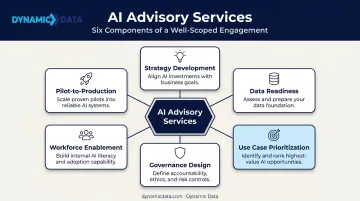
The distinction that matters: a good advisory engagement ends with a prioritized roadmap your team can execute — not a report cataloging AI possibilities with no path to implementation.
Key Advantages of AI Advisory Services
The three advantages below focus on measurable operational impact — the kind tracked in cost reviews, operational reports, and board presentations.
Advantage 1: Faster, More Confident Decision-Making
AI advisory accelerates decision-making by aligning data infrastructure to business priorities. Instead of leaders relying on stale weekly reports or incomplete dashboards, they get accurate, real-time intelligence when it's needed.
In practice, this means auditing existing data pipelines, identifying gaps in reporting workflows, and implementing tools that push actionable information to the right people automatically.
The cost of not doing this is quantifiable. IBM research shows that 80% of organizations still rely on outdated data for decision-making, and 85% of data leaders admit this has directly cost their companies money. Companies using outdated data to train AI models face an estimated 6% global revenue loss.
The upside is equally clear. Forrester's research on insights-driven businesses found that advanced analytics users are 8.5x more likely to report at least 20% year-over-year revenue growth.
KPIs this advantage influences:
- Report generation time
- Decision cycle length
- Forecast accuracy
- Error rates in manual data handling
- Leadership alignment speed
This advantage matters most for businesses scaling operations, entering new markets, or managing complex data environments where manual reporting can no longer keep pace with decision volume. Dynamic Data's work with Pima Solar illustrates this directly — replacing custom Google Sheets with automated dashboards gave leadership visibility into data they didn't know they were missing, reducing time spent on manual status identification.
Advantage 2: Reduced Operational Waste Through Targeted Automation
AI advisory maps existing workflows to find where repetitive, manual tasks consume disproportionate resources. The goal is automation that connects to live processes from day one, not disconnected prototypes that never reach production.
Self-guided AI adoption has a poor track record. Gartner projects that 60% of AI projects will be abandoned through 2026 due to lack of AI-ready data. RAND found AI project failure rates exceed 80% — more than double the failure rate of non-AI IT projects — with misalignment between technical execution and business objectives as the primary cause.
Advisory-led automation avoids these failure modes by:
- Conducting process audits before recommending any tools
- Prioritizing automation use cases by ROI, not technical novelty
- Overseeing implementation so automation connects to real workflows from day one
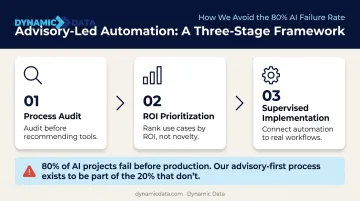
The efficiency gains are real. Nearly half of businesses adopting AI in service operations report cost savings, with operational cost reductions ranging from 5–20%.
KPIs this advantage influences:
- Manual processing time
- Error rates
- Operational cost per task
- Staff hours redirected to strategic work
- Automation ROI
This advantage has the highest impact in organizations with high transaction volumes, fragmented legacy systems, or teams spending significant time on data entry, approvals, and routine reporting.
Advantage 3: Scalable AI Adoption Without Proportional Risk or Cost
Advisory services design transformation programs with scalability built in from the start. Early pilots are architected for production deployment, not just proof-of-concept demonstration.
The alternative plays out poorly. IBM's 2026 research found that only 16% of AI initiatives have scaled across the entire organization, and only 25% deliver the ROI that leaders originally expected. Meanwhile, 92% of companies plan to increase AI investment over the next three years. Yet according to McKinsey's 2025 research, only 1% consider themselves mature in deployment.
Advisory-guided scaling exists precisely to close that gap between investment intent and deployment maturity.
Advisory services create this advantage by:
- Establishing governance frameworks before pilots launch
- Building data foundations that support future use cases, not just the current one
- Structuring phased roadmaps that validate ROI at each stage before scaling
- Keeping each AI system compliant, auditable, and built to expand without costly rework
Addressing technical debt early matters too: IBM research shows it can improve AI ROI by up to 29% by reducing the need for costly rework.
KPIs this advantage influences:
- Time from pilot to production
- Cost of rework
- Number of AI use cases in production
- Governance audit pass rates
- Scalability of data infrastructure
This advantage is non-negotiable for organizations handling sensitive data, operating in regulated environments, or pursuing enterprise-wide AI integration.
What Happens When AI Advisory Is Missing
Without structured advisory, businesses don't avoid AI adoption — they adopt it poorly. The consequences compound.
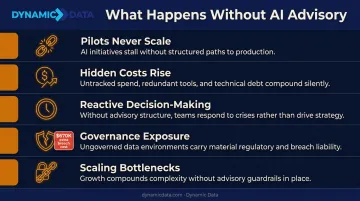
Common outcomes of unguided AI adoption:
- Pilots that never reach production — because they were built for demonstration, not integration with existing systems
- Rising hidden costs from manual workarounds, tool sprawl, and rework when AI investments don't connect to real workflows
- Reactive decision-making despite available data — because no governance or infrastructure routes insights to the people who need them
- Governance exposure — IBM's 2025 Data Breach Report found that breaches involving shadow AI average $670,000 more in cost than governed environments, with 63% of breached organizations having no AI governance policies at all
- Scaling bottlenecks — AI systems built without a strategic framework replace one set of dependencies with another, locking teams into workarounds instead of freeing them
BCG's research makes the pattern concrete: AI leaders focus on an average of 3.5 use cases compared to 6.1 for laggards. Chasing more use cases without a guiding framework is one of the most reliable ways to stall — and the data consistently shows it.
How to Get the Most Value from AI Advisory Services
Advisory delivers its highest return when treated as an ongoing practice rather than a one-time audit. Organizations that consistently see results share a few habits:
- Review outcomes on a regular cadence, not just at project close
- Act on recommendations rather than filing them in a strategy document
- Revisit and update their AI roadmaps as the business evolves
Conditions That Drive Strong Outcomes
Three factors consistently separate high-value advisory engagements from mediocre ones:
- Leadership alignment on measurable goals: Vague objectives produce vague results. Specific targets — reduce report generation time by X, move Y use case to production by Q3 — create real accountability.
- Data infrastructure modernized alongside strategy: Advisory recommendations only translate into results when the underlying data stack can actually support them.
- Change management built in from the start: The BCG 10-20-70 framework makes this concrete — 10% of AI success comes from algorithms, 20% from data and technology, and 70% from people, processes, and cultural change.
The most effective advisory engagements combine strategic guidance with hands-on implementation. A roadmap without the technical capability to execute it is just documentation.
Dynamic Data addresses exactly this gap. By pairing AI and ML expertise with data stack modernization across platforms like Snowflake, BigQuery, dbt, and Tableau, the team turns advisory recommendations into working infrastructure — not just slides.
The Zenus engagement illustrates the difference: strategic planning led directly to a fully automated data infrastructure on BigQuery, complete with version control and automated testing built in for scale.
Conclusion
AI advisory delivers real value when organizations treat deployment decisions, outcome metrics, and organizational adoption with the same discipline they apply to any other core business function.
The gains — faster decisions, reduced operational waste, broader adoption — don't arrive in a single engagement. They build over time, through regular reviews, clear metrics, and honest reassessment when something isn't working.
That's what separates AI advisory from a one-time technology project: it's an ongoing practice, and the organizations that get the most out of it are the ones that run it like one.
Frequently Asked Questions
What is an AI advisory service and what does it typically include?
AI advisory services help businesses identify high-value AI opportunities, build data foundations, and manage adoption across the organization. Engagements typically cover:
- Strategy development and use case prioritization
- Data readiness and infrastructure assessment
- Governance design and compliance frameworks
- Implementation guidance through to production deployment
How do I know if my business is ready for AI advisory services?
Readiness isn't about having perfect data — it's about having specific business problems worth solving. Organizations with manual reporting bottlenecks, scaling challenges, stalled pilots, or fragmented data environments are strong candidates, even if their infrastructure still needs work.
What's the difference between AI advisory services and traditional IT consulting?
Traditional IT consulting builds systems to predefined specifications. AI advisory connects business goals to adaptive, data-driven systems — prioritizing measurable outcomes over the delivery of specific tools. The focus is on what the business needs to achieve, not what software to install.
How long does an AI transformation typically take?
Timelines depend on data readiness, organizational complexity, and scope. Early use cases can reach production in 8–16 weeks. Enterprise-wide transformation typically follows a phased roadmap spanning 12–24 months, with ROI validated at each stage before scaling.
What KPIs should I use to measure AI advisory success?
Track these metrics to gauge program performance:
- Reduction in manual processing time
- Decision cycle speed improvements
- Cost per automated task
- Pilot-to-production conversion rate
- ROI on deployed AI use cases
- Governance audit pass rates (for longer-term programs)
How do AI advisory services help with data governance?
Advisory services establish the policies, infrastructure standards, and oversight frameworks that ensure AI systems use accurate, compliant, and auditable data. This foundation is what allows AI to scale responsibly and prevents the kind of governance gaps that expose organizations to compliance risk and security vulnerabilities.