Gartner confirmed this pattern: by end of 2025, at least 50% of generative AI projects had been abandoned after proof of concept. Poor data quality, inadequate risk controls, and the gap between pilot and production were the leading causes.
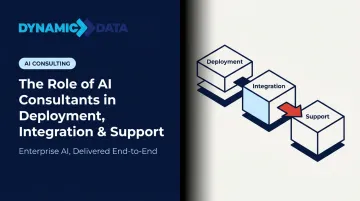
This is precisely where AI consultants earn their value — not during the ideation phase, but during the three phases that determine whether an AI investment pays off: deployment, integration, and ongoing support. These aren't interchangeable steps in a single "implementation." Each is a distinct discipline requiring different expertise, and underinvesting in any one of them creates compounding problems down the line.
This article breaks down what skilled AI consultants actually do across each phase, and why organizations that treat these as afterthoughts consistently face costly setbacks.
Key Takeaways
- Most AI projects fail not at the idea stage, but during deployment, integration, or post-launch
- Pre-deployment readiness audits — covering data quality, governance, and infrastructure — are non-negotiable before any model goes live
- Deployment ≠ integration: moving a model to production and connecting it to your business systems are separate, complex activities
- 63% of AI implementation challenges are human, not technical — which is why change management is a core consulting responsibility
- Post-launch monitoring and model retraining aren't optional; they're where long-term AI ROI is built or lost
The Foundation: What AI Consultants Establish Before Deployment
Before any model touches a production environment, experienced consultants run a pre-deployment readiness audit. This is a technical go/no-go checkpoint that assesses:
- Data pipeline health — are data feeds reliable, consistent, and structured correctly for the model?
- Model validation status — has the model been tested against real-world data distributions, not just clean training sets?
- Infrastructure readiness — can the compute environment handle production load, latency requirements, and scaling?
- Internal team capability — does someone inside the organization know how to interpret, monitor, and own the model's outputs?
The internal ownership gap is the most common deployment failure — and the least expected. A model can work exactly as designed, yet silently drift for weeks because no one inside the organization is monitoring its outputs or flagging anomalies. By the time downstream business decisions reflect the error, the damage is done.
Governance Before Go-Live
Alongside readiness auditing, consultants establish governance frameworks before the first production request is served. This means defining KPIs tied to actual business outcomes and establishing clear data ownership structures.
It also means identifying regulatory compliance requirements specific to the client's industry — whether that's HIPAA for healthcare, SOX for financial services, or GDPR for companies with European data subjects.
According to Precisely's 2024 Global Data Integrity Trends Report, only 12% of organizations have data quality and accessibility sufficient for effective AI implementation, and 62% cite lack of data governance as their primary AI obstacle. Without a governance framework in place before deployment, organizations are building on unstable ground.
At Dynamic Data, pre-deployment work includes data strategy assessments, pipeline audits, and governance framework design — so the organizational infrastructure is ready to support the model from day one, not retrofitted after problems surface.
AI Deployment: Moving From Model to Production
Getting a trained AI model into production means navigating a structured transition from development to live systems — one that involves multiple validation layers before any real user traffic is served.
Testing Strategies That Reduce Risk
AWS documents three primary deployment approaches consultants use depending on the client's risk tolerance:
- Shadow mode — the new model runs in parallel with production but doesn't serve predictions to users. Output differences are analyzed before any live exposure
- Canary deployment — a small percentage of production traffic routes to the new model; if performance metrics hold, traffic gradually shifts over
- A/B testing — multiple model variants run simultaneously against live traffic to determine which performs best against defined business metrics
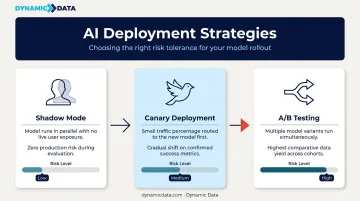
Choosing between these methods comes down to how much production disruption the business can absorb. Shadow mode carries the least risk; A/B testing yields more comparative data but demands greater operational overhead. That overhead starts with infrastructure — and the configuration decisions made there shape both cost and performance.
Infrastructure Configuration
Consultants configure cloud environments, compute resources, API endpoints, and latency thresholds for production. These decisions carry direct cost and performance consequences: over-provisioned compute wastes budget, while under-provisioned infrastructure creates latency that degrades user experience and model usefulness.
Dynamic Data works across AWS, Azure, Google Cloud, Databricks, Snowflake, and BigQuery, giving clients deployment flexibility across the major cloud platforms rather than locking them into a single infrastructure path.
User Acceptance Testing and Phased Rollout
Technical QA confirms a model works. User acceptance testing (UAT) confirms it works for the people who will actually use it. Consultants work directly with business teams — not just engineers — to validate that outputs are interpretable, aligned with the original use case, and actionable in real workflows.
Phased rollout follows UAT: deployment starts with a limited user group or a single business function before expanding. Rollback protocols are defined in advance, so if performance degrades or outputs become unreliable, the team can revert without a crisis-level response.
AI Integration: Connecting Intelligent Systems to Your Existing Business
Deployment gets the model running. Integration makes it useful.
Integration is the work of connecting a deployed AI system to a company's existing software ecosystem — CRMs, ERPs, data warehouses, BI dashboards, or customer-facing platforms. It's often the most technically complex phase of the entire AI lifecycle, and according to MuleSoft's 2026 Connectivity Benchmark Report, 95% of IT leaders cite integration issues as the primary AI adoption barrier.
The Technical Integration Work
Consultants handle the unglamorous but critical plumbing:
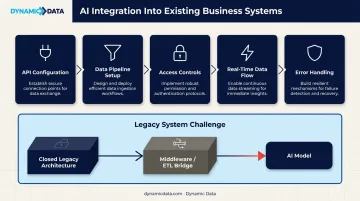
- Building and configuring APIs between the AI model and source systems
- Setting up data pipelines that feed the model clean, current data
- Managing authentication, access controls, and role-based permissions
- Ensuring real-time or batch data flows are reliable, low-latency, and fault-tolerant
- Establishing error-handling protocols so upstream failures don't silently corrupt model inputs
The legacy system challenge complicates this further. Many businesses rely on older software with limited API documentation, closed architectures, or data stored in formats the AI model can't directly consume. Consultants bridge these gaps using middleware solutions, ETL/ELT layers, or custom data scaffolding — avoiding a full infrastructure overhaul while still achieving reliable data flow.
The Human Side of Integration
Technical connectivity alone doesn't create adoption. Consultants work simultaneously with IT teams, data engineers, and department heads to ensure business workflows are redesigned around AI output — not just bolted onto existing processes.
Change management and technical work converge at this point. A model that produces accurate predictions but sits outside the tools a team already uses will be ignored. The measure of success isn't a clean API handshake — it's whether the AI output is actually visible, trusted, and acted on within daily workflows.
Dynamic Data's Zenus engagement illustrates this directly. The team worked embedded within Zenus's engineering team throughout the integration process, making design decisions collaboratively rather than handing off finished work. The client noted the engagement helped "accelerate our product development and go-to-market strategy" — a business outcome, not just a technical one.
Post-Launch Support: Keeping AI Working as Your Business Evolves
AI systems are not set-and-forget infrastructure. They degrade. As real-world data changes, trained models become misaligned with current conditions — a phenomenon known as model drift.
- Data drift — the statistical distribution of input data changes, so the model encounters patterns it wasn't trained on
- Concept drift — the underlying relationship between inputs and outputs shifts, meaning the model's logic itself becomes outdated
This affects every industry differently — financial models shift with market regimes, retail recommendation engines fall out of sync as consumer behavior changes, and healthcare models diverge as patient demographics evolve. Without monitoring, degradation compounds quietly until the business impact becomes obvious, often months after the model started underperforming.
What Ongoing Monitoring Looks Like
Post-launch monitoring isn't just uptime tracking. Consultants establish dashboards that surface:
- Model accuracy metrics — precision, recall, and prediction confidence tracked against baseline benchmarks
- Data quality signals — completeness and consistency of incoming data feeds
- Bias drift indicators — changes in model fairness across demographic or categorical segments
- Feature attribution shifts — which input variables are driving predictions, and whether that's changing
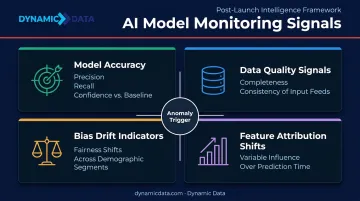
When anomalies appear, they trigger a review workflow. Established protocols mean the response is structured, not reactive.
Retraining and Expansion
Retraining cycles are scheduled based on performance benchmarks, not arbitrary calendars. When accuracy drops below an agreed threshold — or when data distributions shift beyond acceptable tolerances — consultants execute retraining using updated data, then re-validate the model before returning it to production. Re-integration validation is also part of the process, confirming that downstream systems still consume the updated output correctly.
Beyond maintenance, strong consulting relationships tend to expand in scope. At Dynamic Data, what begins as deployment support in data governance or workflow automation often grows into helping clients extend their AI systems to new departments and use cases as teams build confidence with the technology.
Common Challenges AI Consultants Solve Across All Three Phases
The Pilot-to-Production Gap
Pilots work in controlled conditions: clean data, dedicated team attention, narrow scope. Production is messier. McKinsey data shows 88% of companies use AI regularly, but only 21% reach production scale with measurable returns — meaning the vast majority are spending on AI without achieving it.
Experienced consultants design pilots with production constraints in mind from the start. That means using the actual data infrastructure the production system will rely on, building for the organizational processes that will consume the output, and stress-testing for edge cases a controlled environment never surfaces.
Data Quality as a Persistent Problem
Data quality isn't a one-time fix — it's an ongoing concern across all three phases. According to Precisely, **64% of organizations identify data quality as their top data integrity challenge** (up from 50% just a year earlier), and 77% rate their data quality as average or worse.
Consultants address this through continuous auditing across the full project lifecycle:
- Monitor input data at the pipeline level before issues reach the model
- Flag anomalies early using automated checks against established governance rules
- Maintain the data governance structures built during pre-deployment
Dynamic Data embeds a dedicated Data Quality Engineer into client engagements to own this work end to end.
Organizational Resistance
Research from Prosci studying over 1,100 professionals found that 63% of AI implementation challenges stem from human factors, not technical limitations. Teams that weren't involved in selecting the AI system often resist using it.
Consultants address resistance through:
- Role-based training tailored to how each team actually uses the system
- Transparent communication about what the AI does — and where its limits are
- Internal champions — team members who understand the tool and can advocate for it among peers
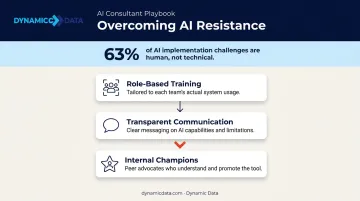
This isn't a one-time effort at go-live. It runs through deployment, integration, and ongoing support.
What to Look for in an AI Consulting Partner
Full-Lifecycle Capability
The right partner demonstrates capability across the full lifecycle — from readiness assessment through deployment, integration, and ongoing support. When evaluating partners, ask specifically:
- What does your post-launch support model look like?
- What SLAs do you commit to for model monitoring and issue response?
- Can you show examples of clients you've supported beyond initial deployment?
A partner who excels at strategy but lacks integration or monitoring depth will leave you exposed at the phases where most AI investments fail.
Integration Experience With Your Stack
Look for hands-on experience connecting AI systems to the specific platforms your business already runs. Key questions to ask:
- Have you integrated AI models with [your specific ERP or CRM]?
- How do you handle legacy systems with limited API documentation?
- What middleware or ETL approaches do you use for closed-architecture integrations?
Vague answers here are a red flag. Integration depth is specific — a consultant who has done it before will be able to describe what went wrong and how they handled it.
A Partner That Builds Internal Capability
The right partner embeds with your team rather than operating in isolation. What this looks like in practice:
- Documentation at every phase — architecture decisions, data flows, configuration choices — kept accessible to internal teams
- Knowledge transfer as a defined deliverable, not an afterthought
- A clear handoff plan so internal teams can manage the system without permanent consulting dependency
That last point matters more than most clients expect. Dynamic Data builds this into every engagement: the team works directly alongside client engineers and decision-makers throughout the process, with the explicit goal of leaving the organization capable of running and extending what was built — not dependent on outside support to keep it functioning.
Frequently Asked Questions
What qualifications do I need to be an AI consultant?
Most AI consultants hold backgrounds in machine learning, data engineering, or software development, combined with hands-on platform experience. Relevant certifications include Google Cloud's Professional Machine Learning Engineer, Microsoft's Azure AI Engineer Associate, and AWS's Certified AI Practitioner. Business acumen — the ability to connect technical outputs to measurable business outcomes — is equally important and often harder to find.
What does an AI consultant do during the deployment phase?
Consultants manage the transition from a trained model into a live production environment. This covers infrastructure configuration, staging and validation tests (shadow mode, canary releases, A/B testing), UAT with business teams, and phased rollout plans with rollback protocols built in for failure scenarios.
What is the difference between AI deployment and AI integration?
Deployment moves a trained model from development into a live production environment. Integration connects that model to existing business systems (CRMs, ERPs, data pipelines, dashboards) so it functions within actual workflows. Skipping either step means the model either never reaches users or never fits how the business actually operates.
How do AI consultants support businesses after the system goes live?
Post-launch support includes ongoing model monitoring (accuracy, bias drift, data quality) and performance benchmarking against agreed thresholds. Consultants also handle periodic retraining when performance degrades, compliance management, and scaling the solution to new business functions over time.
How long does AI integration typically take?
Timelines depend primarily on data maturity and legacy infrastructure complexity. Per Promethium's Enterprise AI Implementation benchmarks: accelerated integrations run 12–18 months, standard implementations 24–30 months, and complex enterprise-wide transformations 36+ months.
When should a company hire an AI consultant instead of building an internal team?
External consultants make more sense when the company lacks specialized deployment or integration expertise, needs to move quickly, or wants to avoid long-term hiring costs for project-based AI work. They're particularly valuable when the initiative requires cross-platform integration expertise that would take an internal team years to build.