This pattern is expensive in ways that rarely show up in a single project invoice. According to RAND's 2024 research, more than 80% of AI projects fail—more than double the failure rate of non-AI corporate IT projects. The gap between a promising proof of concept and a production-grade AI system is where most enterprises lose both time and money.
The core problem: enterprise clients typically evaluate AI consulting through a procurement lens—scope, timeline, cost—while the consultants who deliver the most durable value operate through a partnership lens. Accumulated knowledge, continuous improvement, and compounding ROI look nothing like a project bid.
This article lays out the specific, tangible incentives that long-term AI consulting partnerships unlock for enterprise clients—and why project-based engagements structurally cannot replicate them.
Key Takeaways
- Long-term AI consulting partnerships build institutional knowledge about your data, systems, and goals, which compounds into faster execution on every subsequent initiative
- Enterprise clients in sustained partnerships typically access dedicated team resources, preferential pricing, and priority support unavailable in transactional work
- Switching AI consulting partners mid-roadmap carries real hidden costs: lost context, weeks of reorientation, and stalled delivery timelines
- Well-structured long-term AI partnerships define phased milestones, shared success metrics, and knowledge transfer obligations from the outset
- The right long-term partner demonstrates data engineering depth, governance capabilities, and a track record of delivering production-ready results beyond the pilot phase
Why Enterprise AI Initiatives Demand More Than Project-Based Consulting
Enterprise AI environments are inherently complex. Data sits across legacy systems, cloud warehouses, CRM platforms, and operational tools—often with inconsistent definitions, undocumented pipelines, and years of accumulated technical decisions that only make sense with context.
A consultant brought in for a single project must spend a meaningful share of the engagement just understanding this ecosystem before contributing anything strategic. This is a structural cost built into every fresh engagement, regardless of the consultant's skill.
The Knowledge Depreciation Problem
When a project-based engagement ends, the institutional knowledge the consultant built doesn't stay with you. Their understanding of your data quality issues, pipeline quirks, model performance baselines, and stakeholder dynamics walks out the door. Your internal team is left to reconstruct that context for the next initiative—often for a new vendor who has to start the same discovery process again.
Google researchers identified this as a systemic risk in ML systems: models carry hidden technical debt because they depend on data, configuration, undeclared consumers, and feedback loops that change over time. Without continuity, that debt accumulates invisibly between engagements.
The long-term model works differently. A sustained AI consulting partner develops a living understanding of your data architecture, business priorities, and AI maturity. They can:
- Identify new opportunities without a full discovery phase
- Flag data quality risks before they reach production
- Reduce time from idea to deployment as familiarity compounds
- Adjust recommendations as your business strategy shifts
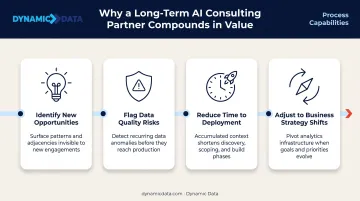
That accumulated context also becomes a financial asset — one that pays forward into every subsequent budget cycle.
The Budget Cycle Reality
Multi-year AI roadmaps don't operate in isolation from your annual planning cycles. IDC's 2025 AI services research confirms that organizations are trying to pivot from "endless experimentation and pilot projects" to scaled, production-grade deployments—but internal skills gaps, implementation costs, and misaligned priorities keep getting in the way.
A consulting partner who understands your planning cycles can do more than execute the current phase. They can translate what was learned in year one into the investment case for year two — connecting deployment results to board-level language around ROI, risk reduction, and competitive positioning.
That makes the business case for the next initiative faster to build and easier to approve.
The Incentives of Long-Term AI Consulting Partnerships
Pricing and Commercial Incentives
Project-based AI consulting is typically billed on time-and-materials terms. That model works for a discrete deliverable—but it creates a structural inefficiency: every new engagement restarts the clock on discovery, and you pay for that orientation each time.
Long-term retained partnerships shift the commercial model in several ways:
- Blended pricing replaces pure T&M, allowing pricing to reflect actual delivery value rather than hours logged
- Volume commitments in multi-year agreements typically create opportunities for preferred rates and budget-predictability provisions—standard in enterprise procurement but rare in project bids
- Outcome-based structures become viable once a partner has enough context to commit to measurable results, rather than just effort
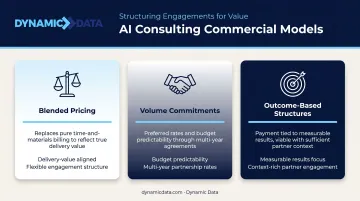
The effective cost per deliverable decreases as the relationship matures: less time goes to orientation, more to execution.
Dedicated Resources and Team Continuity
Long-term enterprise clients can negotiate dedicated team arrangements—where specific data engineers, AI architects, and analytics leads are assigned to the account across engagements rather than rotated based on firm-wide capacity.
This matters more than it sounds. An analytics engineer who has already mapped your data models, written your transformation logic, and understands your reporting cadence can execute a new initiative in a fraction of the time it would take someone onboarding fresh.
IDC's 2025 buyer research found that the top-rated vendor attribute in AI services engagements was the ability to integrate the vendor's project team with the internal client team. That integration only deepens with sustained collaboration—and it's essentially impossible to replicate in a project-based model.
The Zenus engagement at Dynamic Data illustrates this directly. What began as an advisory arrangement evolved into something different: as Panos Moutafis, Co-founder & CEO at Zenus, described it, "their knowledge and expertise surpassed our expectations, and we ended up making some of their staff members an integral part of our team."
Priority Access and Responsiveness
AI systems embedded in production workflows—demand forecasting, inventory optimization, customer scoring—carry real operational consequences when they underperform. Model drift surfaces quietly, and pipeline failures rarely respect business hours.
Long-term clients in AI consulting partnerships often receive contractual priority support: when a production model degrades or a board presentation requires last-minute analytical work, the firm handles their requests before those of transactional clients.
McKinsey notes that ML model performance can degrade or become obsolete as business requirements or underlying data shift—and that MLOps tools need to flag maintenance teams when that happens.
Priority SLAs from a long-term partner provide a direct mitigation mechanism for this risk. Project-based contracts, by definition, do not. That same embedded context also positions a long-term partner to help you get ahead of change, not just respond to it.
Co-Development and Innovation Access
Long-term consulting partners often involve enterprise clients in testing emerging tools against real data environments before broader rollout. For enterprises, this means:
- First-mover access to new methodologies relevant to their stack
- Pilot opportunities with emerging AI capabilities without the procurement overhead of a new engagement
- A partner that evolves its recommendations as the AI and data tooling space evolves
Dynamic Data's technical team works across more than 35 platforms—including Snowflake, BigQuery, Databricks, dbt, Tableau, Power BI, and Sigma—and continuously evaluates new capabilities in automated reporting, ML model optimization, and data visualization. Long-term clients get that evaluation applied directly to their existing environment, translating new capabilities into concrete improvements rather than theoretical recommendations.
How Long-Term Partnerships Enable Compounding AI Value
The most underappreciated aspect of a sustained AI consulting relationship is that its value compounds. Unlike a software license that delivers static functionality, the consulting partnership improves in effectiveness over time—because every engagement adds to the partner's knowledge of your data, workflows, and business context.
The Data Governance Dividend
Enterprises that work with a long-term AI consulting partner progressively build stronger data governance foundations: cleaner pipelines, better-documented models, more consistent data definitions. These are assets that make every subsequent AI initiative faster to deploy and more reliable in production.
The NIST AI Risk Management Framework structures AI risk management across the full lifecycle, requiring controls, measurement, and management of AI risks as they evolve. A long-term partner who understands your governance environment maintains and extends those controls incrementally, rather than rebuilding from scratch with each new project.
Dynamic Data's work with Zenus demonstrates this accumulation effect. The engagement built a fully automated data transformation and testing pipeline using dbt, with version control and automated testing to detect problems before exposure to end users. That infrastructure then supported new services added using the same foundation—each addition faster to deploy because the governance layer was already in place.
Roadmap Acceleration Over Time
McKinsey documented this compounding effect in financial services:
| Institution | Before | After |
|---|---|---|
| Brazilian bank | 20 weeks per ML use case | 14 weeks |
| Asian bank | 18 months to impact | Under 5 months |
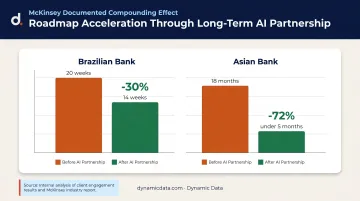
Both reductions came from reusable AI scaling practices and protocol standardization—not from hiring more people.
A consulting partner who has already delivered Phase 1 (modern data stack buildout) and Phase 2 (automated reporting) arrives at Phase 3—predictive analytics, ML-driven decision support—with your environment fully mapped. A new vendor starting Phase 3 needs weeks just to understand what the previous phases built.
Organizational Capability Transfer
Done well, long-term AI consulting partnerships reduce dependency rather than entrench it. Deliberate knowledge transfer—internal training, documentation, capability building—means the enterprise's own team grows in AI literacy over time.
The partner's role evolves accordingly: from tactical execution resource to strategic advisor. The Zenus engagement started with Dynamic Data helping an internal engineering team avoid known pitfalls. It ended with Dynamic Data staff integrated into the client team, accelerating product development and go-to-market strategy. That trajectory reflects what genuine capability transfer looks like.
How to Structure a Long-Term AI Consulting Partnership
A well-structured long-term AI consulting agreement includes more than a statement of work. The core components:
- Phased AI roadmap with defined milestones tied to business outcomes, not just technical deliverables
- Success metrics established at contract stage—both leading indicators (pipeline reliability, time-to-deployment) and lagging business outcomes (cost reduction, forecast accuracy)
- Knowledge transfer obligations with explicit documentation standards and model handoff requirements
- Dedicated resource commitments specifying which roles are assigned to the account
- Escalation procedures for production issues with defined response expectations
- Scheduled strategic reviews — quarterly business reviews are standard in mature partnerships
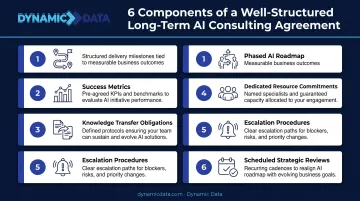
The right engagement model depends on where your organization sits on the AI maturity curve. Each structure carries different risk and reward profiles for both sides.
Engagement Models by AI Maturity
| Model | Structure | Best Fit |
|---|---|---|
| Retainer | Fixed monthly resource commitment | Early-stage AI maturity; building foundational capabilities |
| Outcome-based | Payment tied to measurable results | Mature AI environments with defined, measurable use cases |
| Hybrid | Retainer plus performance incentives | Mid-maturity clients scaling proven use cases |
Early-stage enterprises typically benefit most from retainers, which provide access to consistent expertise while the data foundation is being built. More mature organizations with defined AI use cases can negotiate outcome-based structures — though this only works once the partner has enough context to commit meaningfully to results.
A critical caution: contracts should include explicit language about documentation standards, model handoff requirements, and internal training obligations. Any agreement that creates consulting dependency without building internal capability is a commercial liability — and a sign the engagement isn't structured as a true partnership.
What to Look for in a Long-Term AI Consulting Partner
The most important signal of a long-term partner's quality isn't the pitch deck—it's how they behave six months after initial implementation. Look for partners who:
- Proactively surface new opportunities without waiting to be asked
- Flag data quality risks before they become production issues
- Bring updated recommendations as the AI landscape and your business both evolve
- Demonstrate genuine data engineering depth, not just strategy capability
- Preserve context across personnel changes — documented, transferable knowledge rather than individual memory
IDC's 2025 research identifies the most critical attribute for successful AI services engagements as the ability to achieve business outcomes—not the quality of the proposal, not the size of the firm. That outcome orientation needs to be evident in how the partner behaves, not just what they claim.
Outcome orientation only holds up when it's backed by technical depth. The partner must be able to work across your existing platforms, manage production AI systems (not just build them), and handle the governance requirements that come with scaling AI beyond pilots.
Dynamic Data's 25+ specialist team spans data engineering, BI, AI governance, and visualization — working with clients like Pima Solar and Zenus on engagements built around measurable outcomes. That's the practical difference between a long-term partner and a project vendor.
Frequently Asked Questions
What types of incentives do AI consulting firms typically offer long-term enterprise clients?
The main categories are preferential pricing, dedicated team resource assignments, priority support SLAs, and co-development access to emerging capabilities. Specific incentives vary significantly by firm and should be explicitly negotiated—not assumed—at the contract stage.
How long should a long-term AI consulting engagement last?
Most enterprise AI roadmaps span 18 months to three or more years across phases. Meaningful compounding value typically becomes visible after the first full delivery cycle, roughly 12–18 months in, once the partner has accumulated enough context to meaningfully accelerate subsequent initiatives.
How is a long-term AI consulting partnership different from a simple retainer?
A retainer reserves hours. A true partnership includes a shared AI roadmap, defined knowledge transfer obligations, business-outcome success metrics, and strategic advisory input that evolves with the client's AI maturity. One buys time; the other builds compounding organizational capability.
What should be included in a long-term AI consulting contract for enterprise clients?
Key elements include phased milestone definitions, business-outcome success metrics, dedicated resource commitments, knowledge transfer obligations with documentation standards, IP ownership clauses, and periodic strategic review cadences. All of these should be explicit, not implied.
How do you measure ROI from a long-term AI consulting partnership?
Track leading indicators (time-to-deployment, data quality scores, pipeline reliability) alongside lagging outcomes (cost reduction, forecast accuracy, revenue from AI-driven decisions). Establish the measurement framework at contract stage — retroactive ROI attribution rarely holds up under scrutiny.
When should an enterprise client consider switching AI consulting partners?
Consistent milestone failures, an inability to scale beyond pilots, and absent knowledge transfer are all legitimate triggers. Switching carries real costs in lost context and roadmap momentum, which is why clear contractual expectations at the start matter more than a clean exit clause later.