Introduction
Modern enterprise environments generate staggering volumes of data every hour — transaction logs, sensor feeds, pipeline outputs, API calls, user events. At that scale, manual anomaly detection isn't just slow. The volume and velocity of modern data makes manual review unworkable.
The business cost is concrete. According to IBM's 2024 Cost of a Data Breach report, the average global breach costs $4.88 million, with financial sector breaches averaging $6.08 million. That exposure compounds when detection lags.
The ACFE's 2024 Report to the Nations found that a typical occupational fraud case goes undetected for 12 months before discovery. These aren't edge cases — they're what happens when monitoring can't keep pace with data.
This guide covers five of the best ML-powered anomaly detection solutions purpose-built for enterprise environments — what each does well, where it fits, and how to think about choosing between them.
Key Takeaways
- ML anomaly detection automatically identifies outliers and deviations that static rules and manual monitoring routinely miss
- Top solutions covered: Amazon SageMaker (RCF), Azure Anomaly Detector, Anodot, Splunk UBA, and Dataiku DSS
- Best solution depends on your cloud environment, data type, team expertise, and anomaly use case
- Evaluate tools on real production data: assess false positive rates and baseline adaptability before committing
- Organizations with complex or fragmented data stacks frequently get better results from custom ML solutions than pre-built tools
Why Enterprise Data Needs ML-Based Anomaly Detection
ML-based anomaly detection uses machine learning algorithms to learn baseline behavior from historical data and flag deviations without relying on manually coded rules or fixed thresholds.
Where Rule-Based Monitoring Breaks Down
Traditional monitoring sets static thresholds: if metric X exceeds value Y, trigger an alert. That works in predictable environments. Enterprise data is rarely predictable.
Rule-based systems fail because they can't:
- Adapt to seasonal patterns (a Black Friday traffic spike isn't an anomaly — a rules engine doesn't know that)
- Detect novel attack vectors or previously unseen failure modes
- Handle high-dimensional data where anomalies emerge across correlated variables
- Scale to millions of metrics without generating unsustainable alert volumes
The result is alert fatigue — Trend Micro's SOC research found that 70% of security teams are emotionally overwhelmed by alert volume, and 55% aren't fully confident in their ability to prioritize responses. When analysts stop trusting their alerts, real anomalies get buried.
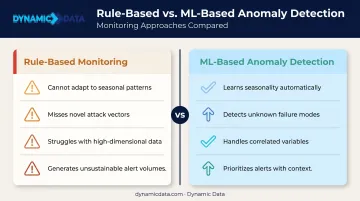
ML models solve this by learning what "normal" looks like for your specific environment. They adapt as patterns shift and surface deviations with context — flagging that an anomaly occurred at 2 a.m. during a routine batch job, not during peak traffic — so analysts can prioritize with confidence.
Best Machine Learning Solutions for Anomaly Detection in Enterprise Data
Each solution below was evaluated on ML model sophistication, real-time detection capability, enterprise scalability, integration breadth, and production track record. The goal: help you match the right tool to your team's technical setup, industry context, and scale requirements.
Amazon SageMaker — Random Cut Forest
AWS's fully managed ML platform includes Random Cut Forest (RCF), an unsupervised algorithm built specifically for anomaly detection in high-dimensional, time-series data. No labeled training data required.
RCF assigns each data point an anomaly score, giving teams an intuitive threshold to work with rather than binary pass/fail outputs. For enterprises already running on AWS, the platform integrates directly with Kinesis for streaming detection — AWS documentation confirms RCF is available within Kinesis Data Analytics SQL — alongside S3 for batch workflows and broader AWS data services.
| Category | Details |
|---|---|
| Key Features | Unsupervised RCF algorithm, streaming and batch support, AutoML, built-in model monitoring |
| Deployment / Integration | Fully managed AWS service; integrates with Kinesis, S3, and broader AWS data ecosystem |
| Best For | Enterprises on AWS needing scalable, cloud-native anomaly detection embedded in existing ML workflows |
Microsoft Azure Anomaly Detector
Azure Anomaly Detector is a purpose-built Azure AI service that applies statistical and ML models to detect anomalies in both univariate and multivariate time-series data — and requires no ML expertise to deploy via its REST API.
Its standout capability is multivariate detection: it correlates signals across up to 300 data streams simultaneously using Graph Attention Networks, catching complex inter-variable anomalies that single-metric tools miss entirely. Azure Synapse Analytics integration is verified through Microsoft's own documentation, enabling direct enrichment of enterprise data pipelines.
One important note: Microsoft announced that new Anomaly Detector resource creation closed in September 2023, with full retirement scheduled for October 2026. Organizations evaluating this service should factor migration planning into their decision.
| Category | Details |
|---|---|
| Key Features | Univariate + multivariate detection, adaptive baselines, batch and streaming modes, REST API access |
| Deployment / Integration | Azure-native; integrates with Azure Synapse Analytics and Power BI |
| Best For | Microsoft-stack enterprises seeking a no-code, API-first anomaly detection service for IoT, finance, and operations data |
Anodot
Anodot is a dedicated real-time analytics platform built around patented ML algorithms that autonomously monitor millions of business and IT metrics — and its design philosophy is fundamentally different from general-purpose ML platforms.
Where other tools require data teams to configure models, Anodot's engine learns metric behavior automatically and groups related anomalies through a patented correlation system (US Patent US10891558B2). The practical outcome: instead of receiving 50 alerts about related symptoms, an analyst sees one correlated incident with root cause context. An Anodot customer case study notes that root cause detection time dropped from "up to a week" to "less than a day."
| Category | Details |
|---|---|
| Key Features | Patented ML detection, cross-dimension anomaly correlation, automated alert grouping, real-time monitoring |
| Deployment / Integration | SaaS platform; integrates with Snowflake, Databricks, AWS, GCP, Salesforce, and major BI tools |
| Best For | Business and BI teams needing autonomous monitoring of revenue, product, and operational KPIs at scale |
Splunk Enterprise + User Behavior Analytics (UBA)
Splunk UBA extends Splunk's machine data platform with ML-driven behavioral analytics — combining unstructured log data, security events, and user activity into a unified model for detecting both known and unknown threats.
The core differentiator is peer group modeling: UBA builds behavioral baselines using up to 365 days of historical data and compares individual entities against peers with comparable roles or activity patterns. This makes it particularly effective at detecting insider threats and privilege abuse — anomalies that look normal against an absolute threshold but stand out against a user's peer group.
Gartner named Splunk a Leader in its 2024 Magic Quadrant for SIEM, and Forrester placed it in the Wave: Security Analytics Platforms Q2 2025 — reflecting its standing in enterprise security operations.
| Category | Details |
|---|---|
| Key Features | ML-based behavioral analytics, peer group modeling, risk scoring, pre-built content for IT/security use cases |
| Deployment / Integration | On-premise, cloud, and hybrid; deep integrations across SIEM, SOAR, and enterprise IT ecosystems |
| Best For | Enterprise IT and security teams needing ML-powered anomaly detection across logs, user activity, and network data |
Dataiku DSS
Dataiku Data Science Studio gives enterprise data teams a platform where they control model selection, preprocessing pipelines, and deployment — rather than inheriting a fixed ML approach. It supports Isolation Forest and other custom algorithms, with full flexibility to define what "anomalous" means for a specific domain.
That flexibility is particularly valuable in regulated industries, where a finance or healthcare team's definition of an anomaly may differ sharply from a generic model's output. Dataiku's SLB solution catalog illustrates this: an Isolation Forest model deployed through Dataiku AutoML for well-log outlier detection in oil and gas operations. Gartner named Dataiku a Leader in its 2025 Magic Quadrant for Data Science and Machine Learning Platforms.
| Category | Details |
|---|---|
| Key Features | Visual ML workflow builder, Isolation Forest and custom algorithm support, model monitoring, AutoML |
| Deployment / Integration | On-premise, cloud (AWS, Azure, GCP), and hybrid; connects to broad range of data sources and BI platforms |
| Best For | Enterprises with in-house data science teams that need a flexible platform to build and deploy custom anomaly detection models |
How to Choose the Right Solution
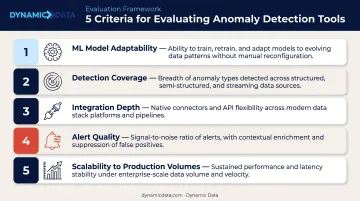
The Five Evaluation Criteria That Actually Matter
Most enterprises select anomaly detection tools based on brand recognition or general ML capability — then discover the fit is wrong after deployment. These five criteria consistently separate useful tools from expensive mistakes:
- ML model adaptability — Can the system learn your specific baselines without rigid manual rules? Does it handle seasonality and data drift automatically?
- Detection coverage — Does it support batch and streaming? Univariate and multivariate signals? The data types you actually have?
- Integration depth — "Supports AWS" isn't good enough. The question is whether it natively connects to the specific services already in your pipeline.
- Alert quality — Look for suppression mechanisms, correlation engines, and analyst feedback loops. Volume without signal quality is noise, not detection.
- Scalability to production volumes — Demo performance and production performance often diverge significantly. Test against real data volumes before committing.
The Most Common Buying Mistake
Selecting a tool based on general ML capability rather than data-type fit. An AWS-native shop with streaming Kinesis data has different requirements than a regulated financial institution running hybrid infrastructure with multivariate sensor signals. The right tool for one is often wrong for the other.
For organizations with highly specialized data environments or fragmented data stacks, purpose-built custom ML solutions consistently outperform off-the-shelf tools by tailoring model selection, data preparation, and alert logic to your specific anomaly definitions. Dynamic Data's Anomaly Detection & Fraud Prevention practice designs and deploys ML models directly against your existing infrastructure, built around your anomaly definitions rather than a vendor's preset assumptions.
Conclusion
There's no universal winner in enterprise anomaly detection. Amazon SageMaker suits AWS-native teams with streaming workloads. Azure Anomaly Detector fits Microsoft-stack organizations needing multivariate detection without ML expertise (though the retirement timeline is worth planning for). Anodot works well for business and BI teams monitoring KPIs at scale. Splunk UBA is the natural choice for security and IT operations. Dataiku DSS serves enterprises with in-house data science capacity that need model flexibility.
The common mistake is skipping real-data evaluation. Assess false positive rates, integration complexity, and whether the tool's baseline modeling adapts to your data's actual seasonality and structure — not just a clean demo dataset.
For enterprises that need an anomaly detection approach built around their specific data stack, Dynamic Data's team of AI and data engineering specialists can design, build, and deploy custom ML solutions: from data pipeline integration and feature engineering through to model monitoring. Talk to the team about your anomaly detection requirements.
Frequently Asked Questions
What is the difference between supervised and unsupervised anomaly detection in ML?
Supervised methods require labeled data — known examples of normal and anomalous behavior — and excel at detecting familiar anomaly types. Unsupervised methods learn what "normal" looks like without labels, making them better suited for unknown or evolving anomalies. Most enterprise deployments use a hybrid approach, combining both where labeled data exists alongside unsupervised coverage for novel patterns.
Which ML algorithm is best for anomaly detection in large enterprise datasets?
There's no single answer. Isolation Forest suits high-dimensional data; Random Cut Forest handles time-series well; ensemble methods improve robustness across diverse types. The right choice depends on your data structure, volume, latency requirements, and whether labeled anomaly examples are available.
How does ML-based anomaly detection differ from traditional rule-based monitoring?
Rule-based systems flag deviations from manually defined thresholds and can't adapt when data patterns shift. ML-based systems continuously learn evolving baselines from your actual data, reducing false positives and catching anomaly types that static rules were never configured to detect.
What are the biggest challenges of deploying anomaly detection ML models in enterprise environments?
The most common obstacles include data quality problems (siloed or noisy data), alert fatigue from high false positive rates, integration friction with legacy systems, and model drift as data distributions change. Clean, well-structured data before deployment is what most often determines whether rollout succeeds.
Can ML anomaly detection models work on real-time streaming enterprise data?
Yes. Amazon SageMaker's RCF integrates with Kinesis Data Analytics for streaming, and Azure Anomaly Detector supports real-time univariate detection. These use cases require models designed for incremental learning or low-latency scoring, since detection delays directly increase incident cost in fraud and IoT scenarios.
How do enterprises measure the ROI of an ML anomaly detection implementation?
Key metrics include mean time to detection (MTTD), mean time to resolution (MTTR), false positive volume, cost of incidents prevented, and analyst hours saved. Establishing baseline measurements before deployment is critical — without pre-implementation benchmarks, quantifying improvement after rollout becomes difficult to defend internally.