Introduction
Most e-commerce businesses are sitting on a goldmine of customer data — and doing surprisingly little with it. According to Edge Delta, companies analyze only 37–40% of their data, even though 97.2% invest in big data solutions. The gap between collecting data and acting on it is where revenue disappears.
Most teams are still reacting — reviewing last month's sales numbers, investigating a spike in returns, figuring out why a campaign underperformed. Predictive analytics flips that model. Instead of explaining what happened, it tells you what's likely to happen next.
For e-commerce specifically, that translates into:
- Stocking the right products before demand peaks
- Identifying customers about to churn before they go cold
- Personalizing the shopping experience in ways that convert
This article covers what predictive analytics is, how it works, the highest-impact use cases, real-world examples from major brands, and a practical starting point for implementation.
Key Takeaways
- Predictive analytics uses machine learning and historical data to forecast what customers will do next — before they do it.
- Key e-commerce benefits include smarter inventory, higher conversions, reduced cart abandonment, and better customer retention.
- Top use cases: demand forecasting, personalized recommendations, dynamic pricing, churn prediction, and marketing optimization.
- Amazon, Netflix, and Macy's have each used predictive analytics to cut costs, lift conversion rates, and retain more customers.
- Getting started requires clean, unified data — and often a specialist partner to get to results faster.
What Is Predictive Analytics in E-commerce?
Predictive analytics is a branch of advanced analytics that combines statistical modeling, data mining, and machine learning to forecast future events. It's distinct from descriptive analytics (what happened) and diagnostic analytics (why it happened). In e-commerce, it means anticipating customer actions before they occur — not explaining them after the fact.
The global predictive analytics market was valued at $18.89 billion in 2024 and is projected to reach $82.35 billion by 2030, growing at a CAGR of 28.3%. Adoption is climbing fast, and brands that haven't started building these capabilities are already operating at a disadvantage.
How Predictive Analytics Works
The process follows four steps:
- Collect data — Pull historical and real-time data from your storefront, CRM, ad platforms, email tools, and inventory systems
- Identify patterns — Machine learning algorithms find relationships and trends within that data
- Generate forecasts — The model produces predictions that improve as more data flows in over time
- Act on outputs — Business teams use those forecasts to make proactive decisions on inventory, campaigns, and customer outreach
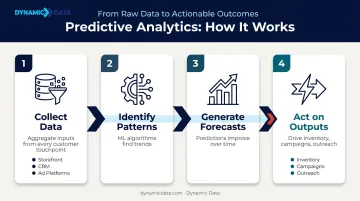
These steps only work as well as the data behind them. Fragmented, inconsistent data produces unreliable predictions — model accuracy is directly tied to data quality, which makes it the foundation every other step depends on.
The 4 Types of Analytics
Gartner's data and analytics framework describes four levels of analytical maturity:
| Type | Question Answered | Example |
|---|---|---|
| Descriptive | What happened? | Monthly sales report |
| Diagnostic | Why did it happen? | Why did Q3 revenue drop? |
| Predictive | What will happen? | Which customers will churn next month? |
| Prescriptive | What should we do? | Send this customer a discount on Tuesday |
Predictive and prescriptive analytics are where the most actionable growth opportunities sit. Most e-commerce teams are still operating at the descriptive level — reviewing what already happened rather than acting on what's coming. Moving beyond that is where the real competitive separation begins.
Key Benefits of Predictive Analytics for E-commerce
Smarter Inventory Management
Inventory distortion — the combined cost of out-of-stocks and overstock — costs global retailers $1.7 trillion annually, according to IHL Group. Out-of-stocks alone account for $1.2 trillion of that figure. Predictive demand models analyze seasonal patterns, historical sales velocity, and market signals to align procurement with actual demand, protecting both margins and customer experience.
Higher Conversion Rates Through Personalization
Analyzing purchase history and browsing behavior enables product recommendations and messaging that actually match what customers want. According to McKinsey, personalization drives 10–15% revenue lift on average, and companies that excel at it generate 40% more revenue from those activities than peers who don't.
71% of consumers expect personalized interactions, and 76% get frustrated when they don't receive them — making personalization a baseline expectation, not a differentiator.
Reduced Cart Abandonment
The average cart abandonment rate is 70.22%, based on analysis of 50 studies by the Baymard Institute. Predictive models identify abandonment signals early and trigger recovery actions before the cart is left behind.
Common signals and responses include:
- Hesitation patterns — trigger an exit-intent prompt before the session ends
- Price comparison behavior — deploy a time-limited discount at the right moment
- Extended checkout dwell time — surface a live chat or assistance offer proactively
This shifts recovery from reactive (post-abandonment emails) to predictive intervention, when purchase intent is still alive.
Customer Churn Prevention
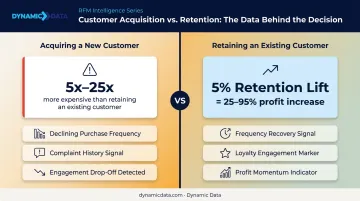
Acquiring a new customer costs 5–25x more than keeping an existing one. Bain & Company research shows that a 5% improvement in retention rates can boost profits by 25–95%. Predictive models flag at-risk customers using signals like declining purchase frequency, complaint history, and engagement drop-off — giving teams time to intervene with a targeted retention offer before the customer disengages.
Improved Marketing ROI
Predictive customer segmentation lets marketing teams direct budget toward the highest-value prospects and match messaging to each segment's predicted behavior. Segmented email campaigns generate a 760% revenue increase compared to non-segmented campaigns, per the Data & Marketing Association.
Top Use Cases of Predictive Analytics in E-commerce
Sales Forecasting and Demand Planning
Predictive models analyze historical sales data, promotional calendars, seasonal trends, and external market conditions to generate forward-looking demand forecasts. Procurement and operations teams can then align inventory and staffing with expected peaks before they arrive.
Beyond logistics, accurate demand forecasting improves cash flow — less capital locked in excess inventory, fewer revenue losses from stockouts.
Personalized Product Recommendations
Recommendation engines use collaborative filtering and purchase-pattern analysis to surface the most relevant products for each individual shopper. The performance data here is striking: only 7% of shoppers click a product recommendation, yet that group generates 26% of e-commerce revenue and 24% of orders, according to Salesforce Shopping Index data.
That click-to-revenue ratio makes recommendation engines one of the highest-leverage applications of predictive analytics in e-commerce.
Dynamic Pricing Optimization
Predictive analytics enables real-time price adjustments based on:
- Current demand signals and inventory levels
- Competitor pricing movements
- Customer price sensitivity by segment
- Historical conversion rates at different price points
Dynamic pricing increases profits by an average of 5–8%. However, 64% of consumers express concern about opaque algorithmic pricing. Brands that implement dynamic pricing need to pair automation with transparency — clear reasoning for price changes, and consistent floor pricing to avoid eroding trust.
Customer Churn Prediction and Retention
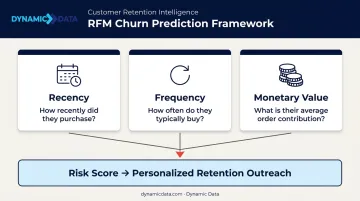
Recovering a lapsed customer costs far less than acquiring a new one — which makes churn prediction a high-ROI application of predictive analytics. RFM modeling (Recency, Frequency, Monetary value) is the most common framework for risk segmentation:
- Recency: How recently did the customer last purchase?
- Frequency: How often do they typically buy?
- Monetary value: What's their average order contribution?
Predictive models combine RFM scores with behavioral signals to prioritize outreach. High-risk customers receive personalized loyalty offers or re-engagement emails timed before they go cold.
Marketing Campaign Optimization
Predictive audience segmentation identifies which channels, messages, and timing are most likely to convert specific customer groups. A brand serving both mobile-first millennial shoppers and desktop-preferred buyers over 45 can route SMS offers to one segment and email-only campaigns to the other — improving conversion rates without increasing spend.
Real-World Examples of Predictive Analytics in E-commerce
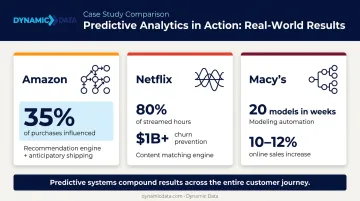
Amazon built its dominance on predictive systems. A McKinsey analysis found that product recommendations drive approximately 35% of Amazon's purchases — a benchmark that shows just how much revenue a well-tuned recommendation engine can capture. Amazon also holds a patent for "anticipatory shipping," a system that pre-positions inventory near likely buyers before an order is placed, based on predicted purchase behavior.
Netflix applies the same logic to subscription retention. Its recommendation engine drives roughly 80% of content hours streamed, and the company attributes over $1 billion in annual churn prevention to personalized content matching. For e-commerce subscription brands, the takeaway is concrete: relevant recommendations reduce cancellations more reliably than discounts.
Macy's delivers one of the most measurable retail outcomes on record. After deploying automated predictive modeling tools, the team built 20 predictive models in a matter of weeks — a 15x productivity gain over manual processes. That acceleration translated directly into a 10–12% increase in online sales, driven by tighter email targeting and personalized website content.
The pattern across all three: predictive systems don't just improve individual touchpoints — they compound across the entire customer journey.
| Brand | Predictive Application | Measured Outcome |
|---|---|---|
| Amazon | Product recommendation engine + anticipatory shipping | ~35% of purchases influenced by recommendations |
| Netflix | Personalized content matching | 80% of streamed hours; $1B+ in churn prevention |
| Macy's | Automated predictive modeling for email & web | 20 models in weeks; 10–12% online sales increase |
How to Get Started with Predictive Analytics in Your E-commerce Store
Step 1: Build a Clean, Unified Data Foundation
Predictive analytics is only as powerful as the data behind it. Before any model can be built, e-commerce businesses need to consolidate data from all sources — storefront, CRM, ad platforms, email tools, and inventory systems — into a centralized data warehouse.
Data silos are the biggest barrier here. When purchase data lives in one platform, customer profiles in another, and campaign data in a third, models can't see the full customer picture. A modern data stack built on Snowflake or BigQuery, with transformation layers like dbt, solves this by creating one reliable, connected data layer.
Step 2: Define Your Priority Use Case
Don't try to build everything at once. Scoping too broadly is a consistent pitfall — teams end up with multiple half-built models that don't deliver clear ROI.
Pick one high-impact application:
- Churn prediction if retention is your biggest revenue leak
- Demand forecasting if inventory mismanagement is eating your margins
- Recommendation engine if average order value and repeat purchase rate are your growth levers
Build your first model around a focused goal, measure the outcome, and then scale.
Step 3: Partner with a Data Specialist to Implement and Iterate
Most e-commerce teams don't have in-house data engineers and machine learning specialists. Building reliable predictive infrastructure from scratch is a significant technical undertaking. It involves:
- Building and maintaining data pipelines
- Feature engineering (preparing raw data for model training)
- Model training, deployment, and ongoing monitoring
Working with a specialist like Dynamic Data cuts the time it takes to go from scattered data to working models. The team's expertise across Snowflake, BigQuery, dbt, and Databricks means infrastructure is built correctly from the start, so models run on clean, well-structured data rather than fragmented inputs that skew outputs.
Frequently Asked Questions
How is predictive analytics used for e-commerce sales forecasting?
Predictive models analyze historical sales data, seasonality, promotional patterns, and demand signals to generate forward-looking revenue and inventory forecasts. This supports proactive procurement, staffing, and working capital decisions — before demand shifts, not after.
What is the role of predictive analytics in e-commerce?
Predictive analytics turns historical and real-time customer data into actionable forecasts. That spans personalization, inventory optimization, dynamic pricing, churn prevention, and marketing performance — every function that touches revenue.
What are examples of predictive analytics in marketing?
Three concrete examples: predictive audience segmentation to match messages to the right customer group, churn-risk scoring to trigger retention campaigns before customers go silent, and send-time optimization that predicts the highest-conversion delivery window for each subscriber.
What are the 4 types of analytics?
Descriptive (what happened), Diagnostic (why it happened), Predictive (what will happen), and Prescriptive (what should be done about it). Predictive and prescriptive analytics deliver the most direct business value — the first two primarily explain the past.
What is the 80/20 rule in e-commerce?
The Pareto Principle holds that roughly 80% of revenue comes from 20% of customers. Predictive analytics (particularly RFM modeling) identifies that top segment, so retention and upsell efforts are concentrated where they generate the most return.