Introduction
Many mid-market companies sit on a frustrating fence: leadership knows AI and machine learning can drive real competitive advantage, but the path forward feels designed for companies with Fortune 500 budgets and data science departments. So they wait — while competitors who moved earlier widen the gap.
Mid-market companies — typically defined as businesses with $10M–$1B in annual revenue — are often better positioned for AI/ML adoption than they realize. The tools have become more accessible, costs have dropped significantly, and the organizational structure that feels like a constraint is often an advantage: fewer stakeholders, faster decisions, and real domain expertise baked into every team.
This guide covers the highest-ROI AI/ML use cases for mid-market companies, what has to be in place before any model is trained, the pitfalls that derail most implementations, and how to build a roadmap scaled to your actual team and budget.
Key Takeaways
- Mid-market companies move faster than enterprises: fewer approval layers and less organizational inertia mean faster deployment
- Highest-ROI use cases: predictive analytics, demand forecasting, anomaly detection, and automated reporting
- Clean, governed data must come before any AI investment; your model is only as accurate as what feeds it
- Define the business problem first; select the tool second
- Start with one well-understood data domain and a time-bounded POC before scaling
Why Mid-Market Companies Have a Unique AI/ML Advantage
Mid-market companies sit in a genuinely favorable position for AI adoption. They have enough operational complexity and historical data to train meaningful models — without the bureaucratic layers that slow enterprise initiatives to a crawl.
Enterprise AI projects routinely stall on multi-quarter approval cycles, deep integration backlogs, and change management programs that span years. Mid-market companies can move from strategy to working pilot in weeks.
Two data points underscore the stakes:
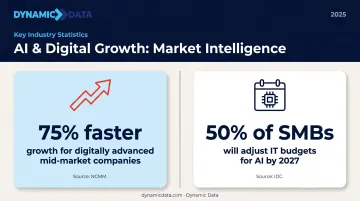
- Middle-market companies with a clear digital vision grow 75% faster on average than less digitally sophisticated peers, per the National Center for the Middle Market
- IDC projects that by 2027, 50% of SMBs will significantly adjust IT budgets for AI as vendor pricing and platform accessibility continue to improve
The competitive gap between companies that act now and those that wait is already widening — and it compounds with each quarter of inaction.
The Most Impactful AI/ML Use Cases for Mid-Market Companies
Operational Efficiency and Automation
ML models are most immediately valuable when applied to high-volume, rules-based work that consumes disproportionate staff time. Invoice processing, data reconciliation, and report generation are common targets.
The numbers are striking: only 35% of FP&A professionals' time goes toward generating insights, while 45% is consumed by data collection and validation alone. That imbalance is a process design issue — and one ML addresses directly.
A practical example: Canon deployed invoice automation through UiPath and achieved roughly 90% straight-through processing on approximately 40,000 invoices in under nine months. For a mid-market finance team processing thousands of invoices monthly, even a fraction of that efficiency gain frees meaningful capacity.
Predictive Analytics and Demand Forecasting
Predictive analytics converts historical patterns into forward-looking decisions — inventory levels, customer churn probability, revenue cycle timing. For mid-market companies operating with lean teams and limited buffer capital, accurate forecasting is especially high-stakes.
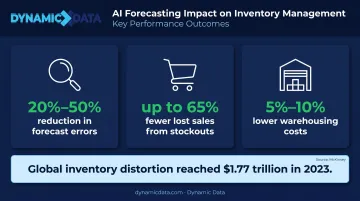
McKinsey reports that AI-driven forecasting can reduce forecast errors by 20%–50%, cut lost sales from stockouts by up to 65%, and reduce warehousing costs by 5%–10%. In retail alone, global inventory distortion — the combined cost of overstocks and stockouts — reached $1.77 trillion in 2023.
Mid-market companies in distribution, retail, and manufacturing stand to capture outsized gains here precisely because their forecasting processes are often still spreadsheet-dependent.
Customer Intelligence and Personalization
The business case for customer intelligence is concrete: companies that execute personalization well generate 40% more revenue from those activities than average performers, according to McKinsey. And 76% of consumers report frustration when companies fail to deliver personalized interactions.
ML models make this accessible without a dedicated data science team. They can surface:
- Which customers are at risk of churning before they leave
- Which product combinations drive repeat purchase behavior
- Which segments respond to specific messaging or offers
For mid-market B2B and B2C companies competing against larger players, this kind of behavioral intelligence is one of the fastest ways to close the experience gap.
Dynamic Data's team builds recommendation engines and behavior models that work on the cloud infrastructure mid-market companies already use — Snowflake, BigQuery, Databricks — without requiring a greenfield data science function.
Anomaly Detection and Risk Management
Manual audit processes simply cannot monitor every transaction, data record, or system signal at scale. ML-powered anomaly detection runs continuously and flags irregularities that humans would miss.
The stakes are significant. The ACFE estimates organizations lose 5% of annual revenue to fraud annually, with average losses exceeding $1.5 million per fraud case. On the cybersecurity side, IBM's 2024 data breach report found that organizations using AI and automation in security operations experienced $2.2 million lower breach costs and contained incidents 98 days faster than those without.
For mid-market companies without large internal audit or security teams, automated monitoring provides the continuous coverage that a manual process never could — without adding headcount.
Reporting Automation and Business Intelligence
The median time to produce period-end management reports is 10 days, according to APQC benchmarks. For many mid-market finance and operations teams, that lag means leadership is making decisions on data that's already two weeks old.
Automated reporting pipelines eliminate the manual build-and-refresh cycle. Dashboards update in real time. Executives see KPIs when they need them, not when a report is finally ready. MIT Sloan research found that organizations in the top quartile for real-time data availability had 50% higher revenue growth and net margins than bottom-quartile peers — a gap that traces directly back to decision speed.
Before the Algorithm: Why a Strong Data Foundation Is Non-Negotiable
No AI model outperforms its training data. Fragmented, duplicated, or ungoverned data produces unreliable outputs — and unreliable outputs erode trust fast. That fragmentation is the most common reason mid-market AI projects stall after launch.
Most mid-market companies have data scattered across ERP systems, disconnected spreadsheets, CRM platforms, and legacy databases that were never designed to talk to each other. Gartner estimates poor data quality costs organizations an average of $12.9 million annually, and 59% of organizations don't even measure data quality.
What a Modern Data Stack Looks Like
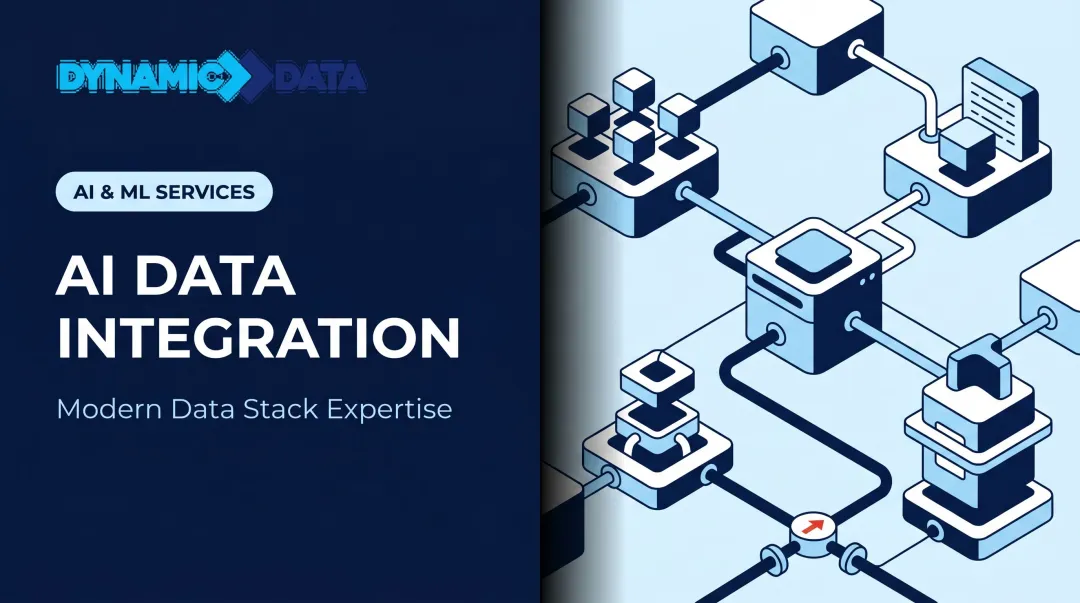
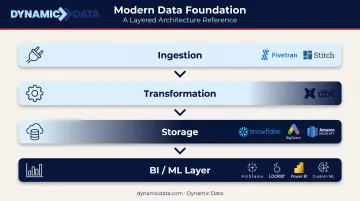
Before introducing any ML model, a mid-market company needs a functioning data foundation across four layers:
- Ingestion — connecting source systems (ERP, CRM, marketing platforms) using tools like Fivetran or Stitch
- Transformation — cleaning and modeling data using tools like dbt to create consistent, reliable structures
- Storage — a cloud data warehouse (Snowflake, BigQuery, Amazon Redshift) where clean data lives
- BI/ML layer — analytics and modeling tools (Tableau, Looker, Power BI, or custom ML models) that sit on top
Dynamic Data's team (including multiple dbt Certified Developers) helps mid-market companies build this foundation from the ground up. The Zenus engagement illustrates what that looks like in practice: Dynamic Data implemented a Google Cloud data warehouse with dbt-powered transformation pipelines, enabling real-time client-facing dashboards in Looker Studio. The client noted it accelerated both their product development and go-to-market strategy.
Start Small, Build Trust
Rather than attempting a full data overhaul, identify one high-quality data domain — such as sales pipeline data or customer transaction history — and build the first AI use case on that clean foundation. A proof-of-concept approach limits risk and generates early wins that build internal momentum for broader adoption.
Good candidates for that first domain include:
- Sales pipeline data — typically well-structured and directly tied to revenue outcomes
- Customer transaction history — high volume, consistent schema, easy to validate
- Inventory records — concrete, measurable, and low-risk to model against
Navigating the Common Pitfalls of Mid-Market AI/ML Adoption
Gartner predicts that at least 30% of generative AI projects will be abandoned after proof of concept by end of 2025 — due to poor data quality, unclear business value, or escalating costs. Most of these failures are avoidable.
Pitfall 1: Technology before strategy
The most common failure starts before a single line of code is written. A team evaluates an AI platform, gets excited about the demos, and purchases before defining the business problem it should solve.
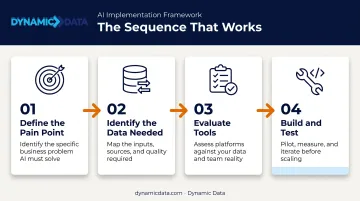
The sequence that works: define the pain point → identify the data needed → evaluate tools → build and test. Without a clear problem statement at the start, even technically sound implementations tend to solve the wrong thing.
Pitfall 2: Underestimating skill gaps
IBM's Global AI Adoption Index identifies limited AI skills and expertise as the leading adoption barrier (33% of enterprises), followed by data complexity (25%). Mid-market companies rarely have full ML engineering capacity in-house.
The practical solution is a hybrid model: partner with external specialists to execute current initiatives while internal teams build capability over time. Dynamic Data's engagements often operate this way — one client noted they initially hired the team in an advisory capacity, but their expertise ran so deep that Dynamic Data's staff became central to the project.
Pitfall 3: Ignoring change management
Even well-built models fail when employees don't trust the outputs. If an ML model recommends a pricing adjustment that contradicts a sales team's gut instinct, and no one has explained how the model works or what it's optimizing for, the recommendation gets ignored.
Adoption requires clear communication about what the AI informs, what decisions remain human, and how results are interpreted. MIT Sloan and BCG research found that organizations where employees derive personal value from AI are 5.9 times more likely to achieve significant financial benefits.
Pitfall 4: Scaling before trust is built
Expanding an AI initiative before it's earned internal trust is how small problems become expensive ones. A stage-gate approach avoids this: start with a narrow, well-defined POC in one department, measure results against pre-agreed metrics, then expand once confidence is established. This limits cost exposure and lets teams validate assumptions before full deployment.
Building a Practical AI/ML Roadmap: Where to Start
Step 1 — Identify the highest-value pain point
The starting question is never "where can we use AI?" It's "what is our most costly, data-rich, and repeatable problem?"
Common high-value starting points for mid-market companies:
- Manual forecasting processes with regular accuracy gaps
- Report generation cycles that take 7–10+ days
- High customer churn with no early-warning signals
- Operational bottlenecks consuming disproportionate staff time
Step 2 — Assess data readiness and build the foundation
Before selecting tools or models, conduct an honest audit of data quality, completeness, and governance in your chosen domain. If data gaps exist, address them first, since this step often reveals infrastructure work that must happen before ML can begin.
This is where working with a firm like Dynamic Data — which specializes in modern data stacks, dbt-certified data modeling, and custom ML solutions — allows assessment and build phases to run in parallel rather than sequentially, cutting weeks off the typical onboarding cycle.
Step 3 — Run a time-bounded POC with defined success metrics
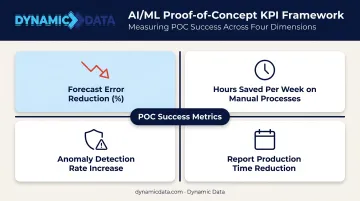
Every AI/ML initiative should launch with pre-agreed KPIs:
- Reduction in forecast error (%)
- Hours saved per week on manual processes
- Increase in anomaly detection rate
- Reduction in report production time
A POC that rules out the wrong tool is still a win. You've validated an assumption for a fraction of full deployment cost, and you can redirect resources before they're committed at scale.
Frequently Asked Questions
What is ChatGPT AI?
ChatGPT is a generative AI tool built on large language models (LLMs) that generates human-like text, answers questions, and assists with tasks. While it's one of the most visible AI tools available, mid-market companies typically benefit more from purpose-built ML solutions trained on their specific operational data.
What are the basics of how AI works?
AI systems learn from data by identifying patterns and using those patterns to make predictions or decisions. Machine learning, a subset of AI, trains models on historical data so they can forecast outcomes or detect anomalies without being explicitly programmed for each scenario.
What are the 5 rules of AI?
There's no single universal standard, but the OECD AI Principles establish five values covering fairness, transparency, safety, accountability, and inclusive growth. For mid-market teams, these translate to governed data practices, clear decision logic, and human oversight at critical steps.
What is the difference between AI and machine learning?
AI is the broad concept of machines performing tasks that typically require human intelligence. Machine learning is a specific technique within AI where models learn from historical data and improve over time — most practical mid-market implementations rely on supervised ML methods like forecasting or classification.
How long does it take to implement an AI/ML solution for a mid-market company?
A focused POC on a well-defined use case with clean data typically delivers in 4–12 weeks. A full production deployment across a business process generally takes 3–6 months. Data readiness and implementation partner experience are the biggest variables.