Introduction
Most organizations collect more data than ever — and make fewer confident decisions because of it. Sales teams run their numbers in spreadsheets. Finance works from a warehouse that marketing can't access. Executives wait days for reports that still contradict each other by the time they arrive.
The problem isn't data volume. It's architecture.
Research from HBR Analytic Services surveying 366 executives found that data-and-AI leaders outperformed their peers across every dimension that matters: operational efficiency (81% vs. 58%), revenue growth (77% vs. 61%), and customer retention (77% vs. 45%). The gap between leaders and laggards starts with architecture and governance — not data volume.
This guide breaks down what enterprise data architecture consulting involves, how to recognize when your organization needs it, what a typical engagement looks like, and how to choose the right partner to close that gap.
Key Takeaways
- Data-and-AI leaders outperform peers on revenue, efficiency, and retention — the gap is architectural, not a data volume problem
- Enterprise data architecture consulting assesses current systems, designs a target architecture, and establishes the governance model to sustain it
- Key warning signs: contradictory reports, failed AI initiatives, siloed data environments, and rising infrastructure costs with no decision-making improvement
- A strong engagement ends with internal teams fully equipped to own and manage the architecture going forward
- Choose partners who start with your business goals, not a preferred platform
What Is Enterprise Data Architecture Consulting?
Enterprise data architecture (EDA) is the organizational blueprint governing how data is collected, stored, integrated, governed, and delivered across an entire organization. It's distinct from system-level or domain-specific architecture, which only governs a single application or department. EDA has to work across all of them simultaneously.
DAMA-MN defines data architecture as the structure and integration of data systems and platforms that support business operations and analytics — aligning data strategy with technical design for scalability, usability, and adaptability across the enterprise. In practice, that means making decisions across four interconnected layers:
- How data moves from source systems into storage
- How it gets transformed into analysis-ready assets
- Who owns it and is accountable for its quality
- How it reaches the people and systems that need it
What Consulting Actually Adds
Enterprise data architecture consulting brings external experts who assess the current-state architecture, identify gaps and anti-patterns, and build a practical roadmap — bridging the gap between technical infrastructure and business strategy. That distinction is what separates useful architecture from shelf-ware: most organizations have architecture documents, but very few have architecture that actually reflects how the business operates and where it's headed.
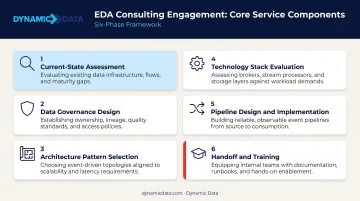
Typical service components in an EDA consulting engagement include:
- Current-state assessment — maps existing data systems, ownership, and downstream consumers to expose gaps and redundancies
- Data governance design — establishing ownership, quality standards, and stewardship roles
- Architecture pattern selection — choosing between data mesh, data fabric, lakehouse, or medallion approaches based on organizational maturity
- Technology stack evaluation — vendor-neutral platform recommendations aligned to budget and existing infrastructure
- Pipeline design and implementation — building the ingestion, transformation, and delivery layers end-to-end
- Handoff and training — equipping internal teams to manage what was built
For organizations that need someone to own the full scope — not just deliver a slide deck — Dynamic Data's data strategy and architecture practice covers all of these components, from strategic planning and architecture design through governance, compliance, and ongoing optimization, with dbt-certified engineers who design and build what they recommend.
Signs Your Enterprise Needs Data Architecture Consulting
Silo Sprawl and the "Which Number Is Right?" Problem
The most common trigger is rarely a dramatic system failure. It's the slow accumulation of disconnected environments that can't answer cross-functional questions — finance running a separate warehouse, marketing maintaining a data lake, sales living in the CRM, none of them integrated.
The result: answering a question like "what's our total customer acquisition cost by channel?" requires a manual data pull from three systems, a lot of assumptions, and a spreadsheet that someone will dispute in the next meeting.
When Dynamic Data began working with Pima Solar, the company was running analytics out of custom Google Sheets because no existing tool was configured for their tracking needs. Their data from CallFire, Go High Level, and JobNimbus existed in separate silos, which made it impossible to see the complete user journey or measure marketing effectiveness accurately.
Operational Warning Signs to Watch For
- Reports that contradict each other across departments, with no clear authority on which is correct
- Long delays between a business question and a reliable answer — days or weeks, not hours
- Analytics tools that were expensive to implement but are barely used
- Data quality issues that recur without a clear owner to resolve them
- AI or ML initiatives that stall or produce unreliable outputs
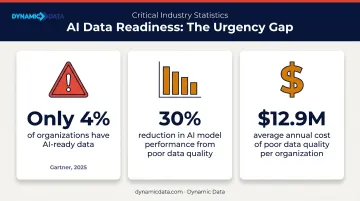
The AI stall point is particularly telling. Gartner research published in 2025 found that only 4% of organizations have AI-ready data, and that poor data quality can cut AI model performance by 30%. Organizations that want to deploy machine learning or predictive analytics consistently discover that their pipelines, lineage tracking, and data ownership structures aren't ready — the technology isn't the bottleneck, the data foundation is.
Poor data quality also carries a direct financial cost. Gartner estimates it costs organizations at least $12.9 million per year on average in rework, failed projects, and missed opportunities.
Core Components of a Strong Enterprise Data Architecture
Ingestion and Integration Layer
Data enters the ecosystem through batch ETL, real-time streaming, API connections, or event-driven pipelines. Standardizing how data flows from source systems — CRMs, ERPs, transactional databases, IoT devices — into a central environment is foundational to everything downstream. Inconsistent ingestion patterns are one of the most common sources of data quality problems, because errors introduced at the source propagate through every downstream layer.
Storage Architecture
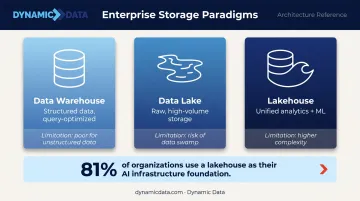
Three main paradigms dominate enterprise storage decisions:
| Pattern | Best For | Limitations |
|---|---|---|
| Data Warehouse | Structured data, query-optimized analytics | Less suited for unstructured or raw data |
| Data Lake | Raw, unstructured, high-volume storage | Without governance, becomes a "data swamp" |
| Lakehouse | Unified analytics and ML on structured + unstructured data | Higher implementation complexity |
Storage decisions are non-trivial. According to IDC data cited by Wasabi, 78% of all stored enterprise data is unstructured — and that share is forecast to grow from 5.5 zettabytes in 2024 to 10.5 zettabytes by 2028. Organizations that architect only for structured, query-optimized workloads are already behind.
The AI workload picture reinforces this: a TDWI/Dremio survey found that 81% of organizations use a data lakehouse as their AI infrastructure foundation. That number alone explains why lakehouse adoption has accelerated faster than any other storage pattern.
Dynamic Data's team works across Snowflake, BigQuery, Databricks, Azure, and AWS — enabling platform-neutral recommendations based on the client's actual workload mix rather than a default preference.
Data Transformation and Semantic Layer
Once data is stored, the next question is whether it can actually be used. Raw data is rarely analysis-ready. ELT/ETL pipelines and business rule engines convert it into clean, structured assets. The semantic layer sits above that — translating technical data models into business-friendly terms so that a marketing analyst can pull a reliable report without needing to understand the underlying schema.
Dynamic Data uses dbt-certified pipelines to build these transformation layers, with version control and automated testing built in. The Zenus engagement illustrates this: the company needed fully automated data processing, moving away from manually processed data to a pipeline that detected problems before they reached end users.
Governance and Data Catalog Layer
Governance is consistently the weakest layer in enterprise data architecture. Most teams underinvest here until a compliance incident or a bad executive dashboard forces the issue. A complete governance framework covers:
- Cataloging what data exists, where it lives, and what it means (metadata management)
- Tracing data from source through every transformation (lineage tracking)
- Enforcing who can view, modify, or export specific datasets (access controls)
- Running automated quality checks continuously — not just at initial setup
Only 19% of enterprises have a clear and fully implemented governance strategy, according to Workday's research — while 35% have no governance strategy at all. Without clear data ownership, governance becomes theater: policies on paper that no one enforces.
Consumption and Delivery Layer
Architecture design should work backwards from how data will actually be used. Governed data reaches its consumers through BI dashboards, embedded analytics, APIs, and ML model training pipelines. A storage layer that analysts can't reach — or don't trust — is an expensive non-answer to the original problem.
What the Consulting Engagement Looks Like
Phase 1 — Discovery and Current-State Assessment
Consultants inventory existing data systems, owners, and consumers. Stakeholder interviews span both business units and IT — because the pain points experienced by a finance director and a data engineer are rarely the same problem, even when they trace to the same architectural gap.
The output is an honest baseline: a current-state assessment documenting existing systems, ownership gaps, quality issues, and regulatory exposure. This becomes the evidence base for everything that follows.
The scope is deliberately focused — enough clarity to design a target state that will actually work, without auditing every table in every database.
Phase 2 — Architecture Design and Framework Selection
Based on discovery findings, consultants select the appropriate architecture framework (such as TOGAF for enterprise-wide governance or DAMA-DMBOK for data management discipline) and the right architecture pattern:
- Data mesh — strong fit for large organizations with mature, autonomous domain teams
- Data fabric — suited for enterprises needing unified metadata and automated data integration
- Lakehouse — balances structured and unstructured data for analytics-heavy environments
- Medallion — works well for teams building incremental data quality layers in Databricks or similar platforms
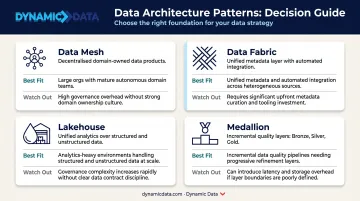
The choice depends on organizational maturity, team capacity, data volume, and regulatory requirements. A data mesh, for example, fails quickly in an organization that doesn't yet have clear data ownership within a single domain.
Phase 3 — Governance Model and Technology Stack
Consultants establish the governance operating model: data ownership RACI, data quality standards, and stewardship role definitions. Technology stack decisions follow from the same evidence base.
Dynamic Data's team works across 35+ platforms, with dbt-certified developers and hands-on experience in Snowflake, BigQuery, Databricks, Azure, and AWS. Platform recommendations reflect the client's operational requirements and budget — there are no preferred vendor relationships influencing the selection.
Phase 4 — Implementation and Integration
Pipelines are built domain by domain, not as a single organization-wide migration. One business domain goes live first as a proof of concept, demonstrating value and surfacing integration challenges before broader rollout. Quality rules are automated. Self-service analytics are enabled for the first domain's users.
The Zenus engagement followed this model: Dynamic Data worked closely with Zenus's engineering team throughout implementation, making design decisions collaboratively at each stage rather than delivering a finished system at the end.
Phase 5 — Handoff, Training, and Ongoing Support
A successful engagement ends with internal teams capable of managing and evolving the architecture independently. That means documentation, training, and governance frameworks that your team can own.
This is worth scrutinizing when evaluating partners. An engagement that produces a well-architected system but leaves no internal capability to maintain it will drift — governance erodes, pipelines break without clear owners, and the architecture can't adapt as the business changes.
Key Benefits of Enterprise Data Architecture Consulting
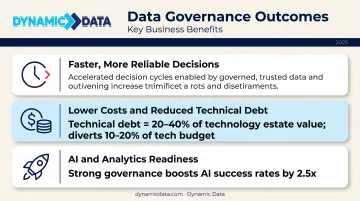
Done right, architecture consulting delivers measurable impact across three areas that matter most to data-driven organizations:
Faster, more reliable decisions. A well-governed architecture eliminates the "which report is correct?" problem. Leaders can act on market changes in hours rather than waiting days for a reconciled dataset.
Lower costs and reduced technical debt. Architecture consulting eliminates redundant tools, consolidates fragmented data environments, and prevents ungoverned data from accumulating into expensive remediation work later.
McKinsey estimates technical debt accounts for 20% to 40% of a technology estate's value before depreciation — and diverts 10% to 20% of the technology budget away from new capabilities.
AI and analytics readiness. Clean, lineage-tracked data produces reliable model outputs. Ungoverned pipelines produce biased or inconsistent results that undermine the AI investment entirely.
Gartner found that strong governance boosts AI success rates by 2.5x — meaning architecture decisions made today directly determine whether AI initiatives deliver two years from now.
How to Choose the Right Enterprise Data Architecture Consulting Partner
Start With Business Goals, Not Platforms
The right partner begins with your business goals and regulatory requirements before recommending any technology. Be cautious of consultants who lead with a preferred vendor or immediately propose the most architecturally complex solution. Good partners match the solution to your organization's actual maturity and team capacity — not to what looks most impressive on a slide deck.
Verify Engineering Execution, Not Just Design Capability
Architecture documents don't move data. Look for partners with hands-on technical credentials:
- Certified dbt developers and cloud platform specialists
- A track record of building, testing, and deploying pipelines into production
- Experience across the platforms already in your stack (or adjacent to it)
Dynamic Data's team holds dbt Certified Developer credentials and ISTQB certification, with practical experience across Snowflake, BigQuery, Databricks, Tableau, Power BI, Looker, and 35+ additional platforms.
Probe Their Governance and Knowledge Transfer Approach
From there, governance is where many engagements quietly fail. Ask prospective partners how they handle RACI design, data stewardship training, and documentation handoff. A partner who builds your internal capability creates lasting value; one who creates dependency is a long-term liability.
Assess Communication Clarity and Cultural Fit
Enterprise data architecture engagements span months and require ongoing collaboration between consultants and internal stakeholders. The right partner explains complex technical decisions in plain business language, involves your team as co-creators, and adapts to your organization's processes. Clients consistently describe Dynamic Data's team as having "a rare combination of technical abilities and interpersonal skills" — and as "business professionals, not just technical professionals."
Frequently Asked Questions
What is the difference between data architecture consulting and data strategy consulting?
Data strategy consulting defines the high-level roadmap for how an organization will use data as a business asset. Data architecture consulting designs the technical and governance infrastructure — storage, pipelines, integration, and data quality systems — that makes that strategy executable. Both disciplines are complementary but distinct: one sets direction, the other makes it buildable.
How long does an enterprise data architecture consulting engagement typically take?
Timelines vary by scope and organizational maturity. Most engagements — from discovery through initial core-domain implementation — run 6 to 12 months, with complex enterprise rollouts extending to 18 months or more. The assessment phase alone typically takes 6 to 8 weeks before architecture design begins.
What are the signs that your organization needs enterprise data architecture consulting?
Common indicators include persistent data quality disputes between departments, inability to answer cross-functional business questions reliably, failed or stalled AI and analytics initiatives, and rising data infrastructure costs without corresponding improvement in decision-making speed or quality.
Can mid-sized businesses benefit from enterprise data architecture consulting?
Yes. Mid-sized companies undergoing digital transformation, scaling rapidly, or preparing for AI adoption often benefit more from architecture consulting than large enterprises — because establishing good architectural foundations early prevents costly remediation later. Dynamic Data works with mid-market clients across SaaS, IoT, construction, real estate, and healthcare, with engagements scaled to match organizational complexity.
What is the first deliverable a business should expect from a data architecture consulting engagement?
The first tangible deliverable is a current-state assessment and gap analysis — documenting existing data systems, ownership gaps, quality issues, and regulatory exposure. This serves as the evidence base for the target-state architecture design and prevents the engagement from being built on assumptions about what the organization currently has.
How does enterprise data architecture consulting support AI and machine learning initiatives?
AI and ML models are only as reliable as the data they're trained on. Architecture consulting ensures the pipelines, quality rules, and governance structures are in place to feed models clean, lineage-tracked data at the scale model training and deployment requires. Without that foundation, even well-built models produce unreliable or biased outputs.