Introduction
Most businesses have tried at least one off-the-shelf AI tool. Many have discovered the same problem: the tool works fine in demos but struggles the moment it encounters proprietary data, a non-standard workflow, or an industry-specific compliance requirement.
That gap — between what generic AI products promise and what businesses actually need — is exactly why demand for custom generative AI development services is accelerating. Gartner forecasts worldwide GenAI spending will reach $644 billion in 2025, up 76.4% year over year.
The investment is real, but so is the risk. Gartner also warns that at least 30% of GenAI projects will be abandoned after proof of concept, largely due to poor data quality and unclear business value.
Understanding what separates successful custom AI builds from abandoned ones starts with knowing what the development process actually involves. This guide covers what custom generative AI development includes, how it differs from off-the-shelf tools, what a quality engagement looks like end-to-end, and how to evaluate the right development partner.
Key Takeaways
- Custom GenAI development builds AI systems around your proprietary data, workflows, and compliance requirements
- Off-the-shelf tools fail at complex, data-sensitive, or compliance-heavy use cases
- Quality engagements span data engineering, model selection, RAG integration, system integration, and ongoing optimization
- Data readiness is the most underestimated factor in GenAI project success
- The right partner combines data engineering depth with AI capability — building production-ready systems, not just models
What Are Custom Generative AI Development Services?
Custom generative AI development services design, build, and deploy AI systems around a specific business's data and goals — not retrofitted from a generic template. The output looks different from off-the-shelf tools because the foundation is different: proprietary data, actual workflows, and real operational constraints.
The distinction matters. Traditional automation executes fixed rules. Generative AI produces new outputs — text, summaries, decisions, classifications — where quality depends entirely on the specificity of the data it learns from or retrieves against. That requires a different development approach from the ground up.
"Custom" has a precise meaning here. It means:
- Using a business's proprietary data as the training and retrieval foundation
- Building around actual internal workflows, not assumed generic ones
- Accounting for industry-specific compliance and data governance requirements
- Integrating with the existing technology stack rather than sitting beside it
Gartner projects that by 2027, more than half of GenAI models used by enterprises will be domain-specific, compared with just 1% in 2024. That gap — from 1% to majority adoption in three years — reflects how quickly domain-specific models are outperforming general-purpose ones on the metrics that matter: accuracy, compliance fit, and integration depth.
Custom GenAI vs. Off-the-Shelf AI Tools: What's the Difference?
Not all AI tools are built the same. Off-the-shelf solutions are trained on generic, public data — they can't access your proprietary systems, require workarounds to fit existing workflows, and tend to create data silos rather than dissolve them. For businesses with complex operations, that gap translates directly into missed ROI.
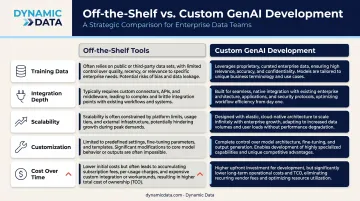
The comparison below captures the practical difference:
| Dimension | Off-the-Shelf Tools | Custom GenAI Development |
|---|---|---|
| Training data | Generic, public datasets | Proprietary business data |
| Integration depth | Shallow API connectors | Deep integration across your full tech stack |
| Scalability | Capped by vendor architecture | Designed for your growth trajectory |
| Customization | UI configuration only | Architecture-level design |
| Cost over time | Escalating license fees | Owned system with compounding ROI |
When Off-the-Shelf Is Sufficient
Generic tools work well for low-stakes, straightforward tasks that don't require proprietary data access — drafting emails, generating basic content, or answering general questions. If the task is isolated and the output doesn't need to reflect your specific business context, an off-the-shelf tool is the right call.
When Custom Development Is Necessary
Custom development becomes necessary when:
- Workflows involve sensitive, proprietary, or regulated data
- Accuracy depends on internal knowledge bases, databases, or historical records
- Industry compliance requirements restrict how data can be processed or stored
- The AI system needs to integrate with CRMs, ERPs, or internal platforms
- Your competitive edge depends on what the AI knows that rivals don't
Core Components of a Custom Generative AI Development Engagement
The Data Foundation Layer
Before any model is selected or built, data must be addressed. Poor data quality is the leading cause of GenAI project failure — Gartner predicts 60% of AI projects unsupported by AI-ready data will be abandoned through 2026.
A quality engagement addresses:
- Data pipeline engineering and ETL/ELT architecture
- Data cleaning, deduplication, and schema design
- Governance frameworks for data quality and access control
Organizations without a modern data stack often need this foundational work done before model development begins. Dynamic Data handles both data engineering and AI development within a single engagement, which avoids the coordination failures that come from treating these as separate workstreams.
LLM Selection, Fine-Tuning, and RAG Integration
Model selection involves evaluating whether to use open-source models (Llama, Mistral), proprietary APIs (GPT, Claude), or domain-trained models — and that decision depends on cost, compliance requirements, latency needs, and data sensitivity.
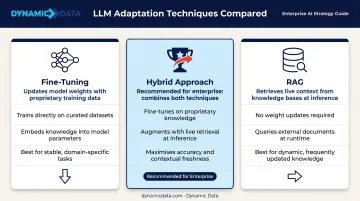
Two techniques shape how models adapt to your domain:
- Fine-tuning updates model weights using proprietary training data, improving performance on specific tasks
- RAG (Retrieval-Augmented Generation) retrieves relevant context from connected knowledge sources at inference time, without touching model weights
As AWS's guidance on RAG vs. fine-tuning notes, hybrid approaches combining both techniques often deliver the strongest results for enterprise use cases. RAG is particularly valuable for keeping AI grounded in current business data — documents, databases, product catalogs, policy manuals — which reduces hallucinations and improves verifiable accuracy.
API Development, System Integration, and Deployment
A custom AI system that doesn't connect to existing infrastructure creates new silos instead of eliminating them. A complete engagement includes:
- API development to expose AI capabilities within existing applications
- Integration with CRMs, ERPs, BI platforms (Tableau, Power BI, Looker, Sigma), and communication tools
- Production deployment on cloud infrastructure (AWS, GCP, Azure, Databricks, Snowflake)
- Performance monitoring, drift detection, and continuous optimization
Deployment opens the iteration cycle. Custom AI systems improve with more data and operational feedback, which is why post-deployment monitoring matters as much as initial build quality.
Business Benefits of Custom Generative AI Solutions
The business case for custom GenAI is grounded in specific, measurable outcomes rather than general capability claims.
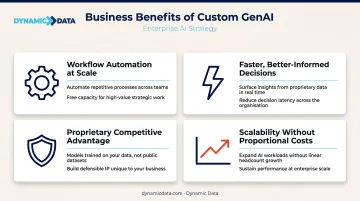
Workflow automation at scale. Custom systems handle high-volume, complex tasks — document processing, report generation, data analysis, customer communications — that generic tools cannot perform reliably in a business-specific context. McKinsey estimates GenAI could increase customer care productivity by 30% to 45% of current function costs. One study found a 14% increase in issue resolution per hour and a 9% reduction in handling time.
Faster, better-informed decisions. Unlike static dashboards, custom generative AI synthesizes data from multiple sources and delivers specific recommendations in plain language. The gap between data and decision shrinks considerably when the AI can navigate your actual data environment, not a generic one.
Proprietary competitive advantage. When a system is trained on your data and built around your workflows, it becomes an asset competitors using the same off-the-shelf tools cannot replicate. Each additional dataset it processes sharpens its accuracy on your specific terminology, edge cases, and business logic — making it harder to replicate and more valuable over time.
Scalability without proportional cost increases. SaaS subscriptions scale in cost with usage. A custom-built system's architecture can be extended for new use cases without a full rebuild — and as the model is exposed to more data, output quality improves without requiring equivalent cost increases.
Taken together, these advantages shift custom AI from a technical project into a long-term business asset — one that gets more valuable as your data grows and your workflows evolve.
Industry Use Cases: Where Custom GenAI Delivers the Most Value
Financial Services
McKinsey estimates GenAI could add $200 billion to $340 billion annually in value for banking if use cases are fully implemented. High-value applications include:
- Automated compliance and risk workflow processing
- ESG report synthesis and regulatory documentation
- Anomaly detection in transactional data
That said, GenAI alone isn't suited for numerical predictive modeling. Reliable custom deployments pair LLM interfaces with dedicated forecasting models and governed analytics pipelines.
Healthcare and Life Sciences
Accenture reports that 40% of healthcare working hours involve language-based tasks GenAI can handle — clinical documentation, patient intake, scheduling, and internal knowledge retrieval.
Voice-enabled documentation tools have shown clinicians saving an average of five minutes per encounter, with some organizations reporting physicians seeing 2–4 more patients per day.
Off-the-shelf tools are generally unsuitable here. Compliance requirements, PHI handling constraints, and the accuracy stakes in clinical settings demand systems built with governance at the architecture level.
E-commerce, Retail, and SaaS
Salesforce research found 93% of retailers already use GenAI for personalization tasks, but only 17% have a complete, unified view of their customers. That data readiness gap is precisely where custom development creates advantage — building recommendation engines, AI-powered support automation, and personalized content generation on top of a unified, proprietary data layer rather than fragmented sources.
How to Choose a Custom Generative AI Development Partner
Data Engineering Depth
A generative AI system is only as good as the data it runs on. The most common reason projects fail isn't model quality — it's data quality. Look for partners who demonstrate genuine capability in data pipeline engineering, governance, and analytics infrastructure, not just model development. This is the differentiating capability between high-ROI deployments and abandoned proofs of concept.
Full-Lifecycle Ownership
Confirm the partner handles the full engagement under one roof:
- Strategy and data preparation
- Model development and system integration
- Deployment and ongoing optimization
Splitting these phases across multiple vendors introduces coordination risk and accountability gaps that erode outcomes before the project even reaches production.
Industry-Specific Experience
Partners with experience in your sector already understand your data structures, regulatory constraints, and operational workflows. A generalist vendor without sector experience has to learn on your timeline and your budget. Ask for case studies with measurable outcomes, not technology demonstrations.
Long-Term Partnership Orientation
Custom generative AI is not a one-time project. It requires continuous iteration as business needs evolve, new data becomes available, and model performance shifts over time. Evaluate whether a partner operates as a long-term intelligence partner or a one-off vendor.
Dynamic Data operates this way by design. The team spans data engineering, AI, and analytics, with engagements that evolve alongside business needs rather than closing out at a fixed deliverable. Clients like Zenus have described the team as becoming "an integral part of our team" — a signal that the relationship was built around outcomes, not project scope.
Frequently Asked Questions
What is included in custom generative AI development services?
A complete engagement covers data pipeline engineering, model selection and fine-tuning, RAG or agent integration, API development, enterprise system integration, production deployment, and ongoing monitoring. Everything is scoped around the client's specific workflows, data environment, and compliance requirements.
How is custom generative AI different from off-the-shelf AI tools?
Custom solutions are built on proprietary business data, integrate deeply with existing enterprise systems, and are architected around the client's specific workflows. Off-the-shelf tools use generic training data and offer limited integration, which creates workarounds and constrains ROI in complex or data-sensitive environments.
How long does it take to build a custom generative AI solution?
Timeline depends on scope and data readiness. Simpler single-use-case deployments may take 8–12 weeks; multi-system enterprise deployments can take several months. Data foundation work, not model development, most commonly drives the overall timeline.
How much do custom generative AI development services cost?
Investment varies by scope, data complexity, and integration requirements. Well-scoped engagements are evaluated against projected ROI — productivity gains, cost reduction, and revenue impact — with most clients prioritizing time-to-positive-ROI over nominal cost.
What industries benefit most from custom generative AI development?
Financial services, healthcare, e-commerce, SaaS, and logistics see the strongest and fastest ROI — all characterized by high data volumes, complex workflows, and clear operational bottlenecks that custom GenAI can address directly.
Do I need clean data infrastructure before investing in custom generative AI?
Data quality and structure are foundational — poor or siloed data produces inaccurate outputs regardless of model quality. Strong partners assess data readiness upfront and incorporate pipeline work into the engagement, so it's not a blocker you need to solve before starting.