Introduction
Most B2B organizations are spending more on AI than ever before — and getting less out of it than they expected. According to McKinsey's 2025 State of AI survey, 88% of organizations now use AI in at least one business function, yet only 39% report measurable EBIT impact at the enterprise level. The gap between adoption and actual value is substantial.
The reason isn't a lack of effort. It's a design mismatch. Off-the-shelf AI platforms are built for mass adoption — broad datasets, standardized workflows, preset configurations. B2B operations run on something different entirely: proprietary data, legacy systems, multi-step approval chains, and compliance obligations that shift by industry and jurisdiction.
This article covers:
- Why generic AI consistently underperforms in complex B2B environments
- Which use cases generate the strongest returns when custom-built
- How industry-specific AI applies across key verticals
- What to look for when evaluating a development partner
Key Takeaways
- Custom AI is built around your workflows, data, and compliance requirements — not the other way around
- Highest-impact B2B use cases: workflow automation, predictive analytics, document processing, and revenue intelligence
- Industry-specific AI achieves accuracy that general-purpose platforms can't replicate by design
- The build-vs-buy decision depends on operational complexity, data sensitivity, and long-term ROI expectations
- Choose a development partner with equal strength in AI capability and data infrastructure
Why Off-the-Shelf AI Falls Short for Complex B2B Operations
The Structural Mismatch
Generic AI platforms are trained on broad, horizontal datasets. They're designed to work for many companies across many industries — which means they're optimized for none of them specifically.
RAND Corporation's 2024 research found that more than 80% of AI projects fail to reach meaningful production — roughly twice the failure rate of non-AI technology projects. The root causes identified: inadequate training data, misunderstood problem definitions, insufficient infrastructure, and misalignment with actual workflows.
These aren't random failures. They follow a predictable pattern when generic tools meet B2B complexity.
The practical consequences show up fast:
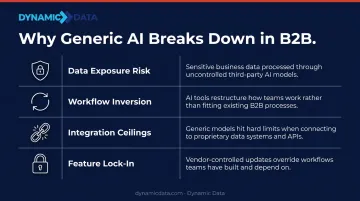
- Data exposure risk — generic SaaS AI tools often require exporting sensitive operational data to third-party platforms
- Workflow inversion — businesses end up adapting processes to fit platform limitations, not the other way around
- Integration ceilings — preset connectors rarely accommodate the legacy ERP, CRM, and operational systems B2B organizations run on
- Feature lock-in — you get what the vendor ships, with no path to extend logic as your business evolves
Custom AI sidesteps these constraints by design. It connects to your existing infrastructure, trains on your proprietary data, and adds new logic as your operations evolve — without forcing workflow changes to accommodate platform limits.
The Compliance and Scalability Gap
Regulated B2B sectors — healthcare, financial services, energy — require governance controls that cannot be retrofitted onto generic platforms without creating audit vulnerabilities. Fewer than 25% of IT leaders are confident their organizations can manage governance when deploying GenAI tools, according to Gartner's November 2025 research.
Regulatory pressure is accelerating this problem. The EU AI Act entered into force in August 2024, with full application for high-risk AI systems taking effect August 2, 2026. High-risk categories include credit scoring, employment screening, and critical infrastructure safety — all core B2B use cases. Systems in these categories must implement data governance, activity logging, human oversight, and post-market monitoring from day one.
Generic platforms are built to a fixed feature set. As workflows shift, data sources multiply, or regulatory requirements tighten, there's no mechanism to adapt — only workarounds. Custom AI, built with governance embedded at the architecture level, scales alongside the business rather than against it.
High-Impact Use Cases: Where Custom AI Drives Real B2B Efficiency
Intelligent Workflow Automation
Rule-based automation handles simple, linear tasks well. Custom AI handles what comes next: conditional logic, role-based routing, exception handling, and multi-step workflows that span systems.
Practical B2B applications include:
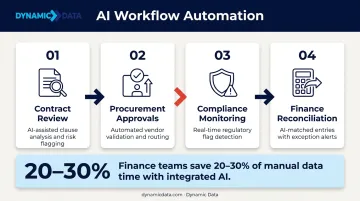
- Contract review with automated clause extraction and risk flagging
- Procurement approvals with vendor validation built into the logic
- Compliance monitoring pipelines that flag anomalies in real time
- Finance reconciliation with intelligent exception routing
McKinsey's research found that finance professionals spend 20–30% less time on manual data tasks when AI is fully integrated. One global consumer goods company saved 30% of finance professionals' time by automating budget variance insights alone.
Dynamic Data's automation and process optimization work is built on this foundation — designing ML-driven workflows that handle the complexity generic automation tools can't reach, with data pipelines engineered to feed them reliably.
Predictive Analytics and Decision Support
The core advantage of custom predictive models is simple: they're trained on your data, not someone else's. A generic demand forecasting tool has never seen your customer mix, your supplier lead times, or your seasonal patterns.
McKinsey's research on AI-driven supply chain forecasting found that AI models reduce supply chain errors by 20–50% compared to traditional methods — with lost sales from product unavailability falling by up to 65% and warehousing costs dropping 5–10%.
Custom models also improve continuously. Each new transaction, each closed deal, each operational data point makes the next prediction more accurate — a compounding advantage that off-the-shelf platforms simply can't replicate.
This is where Dynamic Data's predictive analytics and ML modeling work delivers compounding value — turning a company's proprietary historical data into forward-looking business intelligence, not just backward-looking reports. That spans the full build: data pipeline development, model deployment, and live dashboard delivery.
AI-Powered Document and Data Processing
Unstructured documents represent a significant operational cost center for most finance and operations teams. Invoices, compliance filings, contracts, technical reports — each requires someone to read, interpret, and act on information that could be automated.
NLP and OCR-based custom AI extracts, classifies, and routes data from these documents automatically, populating downstream ERP and CRM systems without manual handling. One enterprise deployment documented by Gartner Peer Insights reduced invoice turnaround from 8 days to same-day processing, with annual savings of $277,000.
For B2B organizations processing thousands of documents monthly, the cumulative time and cost savings are substantial — and unlike rule-based OCR tools, custom NLP models learn document variations and exception patterns specific to your vendor and client base.
Sales and Revenue Intelligence
Most CRM AI add-ons score leads using broad behavioral benchmarks built from someone else's pipeline. Custom sales intelligence trains directly on your closed deals, your lost opportunities, and your customers' actual buying signals — so the model reflects how your market actually behaves.
The performance difference is measurable. McKinsey's B2B sales research documented a logistics provider that increased conversion rates from 1.8% to 3.0% through AI-driven voice analysis of sales calls — identifying $120 million in annual incremental revenue potential when scaled enterprise-wide. A telecom provider cut account plan customization time from 10+ hours to minutes, projecting a 5–15% sales uplift within a year.
Custom sales AI enables:
- Lead scoring built on your historical win/loss patterns
- Pipeline risk flagging tied to behavioral signals specific to your sales cycle
- Personalized outreach triggered by account-specific engagement data
- Cross-sell and upsell identification trained on your customer base
Industry-Specific Custom AI Applications
Every industry runs on different data, different regulations, and different definitions of risk. Off-the-shelf AI platforms are built for breadth — not for the specifics that make your sector's data valuable or sensitive.
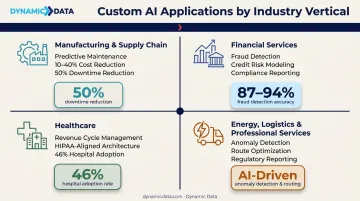
Manufacturing and supply chain: McKinsey research indicates predictive maintenance AI can cut maintenance costs by 10–40% and reduce equipment downtime by up to 50%. Those results come from models trained on proprietary sensor data — the kind no off-the-shelf platform has ever seen. Custom AI built on your equipment's history predicts failures before they cause outages and optimizes production scheduling in ways generic tools simply cannot.
Financial services: Custom AI powers fraud detection, credit risk modeling, and automated compliance reporting built around each organization's specific risk profile. A 2024 peer-reviewed study found ML-based fraud detection systems achieve detection rates between 87–94% while reducing false positives by up to 60%. With EU AI Act requirements now applying to credit scoring systems, governance architecture must be built in from the start.
Healthcare: 46% of hospitals now use AI in revenue-cycle management, per AHA/AKASA/HFMA 2024 data — a meaningful slice of a U.S. healthcare system spending roughly $1 trillion annually on administrative costs alone. Custom AI handles patient history retrieval, documentation gap flagging, and administrative triage.
HIPAA-aligned access controls and audit trails can't be added after the fact. They need to be embedded at the architecture level from day one.
Energy, logistics, and professional services: Real-time anomaly detection, automated regulatory reporting, and route optimization all depend on deep system integrations and accountability standards that generic platforms can't meet. Precision agriculture and retail demand forecasting face the same constraint — they run on local, proprietary datasets that no general-purpose model has ever been trained on.
Is Custom AI Right for Your Business? A Build-vs-Buy Framework
Off-the-shelf AI is appropriate for some situations. Custom development becomes the right decision when specific conditions are present.
| Situation | Recommendation |
|---|---|
| Early-stage AI testing, low complexity | Off-the-shelf is sufficient |
| Standardized functions with generic data | Off-the-shelf is sufficient |
| Legacy system integration required | Custom development |
| Strict regulatory environment | Custom development |
| Proprietary data sensitivity | Custom development |
| Processes requiring detailed audit trails | Custom development |
| Operational complexity exceeds platform capabilities | Custom development |
Custom AI carries a higher upfront investment — but the honest comparison includes recurring SaaS licensing across multiple inadequate platforms, ongoing compliance adaptation costs, and the operational inefficiencies that never get resolved. Worldwide AI spending reached nearly $1.5 trillion in 2025, yet 42% of companies had abandoned most AI initiatives by mid-2025, up from 17% the prior year. The cost of failed generic implementations is real and often invisible until it accumulates.
Cost isn't the only factor. Governance shapes whether a custom build succeeds long-term.
Responsible AI for B2B requires each of the following built in from the start:
- Transparency in decision-making processes
- Role-based access controls
- Encrypted data handling
- Complete audit trails
- Human oversight mechanisms
The EU AI Act makes these a legal requirement for high-risk systems, with full application taking effect in August 2026.
How to Choose the Right Custom AI Development Partner
What Separates Effective Partners from Generic Vendors
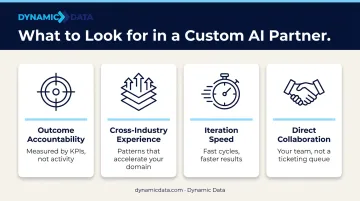
Four qualities define a development partner worth working with:
- Outcome accountability — deliverables tied to measurable business results, not just shipped code. KPIs should be defined before development begins, not after delivery
- Cross-industry experience with an enterprise-ready stack — the ability to navigate the specific data, compliance, and integration challenges of your vertical
- Iteration speed — validated outcomes in weeks, not quarters. Agile delivery matters more than theoretical capability
- Direct collaboration — the people you brief should be the people who build. Handoffs between sales and delivery teams introduce gaps
Data Infrastructure Depth Determines AI Quality
Custom AI only performs as well as the data feeding it. A partner who builds excellent models on top of fragmented or ungoverned data will produce poor results — regardless of model quality.
The right partner brings data pipeline engineering and governance expertise alongside AI capability — knowing how to build or audit the data foundation before model development starts. Dynamic Data, for example, combines custom AI and machine learning development with data strategy and engineering: auditing data quality, designing governance frameworks, and building pipelines that keep models accurate as data volumes grow.
Evaluating a Partner Practically
Once you've assessed a partner's data and AI capabilities, use these questions to pressure-test their approach before signing:
- Do they have industry case studies with measurable outcomes, not just technology descriptions?
- Can they provide transparent project timelines and cost breakdowns at the scoping stage?
- How do they handle ongoing model maintenance, retraining, and scalability as data volumes grow?
- Are KPIs defined contractually before development begins?
- Who specifically will work on your project — and how is collaboration structured?
Frequently Asked Questions
What is custom AI development and how does it differ from off-the-shelf AI tools?
Custom AI is built specifically around a company's own workflows, data, and operational requirements. Off-the-shelf tools require businesses to adapt to preset capabilities and cannot integrate with proprietary systems without creating data exposure risk or compliance gaps.
Which B2B processes benefit most from custom AI development?
The highest-impact use cases are workflow automation (contract review, procurement approvals), predictive analytics (demand forecasting, risk modeling), intelligent document processing (invoices, compliance filings), and sales intelligence (lead scoring, pipeline management).
How much does custom AI development cost for B2B companies?
Costs vary based on solution scope, integration depth, and infrastructure requirements. Simpler automation features cost considerably less than enterprise-grade systems — and when you factor in ongoing SaaS fees for inadequate alternatives and unresolved compliance gaps, custom AI frequently becomes the more cost-effective choice over time.
How long does it take to build a custom AI solution for a B2B business?
Simpler automation features can be validated in weeks. Enterprise-grade systems with deep integrations typically take several months. Agile, iterative delivery keeps timelines shorter and builds in room for course correction at each stage.
What data infrastructure does a B2B company need before investing in custom AI?
Clean, accessible data pipelines, a modern data stack, and basic data governance must be in place before or alongside AI development. Building AI on fragmented or ungoverned data is a primary cause of project failure — getting the data foundation right is a prerequisite, not a nice-to-have.
How do you measure ROI from custom AI development in B2B?
Tie outcomes to measurable business metrics: cost reduction, processing speed, error rate reduction, and hours saved per function. Define these KPIs before development begins and build outcome accountability into the engagement from day one.