The numbers reflect this gap clearly. According to McKinsey's 2025 State of AI report, 88% of organizations now use AI in at least one business function — but only one-third have scaled it across the enterprise. Meanwhile, Gartner predicts organizations will abandon 60% of AI projects through 2026 due to inadequate data infrastructure.
Developing an AI CX strategy isn't purely a technology decision. It depends on data quality, organizational readiness, goal clarity, and the right sequencing of use cases. This article walks through the exact steps, prerequisites, key variables, and failure points involved.
Key Takeaways
- Audit your customer journey and data foundation before selecting any tools or vendors
- Prioritize AI use cases by business impact and data readiness — not by what's trendy
- Data quality determines whether AI improves CX — or creates entirely new problems
- Start with internal, low-risk applications before deploying anything customer-facing
- Success comes from aligning AI with specific CX goals, not from adopting the most advanced technology
How to Develop an AI Strategy to Improve Customer Experience
Step 1: Audit Your Customer Journey and Data Foundation
Start by mapping every key customer touchpoint — from initial awareness through post-purchase support. The goal is to find where friction, delays, or inconsistency currently damage the experience. Gaps you haven't located are gaps you can't fix.
Alongside that journey map, assess the state of your customer data:
- Is it unified in one place, or fragmented across disconnected systems?
- Is it accurate, consistently structured, and accessible to the teams who need it?
- Which touchpoints generate the most data — and where do meaningful patterns already exist?
This step matters more than most companies expect. Research cited by MIT found that 95% of enterprise AI initiatives fail to produce measurable business impact — primarily because AI is deployed into environments with fragmented data that were never designed to support it. Data silos aren't just an inconvenience; they are the primary reason AI CX strategies stall.
That pattern shows up repeatedly in practice. Dynamic Data's work with clients like Zenus and Pima Solar both began by diagnosing data across multiple platforms — understanding what existed, where it lived, and whether it could support the AI use cases the business needed. Model development came only after that foundation was in place.
Step 2: Define CX-Specific Business Objectives
Broad goals like "improve customer experience" cannot guide AI use case selection. You need specific, measurable targets:
- Reduce average support resolution time by X%
- Increase CSAT scores from Y to Z within 12 months
- Reduce churn rate by a defined percentage in a specific segment
Limit initial focus to 2–3 objectives. More than that, and the strategy fragments into disconnected initiatives that compete for resources without clear priority.
There's a validation step most organizations skip: confirm that each objective has a corresponding data signal you actually possess. Objective-setting and data availability must be validated together. If you want to predict churn but lack consistent behavioral or engagement data, that objective cannot be served by AI until that data foundation exists.
Step 3: Identify and Prioritize High-Value AI Use Cases
With objectives defined, brainstorm candidate AI applications and map each to a specific objective from Step 2. Common options include:
- Personalization engines — tailored content, product, or offer recommendations
- AI chatbots and virtual agents — handling routine support queries at scale
- Sentiment analysis — monitoring customer feedback and support transcripts
- Predictive churn models — identifying at-risk customers before they leave
- Agent-assist tools — surfacing real-time guidance for human support agents
Prioritize using two criteria: potential business impact and **feasibility given your current data readiness**. High impact, high feasibility use cases go first.
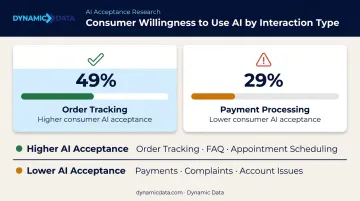
Use cases with lower data requirements and internal application — such as automated call summarization or agent-assist tools — are consistently safer first deployments than customer-facing AI. Consumer comfort with AI interactions varies sharply by interaction type. PwC's 2025 Customer Experience Survey found 49% of consumers are willing to use AI for order tracking, but only 29% would use it for payment processing. Start where the data supports it and where customers are comfortable.
Step 4: Build a Phased AI Roadmap
Structure the roadmap in two phases:
Phase 1 — Internal and back-end applications:
- Automated reporting and data summarization
- Agent-assist tools that surface relevant knowledge during live interactions
- Internal sentiment analysis across support logs
- Predictive analytics feeding into CX strategy decisions
Phase 2 — Customer-facing applications:
- Personalized recommendations and content
- AI chatbots for self-service support
- Proactive outreach driven by churn or opportunity models
For each phase, define: required data inputs, AI approach (NLP, predictive modeling, recommendation engines), integration requirements with existing systems, and measurable success metrics.
Build in explicit checkpoints between phases. Phase 2 should only expand once Phase 1 deployments have validated performance against the CX objectives set in Step 2.
Step 5: Measure, Learn, and Continuously Optimize
Define KPIs before deployment — not after. Without a clean baseline, you cannot measure whether the AI actually produced any real change. Relevant metrics include resolution time, NPS, repeat contact rate, churn rate, and conversion lift.
A few realities about AI performance timelines:
- Most organizations expect results within 3–6 months
- MIT research across 300 AI projects found that measurable business value typically takes 12–18 months to demonstrate
- AI models must be regularly retrained as customer behavior evolves — decisions to retrain should be triggered when model performance drops below a defined threshold or when new data patterns emerge
Treat AI deployment as an ongoing program, not a one-time project. The teams that get lasting results are the ones that build retraining cycles and performance reviews into their operating rhythm from day one.
What You Need Before Building Your AI CX Strategy
Skipping foundational readiness checks leads to higher costs, slower timelines, and poor AI output quality. Two areas matter most.
Data Infrastructure and Quality Readiness
The most common hidden bottleneck is customer data that lives across disconnected systems — CRM, support platform, e-commerce database, marketing tools — with no unified layer connecting them.
AI cannot generate reliable CX insights from fragmented or incomplete data. Before any AI application is deployed, organizations need:
- Structured, automated data pipelines that pull from all relevant sources
- A centralized data warehouse or lakehouse (platforms like Snowflake, BigQuery, or Databricks are commonly used)
- Consistent data models and transformation layers (tools like dbt are standard here)
- Clear data governance frameworks covering ownership, quality standards, and compliance
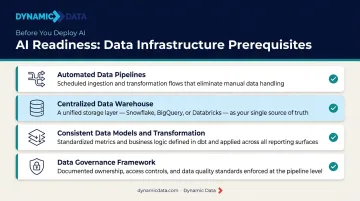
Building this foundation before deploying any AI is the prerequisite most organizations skip — and the one that explains the majority of failed implementations. In Dynamic Data's engagement with Zenus, the work started here: a full data warehouse on Google Cloud, with automated transformation and testing pipelines in dbt, was established first. Only after that infrastructure was stable did AI development begin.
Organizational and Skill Readiness
Even with solid infrastructure in place, the human side of readiness matters just as much. Evaluate whether internal teams can manage, interpret, and act on AI outputs — and be honest about where external expertise may be needed to fill the gaps.
Equally important: identify which stakeholders need alignment before execution begins. CX teams define the objectives, IT and data teams own the infrastructure, and compliance teams govern data use. Without cross-functional buy-in secured upfront, even technically sound AI initiatives stall or get misused once deployed.
Key Variables That Shape Your AI CX Strategy's Success
Two organizations can follow the same steps and get very different outcomes. These variables explain why.
Data Quality and Volume
AI models trained on sparse, biased, or inconsistent data produce flawed personalization, inaccurate predictions, and poor recommendations — directly worsening CX rather than improving it. Poor data quality costs the average organization $12.9 million per year according to Gartner, and successful AI deployments typically consume 60–80% of total project resources in data preparation alone.
Human-AI Balance in the Customer Journey
PwC found that 86% of consumers say human interaction is moderately or very important to their brand experience — and 64% of customers would prefer companies didn't use AI for customer service at all, per Gartner. Deploying AI too aggressively erodes the human connection that most customers still expect.
The practical line to draw:
- Routine, transactional touchpoints (order tracking, FAQ resolution, appointment scheduling) are well-suited for AI automation
- Emotional, complex, or high-value interactions (complaints, financial decisions, account issues) need a human in the lead, with AI in a supporting role
- Every AI-handled interaction should include a clear, accessible path to a human agent — removing that option is one of the fastest ways to damage trust
Governance, Ethics, and Transparency
Trust erodes quickly when customers feel surveilled, misled, or trapped in an automated loop with no recourse. Building governance into the strategy from day one — not as an afterthought — is what separates deployments that scale from those that generate backlash. Key requirements:
- Disclose to customers when they are interacting with an AI system — the EU AI Act's Article 50 transparency obligations take effect August 2, 2026, making this a legal requirement for many deployments
- Maintain opt-out options for AI interactions where feasible
- Audit for algorithmic bias before and after deployment — biased training data produces biased customer outcomes
- Align with the FTC's guidance on AI use in consumer-facing applications, including prohibitions on deceptive AI-generated content
Common Mistakes When Developing an AI CX Strategy
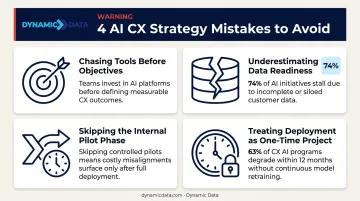
Most AI CX initiatives don't fail because of bad technology — they fail because of avoidable process mistakes. Here are the patterns that consistently derail even well-resourced efforts:
- Chasing tools before defining objectives. Selecting AI platforms or vendors before establishing clear CX goals produces strategies that generate activity but not outcomes. Start with the objective; let the tool follow from it.
- Underestimating data readiness. Many organizations assume their existing data is sufficient, only to discover accuracy problems after deployment. A data audit should precede AI tool selection — 63% of organizations either lack or are unsure they have the necessary data management practices for AI, per Gartner.
- Skipping the internal pilot phase. Deploying AI directly into customer-facing interactions without first refining it internally significantly increases the risk of a poor experience. Agent-assist tools and internal reporting automation are safer proving grounds than customer-facing chatbots.
- Treating deployment as a one-time project. AI strategies without continuous improvement cycles — retraining, performance review, scope adjustment — quickly become outdated. BCG found that 74% of companies fail to show tangible AI value because they under-invest in the people, processes, and organizational adoption surrounding the technology.
Frequently Asked Questions
How do you use AI to enhance customer experience?
AI improves CX through personalization engines, predictive analytics, chatbots, sentiment analysis, and automated issue resolution. Each application requires a clean data foundation and a clear CX objective — without both, the result is noise rather than improvement.
What does an AI strategy consultant do?
An AI strategy consultant assesses your data readiness, identifies high-value use cases, builds a phased implementation roadmap, and provides governance frameworks. The role bridges technical capability with business outcomes, translating what's possible into what's actually worth building.
What is the AI 10-20-70 rule?
Originating from BCG research, the 10-20-70 rule states that roughly 10% of AI success comes from algorithm selection, 20% from data and technology, and 70% from people, processes, and organizational adoption. It explains why strategy and change management consistently matter more than tool selection.
How much does an AI consultant cost?
Costs range from $150–$500+ per hour for individual consultants to $35,000–$150,000+ for mid-market project engagements. Beyond the rate, evaluate expected ROI, time to first measurable result, and whether the engagement includes implementation support or just a deliverable document.
What data do you need before implementing AI for customer experience?
You need unified, accessible customer data including behavioral data, transaction history, support interaction logs, and feedback. This data must be accurate, consistently structured, and stored in a centralized system . Fragmented or inconsistent data will directly limit what AI can reliably do.
How long does it take to develop an AI CX strategy?
A basic AI CX strategy framework takes 4–12 weeks to develop, depending on data readiness and organizational complexity. MIT research across 300 AI projects found that measurable business value realistically takes 12–18 months — setting that expectation early prevents premature conclusions about what's working.