Introduction
Most organizations collect more data than ever — yet fewer than half actually trust it enough to act on it confidently. That gap rarely comes down to the wrong tools. It comes down to governance.
When governance is treated as a compliance checkbox, data teams spend their time cleaning up messes instead of enabling decisions. Reporting breaks. AI initiatives fail. Different departments argue over whose numbers are right. The cost is real: poor data quality costs organizations an average of $12.9 million per year, according to Gartner.
This guide is written for data leaders, CDOs, and organizations scaling their data infrastructure who want a practical path forward. You'll find a clear explanation of what a data governance strategy and roadmap actually are, why confusing the two stalls most programs, and a step-by-step approach to building one that gets implemented.
Key Takeaways
- A data governance strategy defines the goals, rules, roles, and accountability structures for managing data as a business asset
- A data governance roadmap translates that strategy into a sequenced, time-bound plan with milestones, owners, and measurable outcomes
- Effective governance ties directly to business outcomes — not just compliance requirements
- Gartner projects 80% of governance initiatives will fail by 2027 — cultural resistance and over-broad scope, not technology, are the leading causes
- Starting with one high-impact use case builds early wins and the executive buy-in needed to scale
What Is a Data Governance Strategy and Roadmap?
A data governance strategy is the operating model that determines how an organization plans, enforces, and measures the management of its data as a business asset — linking data policies to business outcomes.
Strategy vs. Roadmap: What's the Difference?
Most teams conflate strategy and roadmap. They're related but distinct:
| Data Governance Strategy | Data Governance Roadmap | |
|---|---|---|
| Answers | What and why | How and when |
| Contains | Goals, scope, accountability, framework | Phased initiatives, milestones, owners, timelines |
| Timescale | Ongoing operating model | Quarterly to multi-year execution plan |
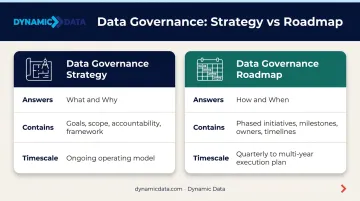
A useful analogy: the strategy is the architectural blueprint for a building — what it needs to achieve and how it should function. The roadmap is the construction schedule — what gets built first, by whom, and by when. Without the blueprint, you're building without direction. Without the schedule, you never break ground.
Governance and data management are also distinct — and often confused. Governance sets the authority, rules, and accountability. Management is the execution of those rules. Without both working together, organizations end up with either well-documented policies no one follows, or active data work with no consistent standards behind it.
The DAMA DMBOK defines governance as "the exercise of authority and control (planning, monitoring, and enforcement) over the management of data assets." The practical implication: governance determines who can do what with data, and under what conditions — before a problem forces the question.
Why Every Organization Needs a Data Governance Strategy
The Business Cost of Ungoverned Data
The $12.9 million annual figure from Gartner is a median. For larger organizations, MIT Sloan research estimates bad data costs 15–25% of revenue. The operational symptoms are consistent across industries:
- Sales and finance use different definitions of "active customer"
- A new analytics initiative requires months of data cleanup before it can start
- Compliance reporting takes weeks because nobody knows where the authoritative data lives
- An ML model produces unreliable predictions because training data is inconsistent
These aren't edge cases. They're the default state for organizations that haven't invested in governance.
Why Governance Is More Urgent Now
Three forces have raised the stakes significantly:
Regulatory pressure. Cumulative GDPR fines have exceeded €7.1 billion since 2018, with €1.2 billion issued in 2025 alone. CCPA carries penalties up to $7,500 per intentional violation. Governance isn't optional when regulators are actively enforcing.
AI readiness. Gartner predicts that by 2027, **60% of organizations will fail to realize the anticipated value of their AI use cases** due to inadequate data governance. AI models are only as reliable as their training data. Ungoverned data pipelines produce unreliable models — and those failures compound as adoption grows.
Data volume. The global datasphere reached approximately 149 zettabytes in 2024 and is forecast to exceed 394 zettabytes by 2028. No manual governance process scales at that rate — which is why strategy matters before volume becomes unmanageable.
What Happens Without a Strategy
Without a strategy, organizations default to reactive, siloed data management. Each team develops its own standards, quality has no clear owner, and every new initiative kicks off with a cleanup sprint. Over time, technical debt compounds into something more serious:
- No single source of truth for key business metrics
- Analytics and reporting that can't be trusted under pressure
- AI and ML initiatives stalled by inconsistent training data
- Compliance exposure from data nobody can fully account for
The organizations most vulnerable to these problems are often the ones growing fastest — where data volume is outpacing the informal rules that used to be enough.
How to Build a Data Governance Roadmap: A Step-by-Step Approach
The foundational principle: a governance roadmap works backwards from business outcomes, not forwards from a data inventory. The first question is always "what decision or capability do we need to improve?" — not "what data do we have?"
Attempting to govern everything at once is the single most common failure mode. A minimum viable governance approach — focused on one high-impact domain — delivers faster results and builds the credibility needed to expand.
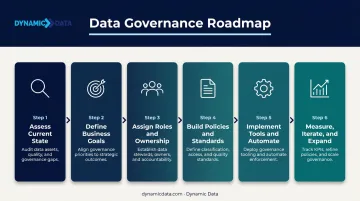
Step 1: Assess Your Current State
Conduct a maturity assessment across three dimensions:
- People — Are data roles and ownership defined? Who is accountable for quality in each domain?
- Process — Are data definitions consistent across teams? Are there documented standards, or just tribal knowledge?
- Technology — Is data discoverable? Is there documented lineage? Can someone find the authoritative source for a given metric?
Note that 59% of organizations don't measure their data quality at all (Gartner). If you're in that group, the baseline assessment is step zero — not an optional exercise.
Step 2: Define Business Goals and a High-Impact First Use Case
Anchor the roadmap to a specific business goal. Good candidates include:
- Improving customer data accuracy ahead of a CRM migration
- Reducing compliance reporting time by 40%
- Enabling a reliable ML model that currently fails due to inconsistent training data
The first use case needs three things: a clear executive sponsor, a measurable outcome, and a realistic timeline — typically 90 to 180 days. Without a sponsor, governance stalls at the first sign of organizational resistance.
Step 3: Assign Roles, Ownership, and Governance Structures
Three roles are non-negotiable:
- Data Owners — Business-side accountability for a data domain (not IT)
- Data Stewards — Day-to-day quality enforcement and policy compliance within a domain
- Data Governance Council — Cross-functional body for strategic decisions, conflict resolution, and priority-setting
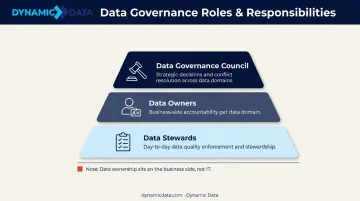
Governance without named owners always fails. Someone must be accountable when data quality degrades — not a committee, a person.
Dynamic Data's governance engagements treat data ownership as a structural requirement, not an organizational nicety — because when no one owns a domain, accountability gaps are where most programs break down.
Step 4: Build Policies, Standards, and a Business Glossary
With ownership defined, the next step is documenting the rules those owners will enforce. Start with a business glossary — defining terms like "active customer," "revenue," or "conversion" consistently across sales, finance, and marketing prevents the metric disputes that erode trust in data.
Also define:
- Data quality standards (accuracy, completeness, timeliness thresholds by domain)
- Access control policies (who can view, edit, or share sensitive data)
- Retention and deletion rules tied to regulatory requirements
Policies must be specific enough to enforce programmatically — meaning each rule should map to a measurable check or automated alert, not a general principle buried in a wiki.
Step 5: Implement Tools and Automate Enforcement
Manual governance cannot scale. Core tooling categories include:
- Data catalogs — for discoverability and metadata management (only 29% of North American companies actively use one)
- Data quality monitoring — automated validation and alerting against defined standards
- Lineage tools — tracing data from source to consumption to support both debugging and compliance
Organizations building on modern data stacks — Snowflake, BigQuery, Databricks — benefit from embedding governance during the build phase. For example, dbt's testing and documentation features enforce quality standards directly in transformation workflows, catching issues at the pipeline level before they reach analysts or dashboards. Dynamic Data's dbt Certified Developers implement these capabilities during stack builds, which means quality rules are version-controlled alongside the data models themselves.
Step 6: Measure, Iterate, and Expand
Define KPIs before launch:
- Data quality scores by domain
- Percentage of datasets with assigned owners
- Time to resolve data issues
- Policy adoption and compliance rates
Establish a quarterly review cadence. Assess progress, update the roadmap based on shifting business priorities, and expand governance to the next domain. Each domain you govern successfully becomes the proof point that secures buy-in for the next one.
The Core Pillars of an Effective Governance Strategy
Roadmap phases define sequencing. Pillars define what must exist for governance to actually function. Five structural elements appear consistently across successful programs:
Pillar 1 — Data Quality
Define standards for accuracy, completeness, consistency, and timeliness (the six DAMA UK quality dimensions also include uniqueness and validity). Quality is not a one-time project. It requires continuous automated monitoring and alerting against defined thresholds.
Pillar 2 — Data Ownership and Stewardship
Governance fails when it lives only in IT. Business-side ownership is essential. The stewardship model distributes accountability across domains: each domain has a named owner and steward, without requiring a large centralized team. The key is that stewards carry fiduciary-level responsibility for data within their area.
Pillar 3 — Metadata Management and Data Lineage
Without knowing what data exists, where it came from, and how it's been transformed, you can't enforce governance or trust the output. A centralized business glossary and automated lineage tracking are foundational, yet consistently underfunded in practice. Gartner's reintroduction of its Magic Quadrant for Metadata Management in November 2025 reflects a market that has begun meeting this need at scale.
Pillar 4 — Compliance and Security Controls
Map governance policies directly to regulatory requirements (GDPR, CCPA, HIPAA). Role-based access controls, data classification, and retention schedules are structural requirements, not afterthoughts.
GDPR Article 30 alone requires a documented inventory of processing activities. That inventory is a governance artifact, not just a legal formality.
Pillar 5 — Metrics and Continuous Improvement
Governance maturity is measured and improved over time. The Gartner maturity model shows that most organizations cluster at Level 3 (Proactive): they've built momentum, but haven't reached systematic management. Fewer than 5% reach Level 5.
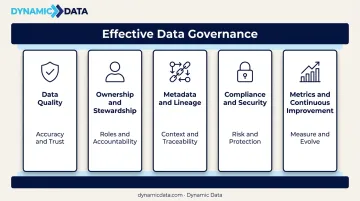
Program-level KPIs (ownership coverage, policy adoption) differ from operational metrics (data quality scores, incident rates). Both matter and should be tracked separately.
Common Pitfalls and Misconceptions in Data Governance
Misconception: Governance Is an IT Project
The most persistent myth in this space. When IT designs, owns, and executes governance without meaningful business involvement, the result is policies that nobody follows and definitions that don't reflect how the business actually uses data.
Business sponsorship isn't an aspiration — it's a prerequisite. If you can't identify a business owner for your first governance domain before you start, that's a signal to resolve before anything else.
Misconception: You Need a Perfect Framework Before You Start
Many teams spend months building policy documents, org charts, and glossaries before governing a single dataset. This stalls momentum and loses executive interest — which the research identifies as the primary reason governance programs die.
The correct sequence: start with one domain, prove value, then systematize. Pick the domain where data quality problems are already costing the business something visible, fix it under a governance model, and let that result make the case for everything else.
Pitfall: Treating the Roadmap as a Fixed Document
A governance roadmap published in Q1 and filed away by Q2 is not a roadmap — it's a deliverable that nobody uses. Business priorities shift. New regulations emerge. A new AI initiative creates an urgent governance need that wasn't in the original plan.
Treat the roadmap as a living operational tool by reviewing it quarterly. At each review, ask three questions:
- What business priorities have shifted since the last review?
- Are any new regulatory or AI initiatives creating unplanned governance needs?
- Which domains are underperforming against original targets — and why?
Dynamic Data works with organizations to run these reviews as structured checkpoints, not retrospectives, so the roadmap stays aligned with what the business actually needs next.
Frequently Asked Questions
What are data governance strategies?
Data governance strategies are the plans organizations use to define goals, assign accountability, establish policies, and measure how data is managed and used as a business asset. A strategy is distinct from a framework (which defines structure) or a roadmap (which defines execution sequence); all three work together.
What is the difference between a data governance strategy and a data governance roadmap?
The strategy defines what you want to achieve and why — goals, scope, operating model, and accountability structures. The roadmap defines how and when you'll get there — phased initiatives, milestones, owners, and timelines. Both are necessary; confusing them is one of the most common reasons governance programs stall before they deliver results.
What are the 5 pillars of data governance?
The five pillars are: data quality, data ownership and stewardship, metadata management and lineage, compliance and security controls, and metrics and continuous improvement. Different frameworks may label or group these differently, but the underlying requirements are consistent across DAMA, Gartner, and most enterprise governance models.
What are the 5 C's of data governance?
No single authoritative standard defines a canonical "5 C's" framework for governance. The widely established quality dimensions from DAMA UK are: Completeness, Uniqueness, Timeliness, Validity, Accuracy, and Consistency — six dimensions, not five. Vendor content sometimes groups a subset under "5 C's," but the full DAMA framework is more reliable.
What are the 4 pillars of data governance?
Some frameworks simplify governance into four pillars: People (ownership and stewardship), Process (policies and standards), Technology (tools and automation), and Data (quality and lineage). This model is useful for communicating governance scope to executive stakeholders who need a concise overview without technical detail.
How long does it take to implement a data governance roadmap?
Building the initial roadmap typically takes four to eight weeks, with the first use case delivering measurable results within three to six months. Full enterprise-scale governance takes longer; research from EW Solutions notes that comprehensive results often require three or more years. The most successful programs treat governance as an ongoing capability, not a one-time project.