
One data platform. Every vertical. One version of the truth.
How mSupply unified a multi-vertical supply chain on a Microsoft Fabric data lakehouse.
mSupply is a major North American distributor of HVAC, plumbing, appliance, and commercial kitchen equipment. After a string of acquisitions, the company had grown into a network of dozens of regional brands, thousands of employees, and operations across the United States and Canada, each running its own ERP, ledger, and workforce system.
That growth came with a cost: no two business units defined “gross sales” or “active accounts” the same way. Leadership couldn't get a single, trusted view of revenue, margin, or inventory across the company. Executive meetings were spent debating whose numbers were right, not deciding what to do next.
Why Dynamic Data?

Multidisciplinary team that came together to offer a comprehensive service

A rare combination of
technical abilities and
interpersonal skills

Fully customized service,
adaptable to the
client's needs
About mSupply
Industry: wholesale distribution. HVAC, plumbing, appliances, and commercial kitchen equipment
Footprint: United States and Canada
Scale: thousands of employees across dozens of regional distribution brands, built through acquisition

The process
The goal
Replace a fragmented, multi-system landscape with one governed data platform.
A single source of truth for sales, inventory, customers, and workforce data across every vertical and every acquired brand.
Three problems stood in the way:
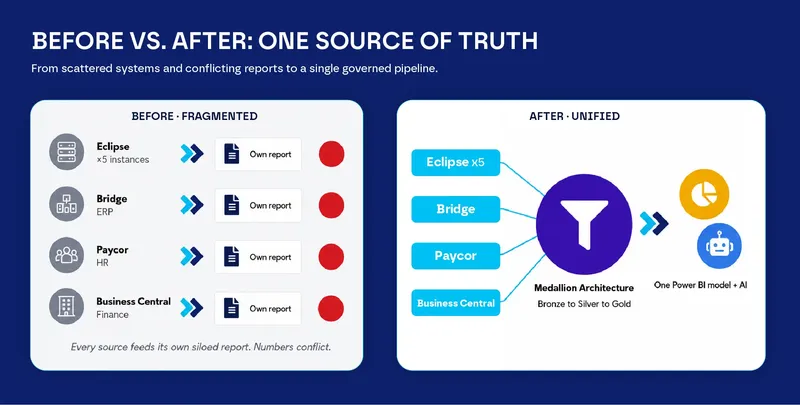
A fragmented footprint. Overlapping order and customer IDs across independent systems made it nearly impossible to get one centralized view of revenue, margin, and customer behavior.
No historical view. Source systems only showed current-state snapshots. Supply chain leaders had no point-in-time tracking for inventory valuation, stock aging, or demand trends; data they needed to manage working capital.
No shared definitions. Different business units applied different logic to the same metrics, so leadership spent more time debating reports than acting on them.
The stack
Microsoft Fabric (OneLake, Lakehouse, Warehouse, SQL Endpoints, Direct Lake) · dbt (Core and Cloud) · Power BI · GitHub · Model Context Protocol (MCP)
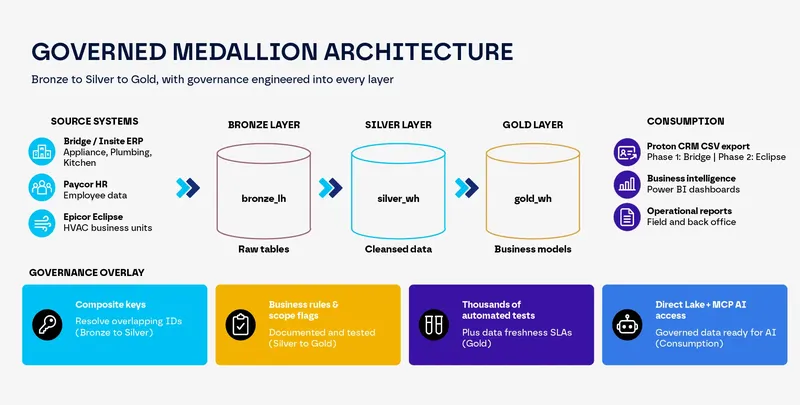
As mSupply's core data engineering team, we designed and built a unified data lakehouse on Microsoft Fabric, powered by dbt and structured around a strict Bronze, Silver, Gold Medallion Architecture. That structure turns raw, fragmented feeds from every operational system into clean, tested, business-ready data.
Here's what we built:
One model across every vertical. We centralized ingestion from every operational system, regional database, and piece of corporate software into a single lakehouse. Using composite-key resolution, we merged overlapping customer and product records from acquired companies without losing data or creating duplicates. The result: unified fact and dimension models for orders, customers, products, and sales teams that leadership can view company-wide or filter down to a single business unit, in one click. The same standardized layer now feeds both BI dashboards and other enterprise systems, including new CRM rollouts.
A history mSupply never had. We built pipelines that capture inventory positions, unit costs, and stock classifications at regular intervals over time. For the first time, supply chain leadership can see how stock levels and turnover have actually moved, not just where they stand today.
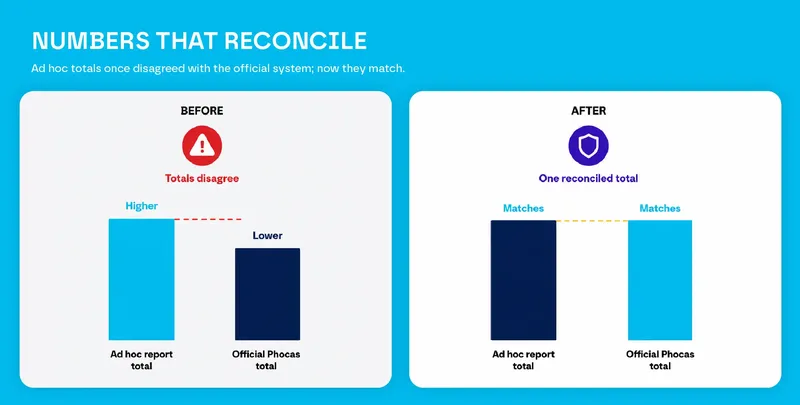
One definition for every number. We replaced spreadsheet formulas and tribal knowledge with business logic that's written down, tested, and applied the same way across every vertical. Executive dashboards now reconcile to the dollar with official financial statements.
Governance and monitoring built in. We set up development, staging, and production environments with pull-request code review and automated builds, so changes ship without downtime. Thousands of automated tests check primary keys, referential integrity, null constraints, margin boundaries, and volume anomalies before bad data ever reaches a dashboard. Automated alerts flag pipeline delays or bottlenecks as they happen.
Reporting that's ready for AI. We built high-performance Direct Lake semantic models in Power BI, so dashboards load near-instantly without waiting on data refreshes. Local analysts can build their own reports on top of certified company-wide metrics without breaking them. We also connected an AI knowledge server (via MCP) secured with single sign-on, so mSupply's team can ask questions of their data, and trust that every answer is grounded in the company's certified definitions.
The results
Sales, inventory, product, customer, and workforce data from every vertical and every acquisition now live in a single governed model, replacing siloed regional reports.
Leadership can see sales performance, inventory turnover, operational health, and headcount planning in one place, with every number traceable back to documented logic.
Teams can build their own reports or ask questions in natural language, backed by the same trusted data either way.
Freshness targets, automated testing, and clear data lineage mean the conversation has moved from “whose numbers are right” to what to do about them.