
One tracking foundation. Five years of platform changes. Still one version of the truth.
How Herbaly kept one accurate tracking layer running through five years of platform change.
Herbaly is a direct-to-consumer (DTC) wellness brand selling functional teas, capsules, and supplements, direct through Shopify, with paid acquisition running across a wide mix of ad platforms, an active affiliate program, and email and retention through Klaviyo.
Herbaly came to us running Universal Analytics, a patchwork of landing page tools, and no reliable way to say which channel actually drove a sale. Since then, we've stayed on as their tracking team through a full site migration, a full analytics platform change, five different landing page tools coming online, and every ad platform's slow move away from third-party cookies.
Why Dynamic Data?

Multidisciplinary team that came together to offer a comprehensive service

A rare combination of
technical abilities and
interpersonal skills

Fully customized service,
adaptable to the
client's needs
About Herbaly
Industry: DTC wellness / functional beverages
Products: Functional teas, capsules, and supplements targeting blood sugar, heart health, and general wellness
Herbaly is a direct-to-consumer (DTC) wellness brand selling functional teas, capsules, and supplements, targeted blends for blood sugar support, heart health, and general wellness.

The process
The goal
Give Herbaly one tracking layer that stays accurate no matter what sits on top of it.
Three problems stood in the way:
● A fragmented footprint. Shopify handled checkout, but traffic landed across Unbounce, Instapage, WordPress, Builder.io, Replo, and Webflow funnels at different points over the years, each one a chance for a session to fragment or a conversion to go uncounted.
● No shared source of truth. Shopify, the landing page tools, the ad platforms, and Klaviyo were each reporting their own numbers, with no consistent way to trace a sale back to the marketing that drove it.
● A moving industry underneath it all. Universal Analytics was sunset mid-engagement. iOS privacy changes and cookie deprecation degraded browser-based ad tracking industry-wide. Shopify deprecated checkout.liquid entirely. None of these were optional, the tracking had to keep working through all of them.
The stack
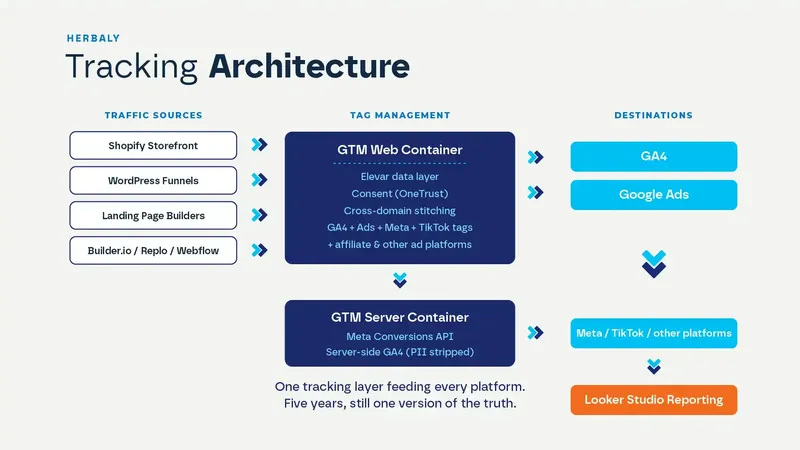
Google Tag Manager (web and a dedicated server-side container), GA4, Elevar, Klaviyo, Meta Conversions API, Google Ads (including Enhanced Conversions), TikTok, and half a dozen more ad platforms, plus OneTrust for consent and Looker Studio for reporting.
What we built
Five years, one tracking layer, rebuilt in place at every turn:
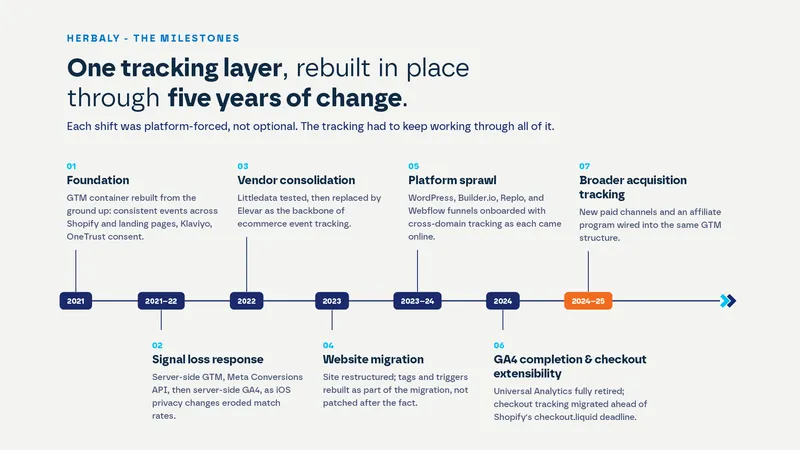
Foundation. We took over Herbaly's GTM container and rebuilt the tracking layer from the ground up: consistent event tracking across Shopify and the landing page tools, Klaviyo integration, and OneTrust consent management in place from day one.
Signal loss response. As iOS privacy changes and cookie restrictions started eroding ad platform match rates, we stood up a dedicated server-side GTM container and layered in the Meta Conversions API, followed by server-side GA4 — with personal data explicitly stripped before it left the server. GA4 itself was introduced in parallel with Universal Analytics around this time, well ahead of Google's later sunset deadline.
Vendor consolidation. We tested Littledata as a Shopify-native tracking layer, then moved off it in favor of Elevar, which became the backbone of e-commerce event tracking for the rest of the engagement, GA4 purchases, Facebook events, and later TikTok all migrated onto it as Elevar's coverage matured.
Website migration. Herbaly restructured its site; we rebuilt the affected tags and triggers as part of the migration instead of letting tracking break and get patched after the fact.
Platform sprawl. Landing pages spread across WordPress, Builder.io, Replo, and Webflow funnels running in parallel with Shopify. We extended cross-domain tracking and event consistency to each one as it came online, and tested additional attribution tools — keeping what held up and removing what didn't.
GA4 completion and checkout extensibility. We finished retiring Universal Analytics, and when Shopify deprecated checkout.liquid in favor of Checkout Extensibility, we migrated the checkout-side tracking ahead of the deadline.
Broader acquisition tracking. New paid channels and an affiliate program came online over this period, each wired into the same GTM structure rather than bolted on separately.
The results
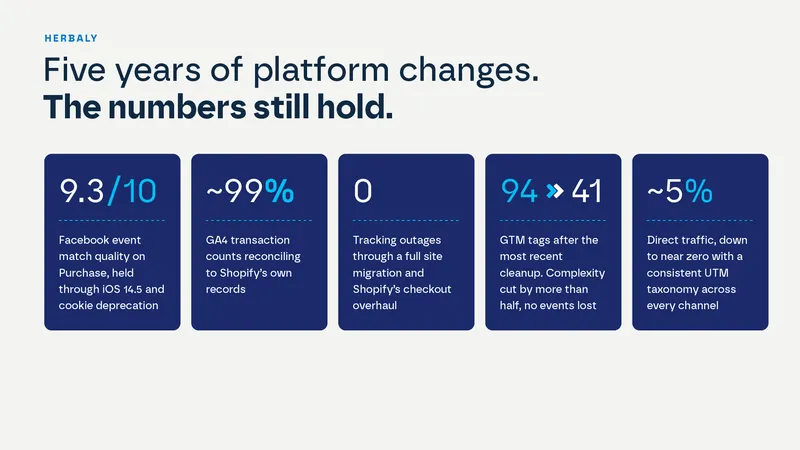
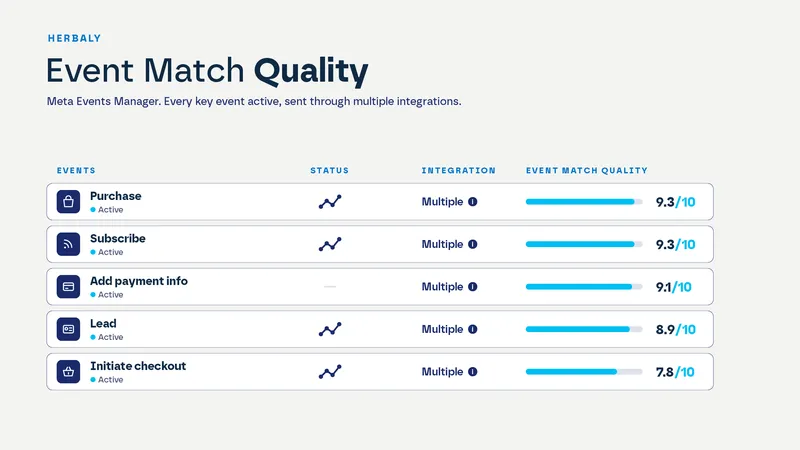
Facebook event match quality on purchase held at 9.3/10 through iOS 14.5 and ongoing cookie deprecation, via the dedicated server-side Meta Conversions API setup.
GA4 transaction counts reconciling to Shopify's own records at roughly 99%, proof the numbers reported are the numbers that happened.
Zero tracking downtime through a full website migration and Shopify's checkout overhaul.
Direct traffic reduced to near 5% through a consistent UTM taxonomy across every paid and organic channel.
Michael Klein
"In a multi-channel business, accurate order attribution is what makes your ad spend accountable, and strong match rates are the signal the algorithms need to perform. Dynamic Data gives us clean reporting and feeds our ad partners the signal they need, so we can make decisions with confidence."