

Context is The Moat: What Snowflake Summit 2026 Taught Me About Building AI That Actually Works
There’s a story from Snowflake Summit 2026 that I haven’t been able to shake. A bank built an AI fraud-detection agent, connected it to its data, and turned it loose. The agent promptly locked out 6,500 legitimate customers. The cause wasn’t a bad model or a clever attacker. It was that the agent did math across three different systems whose data was never meant to be combined. The numbers looked authoritative. They were also wrong.
That story captures the single biggest theme of the entire week. After sitting through nearly twenty sessions — keynotes, customer case studies, deep technical talks, and a few hallway conversations that were just as valuable — I came away convinced that the conversation has finally matured past “look what AI can do.” The hard question everyone is now wrestling with is quieter and far more useful: what does AI need to be trusted?
The answer, again and again, was the same word: Context. And the organizations that build it well are going to pull away from the ones that don’t. Context is the moat.
The short version: the model you pick is now a commodity; the context underneath it — a governed semantic layer that encodes what your business actually means — is the durable advantage. Build that first, govern it well, and AI becomes trustworthy. Skip it and you scale confident, expensive mistakes.
The Uncomfortable Statistic
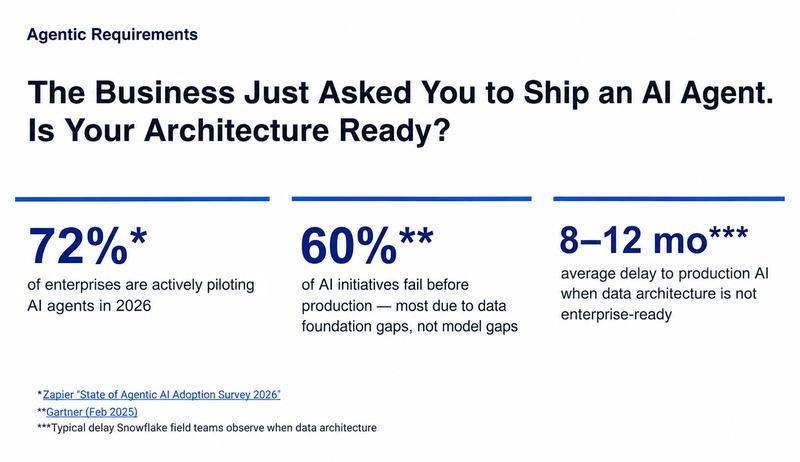
Let me start where one of the architecture sessions started, because the numbers are sobering. Roughly 72% of enterprises are now piloting AI agents. But around 60% of those initiatives fail before they ever reach production. (The 72% figure comes from Zapier’s State of Agentic AI Adoption 2026; the 60% from Gartner.) That is not a technology-adoption curve, that’s a graveyard.
The presenters had a name for the cause: shadow architecture. It’s what happens when an agent queries data that is incorrect, incompatible, or simply not what the agent thinks it is. The bank’s fraud agent was a textbook case. And the crucial insight is that these failures almost never trace back to the AI model itself. They trace back to the data foundation underneath it. The model is rarely the weak link. The plumbing is.
This reframes the whole problem. If you believe your AI initiative will succeed or fail on the quality of the model you pick, you’re optimizing the wrong thing. The model is increasingly a commodity — you can swap in the latest from Anthropic or OpenAI almost at will. What you cannot swap in overnight is a clean, governed, well-understood representation of your own business. That takes time to build, which is exactly what makes it valuable.
“Intelligence without context is just confident guessing”
One line, delivered almost in passing during a session on analytics, became my mental bumper sticker for the week: intelligence without context is just confident guessing.
It explains the bank story perfectly. The agent wasn’t unintelligent. It was confident and wrong, which is the most dangerous combination in any decision-making system, human or machine. A large language model dropped directly onto a raw data warehouse will happily tell you about your “closed business”, without knowing whether your company means closed-won deals or lost ones. It will calculate “profit” without knowing if you mean gross or net. It will define your “top 20 customers” by whatever logic it invents in the moment, which may not match what your CFO would recognize.
This is why one of the most repeated pieces of advice across the week was almost contrarian for an AI conference: do not connect a language model directly to your data warehouse. As one panelist put it, getting the wrong information quickly is far worse than spending a little more time to get the right information. Speed without correctness isn’t an advantage — it’s a liability that scales.
The reason the warning lands so hard is that AI has genuinely changed what people expect from data. The same analytics panel argued that AI has effectively “eaten” routine business intelligence: the static reports, the dashboards nobody opens, what one speaker memorably called the “dashboard graveyard.” People increasingly want to ask a question in plain language, in the tools they already use, and get a trustworthy answer. But that experience is only as good as the meaning layer sitting between the question and the data. Remove that layer and you’ve just automated the production of confident nonsense.
Slow Down to Speed up
If context is the thing that matters, how do you build it? The most counterintuitive — and most consistent — guidance of the conference was this: slow down to speed up.
It came up in nearly every customer session. Invest the unglamorous time upfront. Sit down with the actual business owners and define what your metrics mean. Model the data deliberately before you point AI at it. The payoff isn’t immediate, but it compounds. Teams that did this groundwork reported exponential gains later in both speed and trust, while teams that rushed straight to a flashy demo tended to stall out before production, that 60% again.
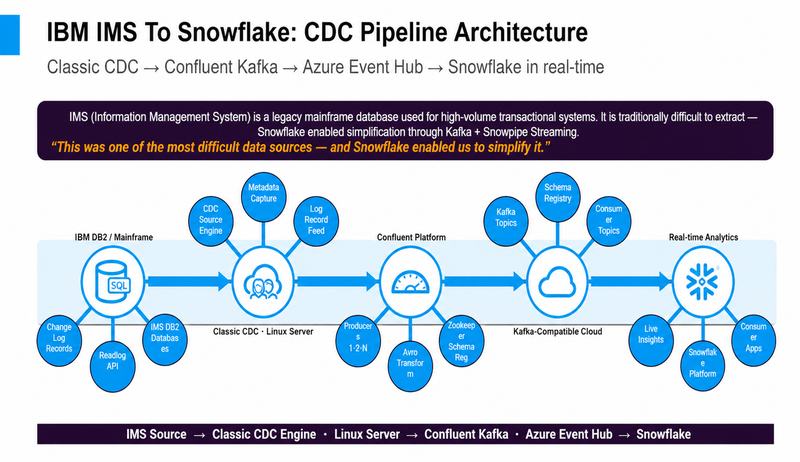
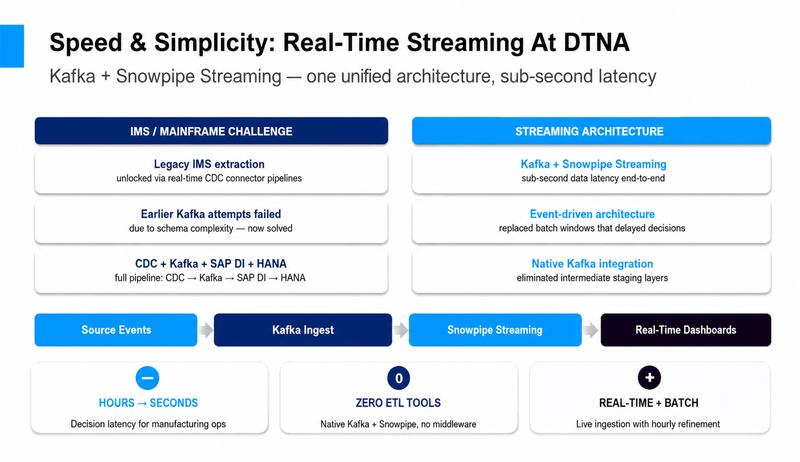
Daimler Truck North America’s session was the clearest illustration. Their AI transformation isn’t a six-week sprint; it’s a multi-year journey laid out across phases. They spent 2024 building the foundation: the core platform, cost guardrails, the first hard migration off legacy SAP systems. They spent 2025 scaling it, onboarding more than 30 source systems and replacing brittle, hand-written SQL with system-managed pipelines. Only in 2026 did they turn on the self-service AI layer for business users. The result of that patience is striking: they pulled real-time data out of decades-old IBM mainframe systems and cut data latency from hours to sub-seconds, and adoption across the business climbed toward 80%. They earned the fast part by doing the slow part first.
There’s also a humility in this approach that I appreciated. One company on the analytics panel described using their AI migration as an excuse to finally delete 70% of their old dashboards, content nobody used but everybody was afraid to touch. Slowing down isn’t just about building new things carefully. It’s about being honest about what you can leave behind.
The Semantic Layer: Where Context Actually Lives
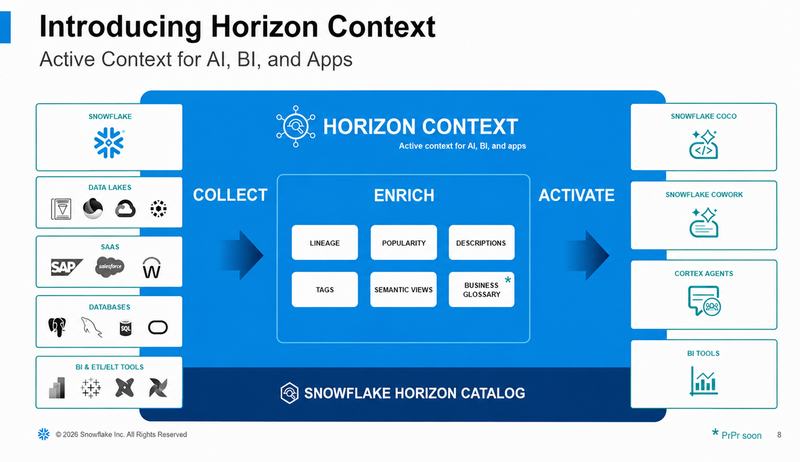
So where does context physically live? The technical answer that dominated the week is the semantic layer, and Snowflake is betting heavily on it.
Think of a semantic layer as a translation dictionary that sits between human (or AI) questions and the raw tables in your database. It’s where you write down, once and for all, that “net sales equals sales minus returns,” that the “Northeast region” means these specific states, and that when someone says “revenue” they mean this exact calculation. Define it in one place, and every dashboard, every spreadsheet, and every AI agent draws from the same source of truth. The CFO’s number and the chatbot’s number finally match.
Snowflake’s push here is called Horizon Context, built around objects they call Semantic Views. What makes these interesting is that they hold two kinds of knowledge at once: the technical model (the facts, dimensions, and how tables relate) and the AI-friendly context (synonyms, plain-language descriptions, sample values) that helps a model reason correctly. And because they live inside the database, they automatically inherit its security, so an agent answering a question can only see the rows a given user is actually allowed to see.
The honest problem with semantic layers has always been that they’re tedious to build and even more tedious to maintain. Snowflake’s answer is to automate the grunt work. A feature called Semantic View Autopilot will look at your existing Power BI or Tableau files, or just analyze your historical query patterns, and propose a starting semantic model — solving the dreaded “zero to one” problem. A companion tool, Semantic Studio, gives teams a visual, version-controlled environment to refine those definitions, the same way software engineers manage code.
A pair of customer stories showed how far this idea can be pushed. Xero, the accounting-software company, described their struggle that context was effectively “trapped in the minds of data scientists”, and that bottleneck only gets worse as schemas change. Their solution was to stop maintaining context by hand entirely. They built a “context graph” that rebuilds itself automatically every night by mining metadata they already produce, then let an AI agent navigate it. The most profound line from that talk was about people, not technology: the role of their engineers is shifting from writing SQL to becoming problem experts who design the memory systems that let AI operate safely. That’s a glimpse of where a lot of data jobs are heading.
The Open Standard Nobody Owns
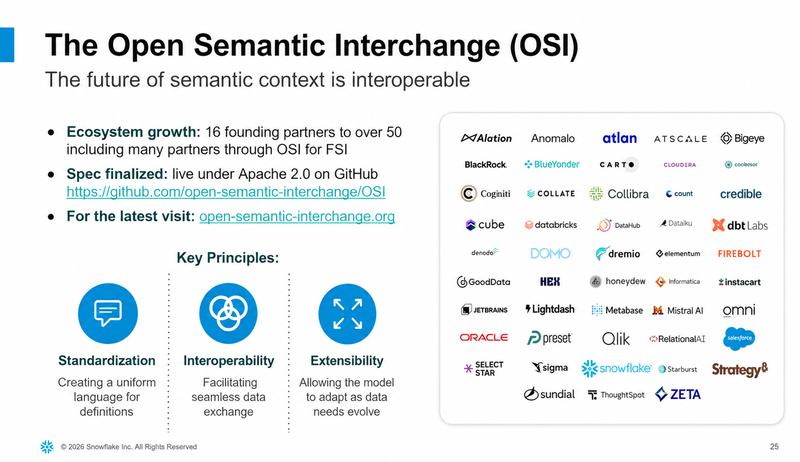
Here’s where it gets bigger than any one vendor. If context is going to be this valuable, the obvious risk is that it gets locked inside whichever tool you happened to build it in — trapped in dbt, or Looker, or Palantir, in incompatible formats. Move tools and you start over.
The proposed answer is the Open Semantic Interchange (OSI) — an open, vendor-neutral standard for describing business meaning so it can move freely between tools. It’s notable for who’s backing it: not just Snowflake, but Goldman Sachs, J.P. Morgan, dbt Labs, Collibra, and dozens of others. By the conference, the effort had roughly tripled, from 16 founding partners to more than 50 participating companies. When fierce competitors agree on a standard, it usually means everyone has felt the same pain.
OSI’s most ambitious idea is a three-layer model of meaning. The physical layer is your tables and columns. The logical layer is your metrics and dimensions. And the top layer — the one most organizations are missing — is a conceptual layer: an ontology that captures the actual vocabulary and rules of your business. It’s the difference between knowing a column is named cust_lat and knowing it represents a customer’s latitude, which must fall between -90 and 90, and that a customer owns an account. That last kind of knowledge is precisely what an agent needs to act, not just retrieve.
The Products Built on Top of Context
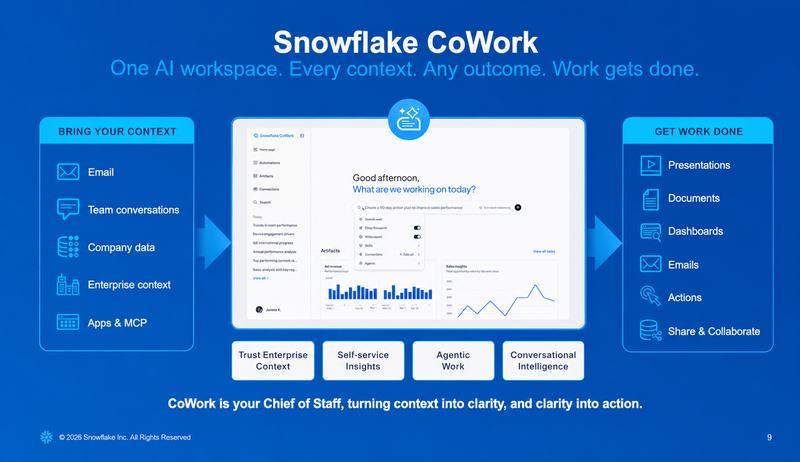
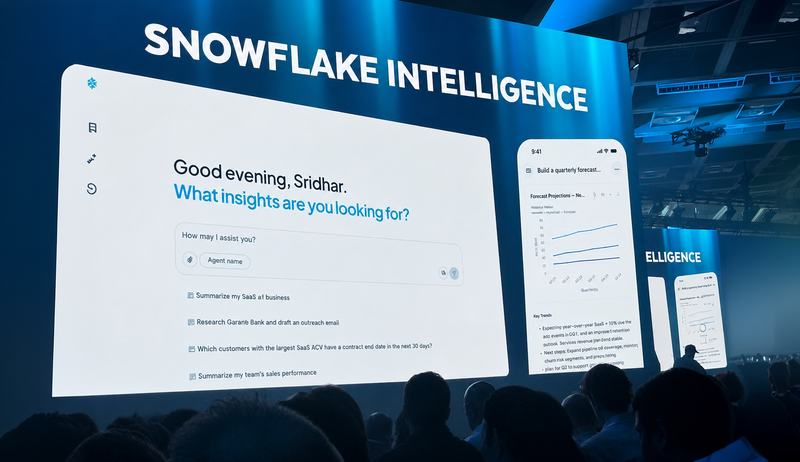
With that foundation in place, the products Snowflake announced start to make a lot more sense. Two rebrands anchored the week. Snowflake CoWork (formerly Snowflake Intelligence) is the personal AI work agent for everyday business users, it’ll summarize meetings, do deep research across Slack, Gmail, and Salesforce, and even run on a mobile app with Face ID, ready to give an executive a “morning briefing” before they open their laptop. CoCo (formerly Cortex Code) is its technical sibling, an AI coding agent that automates the painful work of migrations and pipeline-building, reportedly compressing some migration timelines from months to days.
But the announcement that best proves the thesis of this whole post was a quieter one: Cortex Sense. It’s a service that automatically gathers and applies enterprise context for agents. And the number attached to it is the most important figure I wrote down all week. On hard enterprise questions, accuracy reportedly jumped from 24% to 83% once that context was applied. Same underlying models. Same questions. The only thing that changed was context, and it more than tripled the agent’s reliability. If you ever needed proof that context is the variable that matters, that’s it.
Governance is The Other Half of The Moat
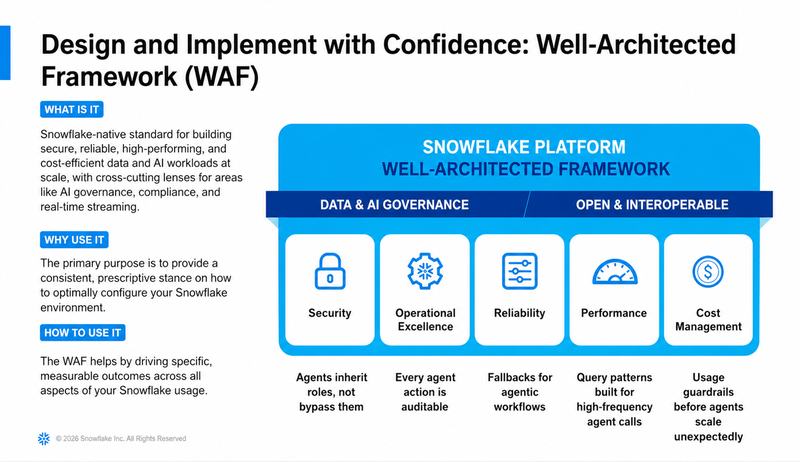
Context makes AI correct. Governance makes it safe to deploy, and the two are inseparable, because an agent that can act on your behalf is also an agent that can do damage. Snowflake’s security sessions treated agents bluntly as “digital employees,” and argued you should manage them with the same rigor.
A few of the new controls stuck with me. Every agent now gets its own identity — a recognizable principal in the audit logs — so you can see exactly what an agent did and restrict it from sensitive data like payment or personal information. Intent-driven governance lets an administrator set a high-level policy like “protect all PII” and have the system enforce it automatically across the whole data estate, rather than chasing it table by table. Multi-party approval borrows the “four eyes” principle from finance: truly sensitive operations now require a second administrator to sign off, which protects you from a rogue actor or a rogue agent. And built-in AI guardrails watch for prompt-injection and jailbreak attempts out of the box.
The efficiency gains here matter too, not just the protection. One security team noted that generating a compliance audit report — for standards like PCI, SOC 2, or ISO 27001 — used to take up to eight hours and can now be done in minutes. Governance, done well, stops being the thing that slows you down and becomes another place where good foundations pay off.
It’s Working — When The Foundation is There
None of this would matter if it were only theory, so the customer proof points were the part I found most persuasive.
United Rentals built a “BI Agent” that, within five months and entirely through word-of-mouth, reached more than 850 monthly active users running over 12,000 queries a month. Frontline branch managers — people who never wrote SQL and used to wait on analysts — now run their own root-cause analysis on revenue and equipment failures, saving an estimated 30 minutes per query. The agent hit 99%+ accuracy. How? It was built on 19 carefully composed semantic views and inherited row-level security from the company’s existing org hierarchy. The accuracy came from the context, full stop.
Snowflake shared its own internal “Snow-on-Snow” results too: more than a million questions answered across its 6,000-person sales organization, translating to over $16 million in overhead savings and the equivalent of 80-plus full-time employees’ worth of recovered productivity. And in a session on supply chain, AT&T described an AI system managing $50 billion in influenceable spend across 250,000 suppliers and 800,000 contract documents — with a hard rule that AI-generated information is flagged as such until a human expert certifies it. Human-on-the-loop, by design.
What I’m Taking Back to Clients
If I had to compress the whole week into advice, it would be this. The competitive advantage in enterprise AI is not the model you choose — those are converging and swappable. The advantage is the context you build underneath it: the semantic layer that encodes what your business actually means, and the governance that makes acting on it safe. That’s the part competitors can’t copy quickly, because it’s a faithful representation of your specific organization, and it takes deliberate work to create. And none of this is Snowflake-specific: the same principle holds whether you run Databricks, BigQuery, or Microsoft Fabric — which is exactly why the industry is rallying around an open standard for it.
The discipline this demands runs against every instinct in a hype cycle. It means resisting the impulse to wire a chatbot straight into your warehouse for a quick win. It means spending real time with business owners arguing about what “revenue” means before you let anything automate the answer. It means slowing down precisely when everyone around you is speeding up.
But the math from the conference is hard to argue with. Roughly 60% of agent projects die before production, and the survivors are overwhelmingly the ones that did the foundational work first. The bank that locked out 6,500 customers had the model. What it lacked was the context. That gap — between a demo that impresses and a system you’d actually trust with a decision — is the whole game now.
Intelligence without context is just confident guessing. The organizations that internalize that, and do the patient work of building real context before they scale, are digging a moat. Everyone else is just building faster ways to be wrong.
By Victoria Gallerano, CEO of Dynamic Data.
If your team is weighing an agentic AI initiative — or trying to rescue one that stalled before production — let’s talk.
Notes synthesized from sessions attended at Snowflake Summit 2026, including the Agentic Enterprise keynotes, the Well-Architected Framework session, “AI Has Eaten BI,” Daimler Truck NA’s modernization story, the Horizon Context and Open Semantic Interchange sessions, Xero’s Semantic Memory talk, the CoWork and Cortex Agents sessions, the Secure & Resilient AI Estate session, and customer case studies from United Rentals, AT&T, and others.