

Your Data Speaks Tables. Your Business Speaks Entities. Bridging the Gap with Microsoft Fabric IQ.
When an analyst says “customer,” your data platform hears a table. To the business means something else entirely: the entity that places orders, receives shipments, belongs to a region, and shows up under three different IDs across two ERPs. Same word, two different worlds.
That gap — between the language the business speaks and the structures the data lives in — is exactly what Microsoft is going after with Fabric IQ, the new intelligence layer of Microsoft Fabric. We’ve been building on it, and it’s worth understanding now, while it’s still early.
The Layer That Was Always Missing
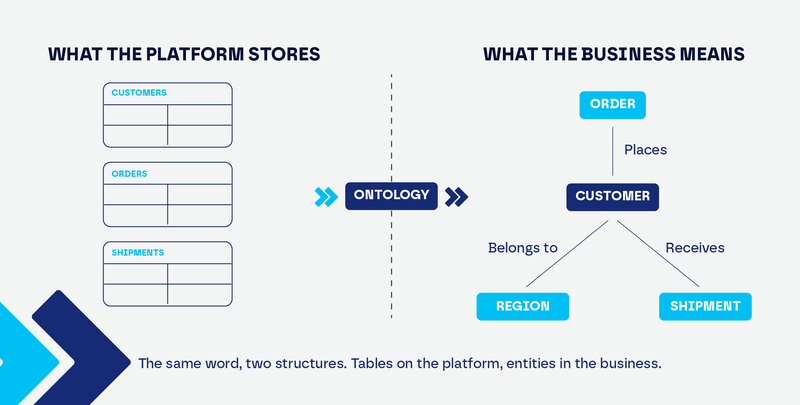
Every analytics stack has tables, and most mature ones have a semantic model on top: certified measures, governed KPIs, one blessed definition of revenue. That was enough when the consumer was a human reading a dashboard.
AI agents raise the bar. An agent doesn’t just need the right numbers. It needs to understand how your business fits together. That orders are placed by customers and shipped from warehouses. That warehouses roll up into districts, districts into regions, with business units cutting across all of it. That “inventory” isn’t a table; it’s a living position connecting products, locations, and time.
Fabric IQ’s answer is an ontology: a declared map of your business entities, their properties, and 'crucially' their relationships. Define Customer, Product, Order, Inventory, and Warehouse once, and every agent, report, and application downstream shares that understanding.
The smartest design decision in the product: you can generate the ontology directly from a Power BI semantic model you already trust. You’re not starting from a blank canvas, you’re promoting logic that’s already certified and in production into a richer, agent-readable form. From there, Fabric materializes your entities and relationships as a graph automatically. No separate build, no parallel pipeline.
The ontology can also be exposed as an MCP server, so agents outside Fabric (Claude, say, or your own) can consume that same business context as a tool. Your ontology becomes a shared source of meaning for the whole agent ecosystem.
What You Get on Top
Two agents consume that shared meaning, covering the two halves of operational intelligence.
The Data Agent answers. Point it at your data, and business users ask questions in natural language. No DAX, no SQL, no ticket to the data team. It’s the “virtual analyst” pattern, grounded in your own definitions instead of an LLM’s best guess.
The Operations Agent acts. Same ontology, different job: it watches live data for conditions you define and triggers governed responses. Think low-stock alerts landing in Teams before the stockout happens. Monitoring that used to be a dashboard someone had to remember to check now runs as an always-on loop.
One meaning layer, one agent that answers, one agent that acts. It’s a coherent design.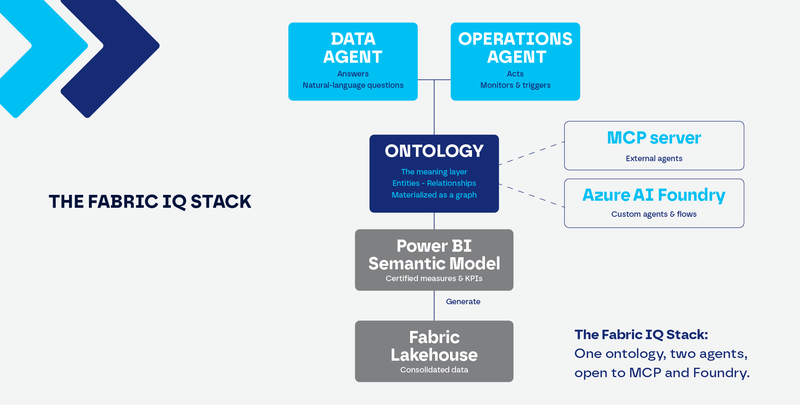
How We Used It
We put Fabric IQ to work for a large B2B distributor, the kind of business where complexity isn’t theoretical. Multiple business units from years of acquisitions. Two ERP stacks. Tens of millions of order lines consolidated into a Fabric Lakehouse. And underneath every operational question, a dense web of relationships: products stocked at warehouses, supplied by vendors, ordered by customers, rolling up through branches, districts, and regions.
Inventory was the natural proving ground. The questions a distributor lives by — where is stock concentrated? how fast is it turning? which locations are at risk? — are exactly the kind that cut across entities and levels.
Defining Inventory, Products, Warehouses, Orders, and Vendors as first-class entities — with relationships declared, not implied by join keys, gave the agents a map of the business that no schema can communicate on its own. On the action side, the Operations Agent turned that same map into a working low-stock watchdog, with notifications flowing into Teams, where the team already lives.
Where It Stands Today
Microsoft released Fabric IQ in preview, and it’s evolving fast. So the most useful thing we can share is a distinction: the ontology gives you two capabilities, and they sit at different stages of maturity.
The ontology as a meaning layer is valuable today. As shared context — what your entities are, how they connect, which sources to trust — it grounds agents and keeps definitions consistent across every experience. This is the durable part, and it’s ready now.
The graph as a query engine is more situational. Alongside the ontology, Fabric exposes a graph you can query directly with GQL. In our experience, it can struggle against huge fact tables. The heavy lifting of analytics (large aggregations, multi-level rollups) still belongs to the semantic model, where DAX and SQL have a two-decade head start. Scope it down, though, and the picture changes. For narrow use cases — a single business unit over reduced tables — and for relationship-first questions, where you’re tracing connections and navigating paths across entities, it delivers real results. The takeaway: apply direct graph querying selectively, where it fits, rather than betting the whole architecture on it.
The agents follow a similar shape. Both fit specific, well-defined use cases that don’t need much customization: one source, clear questions, simple rules. That simplicity is a feature — setup is fast and value shows up quickly. When you need more — complex orchestration, multiple tools, your choice of models — the ontology doesn’t lock you in. You can connect it to Azure AI Foundry and build richer agents, combining the same business context with other tools, knowledge sources, and custom flows.
Why This Matters Now
The direction of travel is clear across the industry: agents need business language, declared once and shared everywhere. Microsoft is building that layer natively into Fabric, generated from the semantic models enterprises already own. A pragmatic on-ramp, not a rip-and-replace.
If your organization runs on complex entity relationships — distribution, supply chain, anything multi-BU — and your data already lives in (or is heading toward) a Fabric lakehouse, Fabric IQ is worth a hands-on look today. Start with the ontology over your certified semantic model. Stand up a Data Agent for one domain. Wire one Operations Agent rule into Teams. And as your ambitions grow, the same ontology can feed more sophisticated agents through Foundry or MCP.
The meaning layer is the bet. The rest is timing.
By Marco Luquer, Data & AI Architect at Dynamic Data